A note on stress-driven anisotropic diffusion and its role in active deformable media
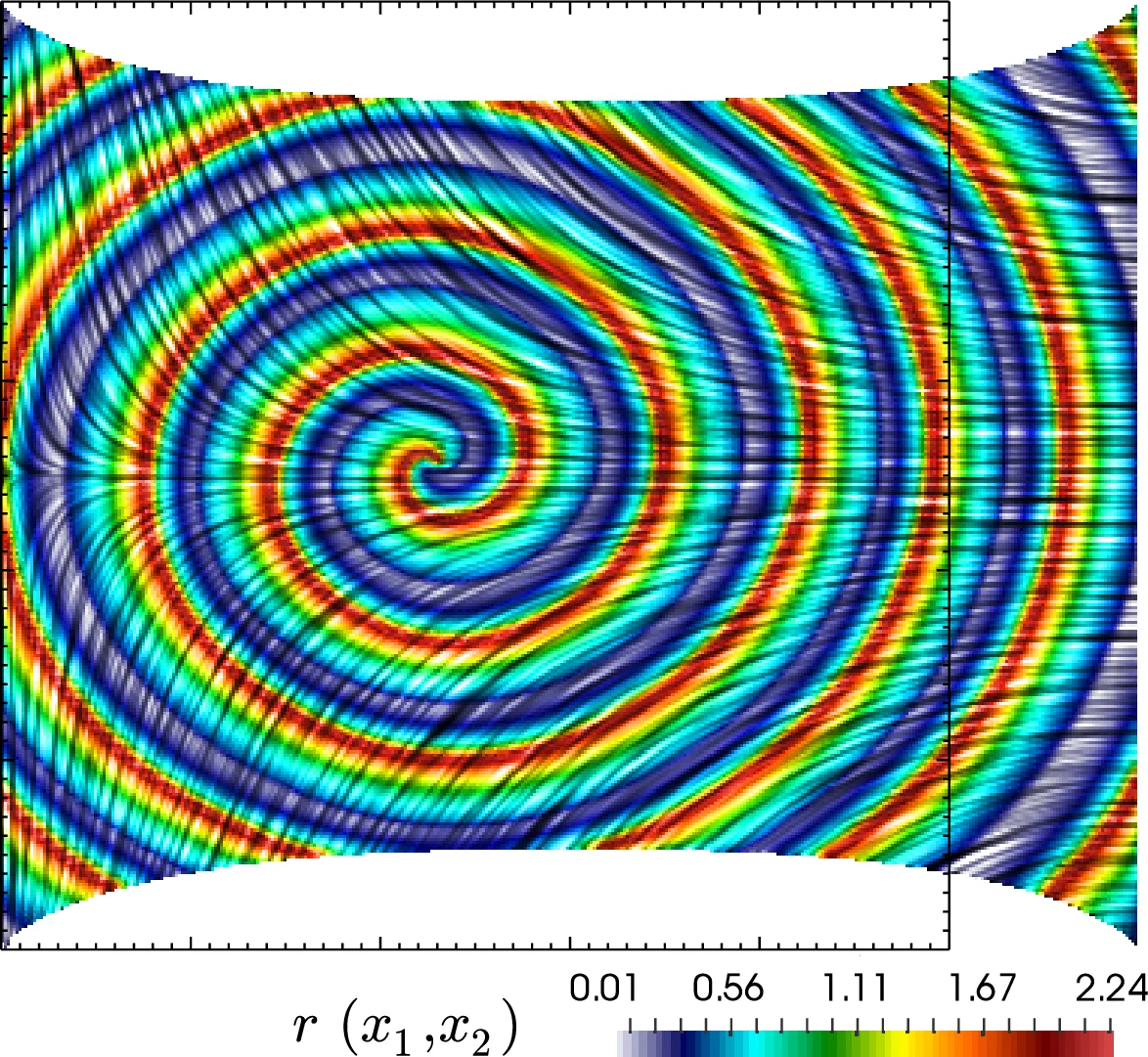
We propose a new model to describe diffusion processes within active deformable media. Our general theoretical framework is based on physical and mathematical considerations, and it suggests to use diffusion tensors directly coupled to mechanical stress. A proof-of-concept experiment and the proposed generalised reaction-diffusion-mechanics model reveal that initially isotropic and homogeneous diffusion tensors turn into inhomogeneous and anisotropic quantities due to the intrinsic structure of the nonlinear coupling. We study the physical properties leading to these effects, and investigate mathematical conditions for its occurrence. Together, the experiment, the model, and the numerical results obtained using a mixed-primal finite element method, clearly support relevant consequences of stress-assisted diffusion into anisotropy patterns, drifting, and conduction velocity of the resulting excitation waves. Our findings also indicate the applicability of this novel approach in the description of mechano-electrical feedback in actively deforming bio-materials such as the heart.
💡 Research Summary
The paper introduces a novel framework for modeling diffusion processes in active deformable media, with a particular focus on cardiac tissue where electrical excitation and mechanical deformation are tightly coupled. Traditional electromechanical models treat the diffusion (conductivity) tensor as a constant, independent of deformation, which neglects the well‑established physical fact that stress can alter electrical properties. To address this, the authors propose a stress‑assisted diffusion tensor
dᵢⱼ = D₀ (δᵢⱼ + D₁ σᵢⱼ + D₂ σᵢₖ σₖⱼ),
where σᵢⱼ is the Cauchy stress tensor, D₀ is the baseline diffusivity, and D₁, D₂ are material parameters governing linear and quadratic stress coupling. This formulation extends the Landau‑Lifshitz theory of electrodynamics in continuous media to finite deformations and provides a systematic way to embed mechano‑electrical feedback directly into the diffusion term.
Mathematically, the diffusion tensor must remain positive‑definite (elliptic) for the reaction‑diffusion (RD) system to be well‑posed. The authors derive explicit conditions on D₁ and D₂ by requiring the quadratic polynomial y = 1 + D₁ σ + D₂ σ² to be positive for all admissible stress values σ. These conditions translate into inequalities such as –D₁ ± √(D₁² – 4 D₂) ≥ 0 and D₁ ≥ ±2|D₂|. Violating these bounds leads to loss of ellipticity, causing numerical instability and physically unrealistic conduction behavior.
The governing equations combine the stress‑assisted diffusion with a two‑variable FitzHugh‑Nagumo‑type RD model for the transmembrane potential V and a recovery variable r, together with an active stress evolution equation for the contractile tension Tₐ. The mechanical part assumes an incompressible Mooney‑Rivlin hyperelastic solid (J = 1) and includes both passive stress (derived from the strain‑energy function) and active stress that switches on when V exceeds a threshold via a Heaviside function Γ(V). The full set reads:
∂V/∂t = ∂ₓᵢ ( dᵢⱼ ∂V/∂xⱼ ) + I_ion(V, r),
∂r/∂t = f(V, r),
∂Tₐ/∂t = Γ(V) (k_Tₐ V – Tₐ),
∂σᵢⱼ/∂xᵢ = 0,
with I_ion and f defined by the standard FitzHugh‑Nagumo kinetics.
For numerical solution, the authors employ a mixed‑primal finite element method (FEM) that directly approximates stresses and strains, avoiding post‑processing from displacement fields. Stresses are discretized with lowest‑order Raviart‑Thomas elements, displacements with stabilized Brezzi‑Douglas‑Marini (BDM) elements of degree one, and the electrophysiological fields with continuous linear elements. Time integration uses a first‑order backward Euler scheme combined with a fixed‑point iteration to decouple the RD system from the mechanics, and Newton iterations for the nonlinear elasticity. The scheme respects the CFL condition dictated by the finest mesh, and linear solves are performed with PETSc’s LU solver preconditioned by ILU.
Two main computational experiments are presented. First, a proof‑of‑concept physical test shows that a dye diffusing in a sponge spreads as a disk when the sponge is relaxed but becomes an ellipsoid when the sponge is uniaxially stretched, illustrating stress‑induced anisotropic diffusion. Second, extensive 2‑D simulations explore the (D₁, D₂) parameter space under a 20 % uniaxial stretch (physiological for cardiac tissue). The stress tensor in the central region is diagonal with components σ₁ = σ₂ = 1, leading to a diffusion tensor
Comments & Academic Discussion
Loading comments...
Leave a Comment