Diffusion of innovation in large scale graphs
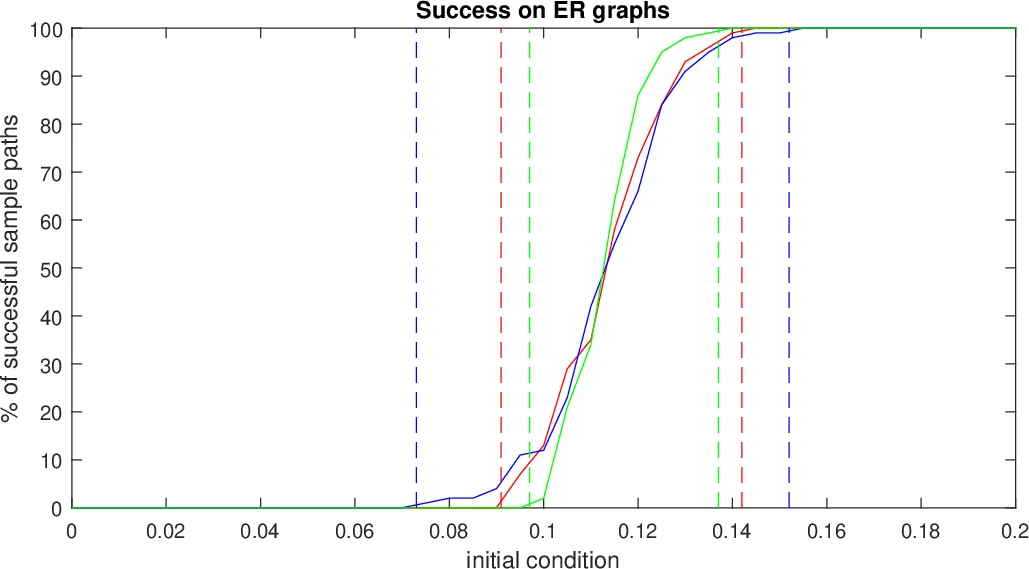
Will a new smartphone application diffuse deeply in the population or will it sink into oblivion soon? To predict this, we argue that common models of spread of innovations based on cascade dynamics or epidemics may not be fully adequate. Therefore we propose a novel stochastic network dynamics modeling the spread of a new technological asset, whose adoption is based on the word-of-mouth and the persuasion strength increases the more the product is diffused. In this paper we carry on an analysis on large scale graphs to show off how the parameters of the model, the topology of the graph and, possibly, the initial diffusion of the asset, determine whether the spread of the asset is successful or not. In particular, by means of stochastic dominations and deterministic approximations, we provide some general results for a large class of expansive graphs. Finally we present numerical simulations trying to expand the analytical results we proved to even more general topologies.
💡 Research Summary
The paper addresses a practical question: will a new smartphone application spread widely or fade away? Existing diffusion models based on epidemic or cascade dynamics are argued to be insufficient for “light‑choice” innovations, where the decision to adopt depends more on the overall market penetration than on the immediate state of a few neighbors. To capture this, the authors propose a stochastic network model in which agents update their binary state (adopt = 1, not adopt = 0) via two mechanisms.
- Gossip persuasion: When an edge (v,w) activates, if v is non‑adopter and w is adopter, v becomes an adopter with probability φ(z), where z is the global fraction of adopters in the whole population. The function φ:
Comments & Academic Discussion
Loading comments...
Leave a Comment