Node and layer eigenvector centralities for multiplex networks
Eigenvector-based centrality measures are among the most popular centrality measures in network science. The underlying idea is intuitive and the mathematical description is extremely simple in the framework of standard, mono-layer networks. Moreover, several efficient computational tools are available for their computation. Moving up in dimensionality, several efforts have been made in the past to describe an eigenvector-based centrality measure that generalizes Bonacich index to the case of multiplex networks. In this work, we propose a new definition of eigenvector centrality that relies on the Perron eigenvector of a multi-homogeneous map defined in terms of the tensor describing the network. We prove that existence and uniqueness of such centrality are guaranteed under very mild assumptions on the multiplex network. Extensive numerical studies are proposed to test the newly introduced centrality measure and to compare it to other existing eigenvector-based centralities.
💡 Research Summary
This paper addresses the problem of defining a centrality measure for multiplex (multilayer) networks that simultaneously ranks both nodes and layers. Classical eigenvector‑based centralities such as the Bonacich index or PageRank are well‑understood for single‑layer graphs thanks to Perron‑Frobenius theory, which guarantees existence, uniqueness, and convergence of the leading eigenvector under mild conditions (e.g., irreducibility). Extending these ideas to multiplex networks is non‑trivial because a multiplex is naturally represented by a third‑order adjacency tensor rather than a collection of independent adjacency matrices. Existing approaches either compute eigenvectors layer‑by‑layer and then aggregate them, or they first aggregate the layers into a single matrix (often using a weighted sum) and then compute a standard eigenvector. Both strategies either ignore inter‑layer information or require each layer to be strongly connected, limiting their applicability to sparse real‑world data.
The authors propose a novel centrality based on the Perron eigenvector of a multi‑homogeneous map defined directly on the adjacency tensor. The map F takes two positive vectors, x (node scores) and y (layer scores), and returns updated vectors by contracting the tensor along appropriate modes: each node score is a weighted sum of products of neighboring node scores and the corresponding layer scores, while each layer score aggregates contributions from all node pairs within that layer. This construction is homogeneous of degree one in each argument, but it is not linear; consequently, the map cannot be reduced to a standard matrix eigenproblem without loss of information.
Using an extension of Perron‑Frobenius theory to multi‑homogeneous maps (citing Gaubert and Gunawardena, 2012), the authors prove that, under a very weak “multi‑connectedness” condition—essentially that the tensor is not block‑diagonal—there exists a unique positive eigenpair (x*, y*) satisfying F(x*, y*) = λ (x*, y*) for some λ > 0. Importantly, this condition does not require each individual layer to be connected; even if some layers are completely disconnected, the overall multiplex can still admit a well‑defined centrality. This theoretical guarantee is a major contribution because many real multiplexes are extremely sparse and contain isolated layers.
For computation, the paper introduces a power‑iteration scheme that repeatedly applies F to an initial positive pair (x⁰, y⁰) and normalizes the result at each step. The authors provide a convergence analysis, including an explicit bound on the approximation error after k iterations, showing linear convergence under the same mild assumptions used for existence. The algorithm exploits sparsity by performing tensor‑vector products only on non‑zero entries, and its memory footprint scales with the number of non‑zero hyperedges rather than with the full n × n × L tensor.
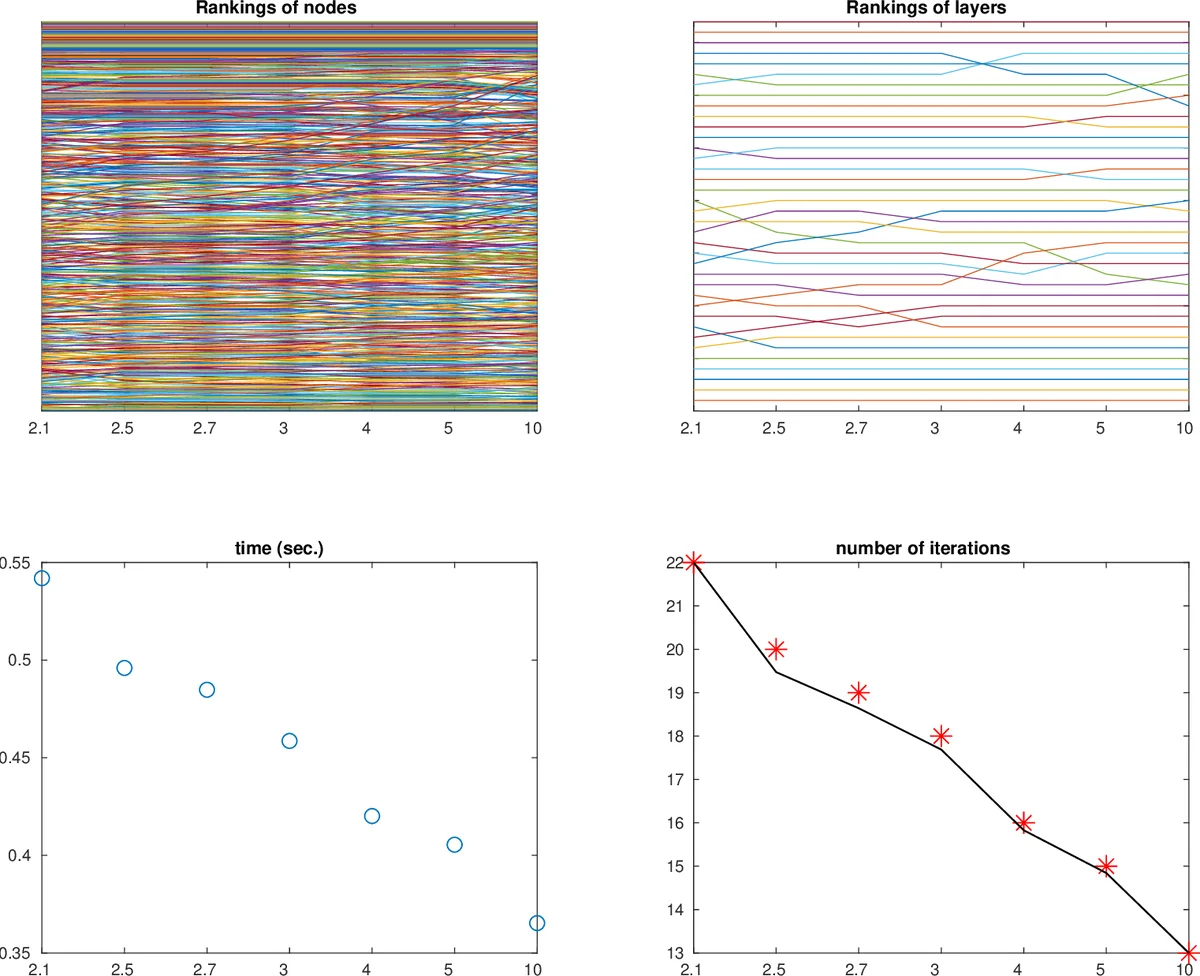
Extensive experiments are conducted on two real multiplex datasets: (1) a social‑communication network with four channels (phone, email, face‑to‑face, online) and (2) a multimodal transportation network with road, rail, air, and bus layers. The proposed node‑layer eigenvector centrality (NL‑EC) is compared against several state‑of‑the‑art matrix‑based centralities: the Q‑matrix method (layer‑wise eigenvectors stacked), the weighted‑average adjacency approach, and the Khatri‑Rao product method. Results demonstrate that NL‑EC yields more stable and interpretable rankings. In particular, when some layers are nearly disconnected, matrix‑based methods either fail to converge or produce degenerate scores, whereas NL‑EC still provides meaningful node and layer rankings. Sensitivity analysis with respect to the layer‑weight vector ω shows that NL‑EC’s rankings are robust to variations in layer importance, confirming the method’s stability.
The paper’s contributions can be summarized as follows: (i) introduction of a genuinely tensor‑based, multi‑homogeneous centrality that respects the full multiplex structure; (ii) rigorous existence and uniqueness results under extremely mild connectivity assumptions; (iii) an efficient, provably convergent power‑iteration algorithm; (iv) comprehensive empirical validation on realistic multiplex networks. The authors argue that the ability to rank layers alongside nodes opens new avenues for applications such as identifying the most influential communication channel in social media, prioritizing transportation modes for infrastructure investment, or detecting critical functional modules in multilayer biological networks. Future work is suggested on extending the framework to directed or temporal multiplexes, exploring alternative non‑linear maps, and integrating the centrality into downstream tasks like community detection or link prediction.
Comments & Academic Discussion
Loading comments...
Leave a Comment