Stability and instability of breathers in the $U(1)$ Sasa-Satusuma and Nonlinear Schr"odinger models
We consider the Sasa-Satsuma (SS) and Nonlinear Schr"odinger (NLS) equations posed along the line, in 1+1 dimensions. Both equations are canonical integrable $U(1)$ models, with solitons, multi-solitons and breather solutions, see Yang for instance. For these two equations, we recognize four distinct localized breather modes: the Sasa-Satsuma for SS, and for NLS the Satsuma-Yajima, Kuznetsov-Ma and Peregrine breathers. Very little is known about the stability of these solutions, mainly because of their complex structure, which does not fit into the classical soliton behavior by Grillakis-Shatah-Strauss. In this paper we find the natural $H^2$ variational characterization for each of them, and prove that Sasa-Satsuma breathers are $H^2$ nonlinearly stable, improving the linear stability property previously proved by Pelinovsky and Yang. Moreover, in the SS case, we provide an alternative understanding of the SS solution as a breather, and not only as an embedded soliton. The method of proof is based in the use of a $H^2$ based Lyapunov functional, in the spirit of the first and third authors, extended this time to the vector-valued case. We also provide another rigorous justification of the instability of the remaining three nonlinear modes (Satsuma-Yajima, Peregrine y Kuznetsov-Ma), based in the study of their corresponding linear variational structure (as critical points of a suitable Lyapunov functional), and complementing the instability results recently proved e.g. in a paper by the third author.
💡 Research Summary
The paper investigates the stability properties of four localized breather solutions that arise in two integrable, U(1)‑invariant nonlinear wave equations in one spatial dimension: the cubic focusing nonlinear Schrödinger (NLS) equation and the third‑order Sasa‑Satsuma (SS) equation. The breathers under consideration are: (i) the Sasa‑Satsuma breather (SS), (ii) the Satsuma‑Yajima breather (SY) of the zero‑background NLS, (iii) the Peregrine breather (P) and (iv) the Kuznetsov‑Maslov (K‑M) breather, both of which live on a non‑zero Stokes background.
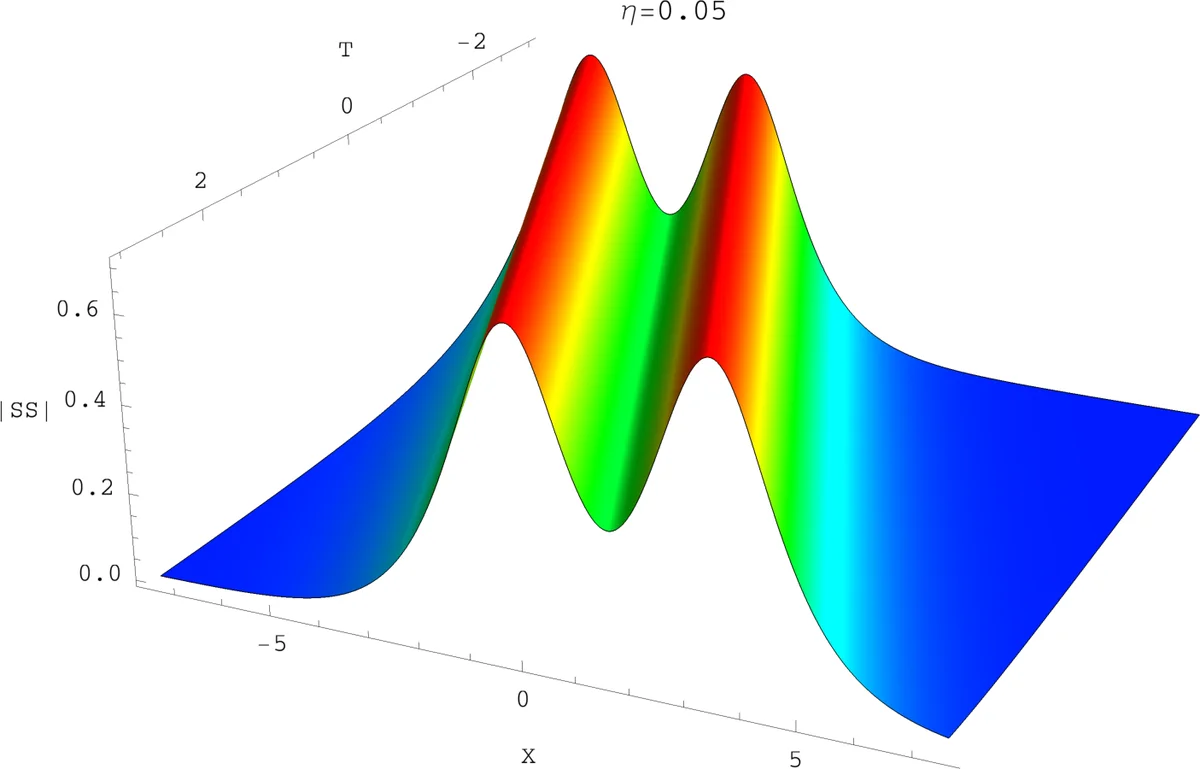
The authors first provide explicit formulas for each breather, describing their parameter dependence, shape (single‑hump versus double‑hump), and limiting cases (e.g., the SS breather reduces to the NLS soliton when the complex parameter η→1). They emphasize that the SS breather, traditionally called an “embedded soliton,” should be regarded as a genuine breather because it is periodic in time with a non‑trivial period.
A central contribution of the work is the identification of a natural H²‑based variational characterization for each breather. By forming a suitable linear combination of the conserved quantities (mass, momentum, and Hamiltonian) they construct a Lyapunov functional ℒ whose critical points are precisely the breather profiles. The first variation of ℒ reproduces the original nonlinear equation, while the second variation yields a quadratic form that encodes the spectral properties of the linearized operator around the breather.
For the SS breather the second variation is shown to be positive definite on the orthogonal complement of the symmetry directions. This positivity allows the authors to build an H² Lyapunov functional that is coercive near the breather, establishing orbital stability in the H² topology. This result strengthens the earlier linear stability analysis of Pelinovsky and Yang, providing a full nonlinear stability theorem for the SS breather.
In contrast, the SY, P, and K‑M breathers exhibit a second variation with at least one negative direction. By analyzing the associated linearized operators, the authors recover the known spectral instabilities: the SY breather is close to a family of two‑soliton solutions and can be perturbed into configurations that diverge in time; the Peregrine and Kuznetsov‑Maslov breathers sit on a non‑zero background and inherit the modulational instability of the underlying NLS, leading to exponential growth of low‑frequency perturbations. The variational perspective thus provides a rigorous justification of the instability results previously obtained by numerical and scattering‑theoretic methods.
The paper also discusses well‑posedness issues for the three models, establishing local (and, where applicable, global) existence in Sobolev spaces H^s with s>½ for SS, s≥0 for NLS with zero background, and s>½ for the non‑zero background formulation. These functional‑analytic foundations are essential for the stability arguments.
Overall, the work delivers the first comprehensive H² variational framework for breather solutions in both the Sasa‑Satsuma and nonlinear Schrödinger equations. It proves that the SS breather is nonlinearly orbitally stable, while the SY, Peregrine, and Kuznetsov‑Maslov breathers are variationally unstable. The methodology—combining integrable‑system explicit formulas, conserved‑quantity Lyapunov functionals, and spectral analysis—offers a powerful template for studying complex, time‑periodic structures in other integrable or near‑integrable dispersive PDEs.
Comments & Academic Discussion
Loading comments...
Leave a Comment