Analytical Formulation of the Block-Constrained Configuration Model
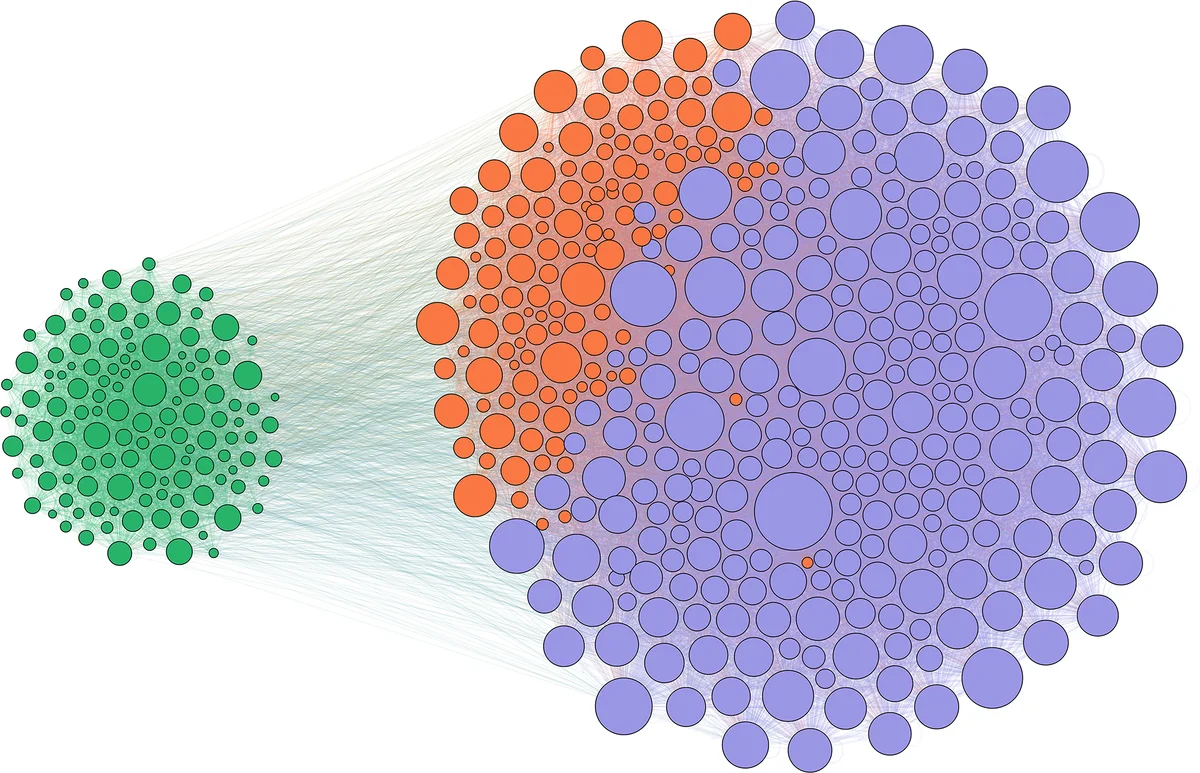
We provide a novel family of generative block-models for random graphs that naturally incorporates degree distributions: the block-constrained configuration model. Block-constrained configuration models build on the generalised hypergeometric ensemble of random graphs and extend the well-known configuration model by enforcing block-constraints on the edge generation process. The resulting models are analytically tractable and practical to fit even to large networks. These models provide a new, flexible tool for the study of community structure and for network science in general, where modelling networks with heterogeneous degree distributions is of central importance.
💡 Research Summary
The paper introduces the Block‑Constrained Configuration Model (BCCM), a novel family of random graph models that simultaneously preserves heterogeneous degree distributions and enforces explicit block (community) structures. The authors build on the Generalised Hypergeometric Ensemble of Graphs (gHypEG), which extends the classic Configuration Model (CM) by adding a propensity matrix Ω that captures dyadic preferences independent of vertex degrees. In gHypEG, the probability of an edge between vertices i and j is proportional to the product of a combinatorial term Ξ_{ij}=k_out_i·k_in_j (derived from the CM) and a propensity term Ω_{ij}. This formulation yields a multivariate Wallenius non‑central hypergeometric distribution over the space of multigraphs, allowing exact likelihood computation.
BCCM specializes gHypEG by constraining Ω to reflect a block structure. Vertices are assigned to B blocks; if i and j belong to the same block b, Ω_{ij}=ω_b, otherwise Ω_{ij}=ω_{b_i b_j}. The set of parameters ω_{b_i b_j} forms a B×B block matrix analogous to the SBM’s probability matrix, but because degree information is already encoded in Ξ, no additional degree‑correction terms are required. Consequently, BCCM inherits the CM’s ability to reproduce any prescribed degree sequence while gaining the SBM’s flexibility to model assortative, disassortative, core‑periphery, hierarchical, multipartite, or any custom block patterns simply by choosing appropriate ω values.
The authors derive closed‑form expressions for the likelihood of an observed graph under BCCM (Eq. 3‑4). For large graphs, sampling without replacement from the urn can be approximated by sampling with replacement, leading to a multinomial approximation that greatly simplifies computation. This analytical tractability enables direct use of information criteria such as Akaike (AIC) and Bayesian (BIC) for model selection, with the number of parameters equal to the number of distinct block‑pair propensities (≈B²). The paper outlines a two‑step fitting procedure: (1) estimate the degree sequences from the data to construct Ξ, and (2) given a block assignment (obtained via prior knowledge or a community‑detection algorithm), estimate the ω parameters by maximum likelihood, effectively matching expected and observed inter‑block edge counts.
Generation of synthetic networks follows the same framework. After specifying degree sequences (e.g., uniform, power‑law, exponential) and a block matrix B, the model draws m edges from the multivariate Wallenius distribution using the BiasedUrn library. The authors illustrate this with a five‑block ring structure where diagonal block propensities are ten times larger than off‑diagonal ones. By varying the degree distribution while keeping B fixed, they demonstrate how the same block structure can produce markedly different global topologies: uniform degrees yield classic SBM‑like clusters, whereas power‑law degrees concentrate high‑degree vertices in certain blocks, altering centrality and connectivity patterns.
Key contributions of the work include:
- A unified model that naturally incorporates degree heterogeneity without ad‑hoc corrections.
- Exact, closed‑form likelihood enabling efficient inference and principled model comparison on large networks.
- A flexible block‑propensity matrix that can encode a wide variety of mesoscale structures.
- An efficient sampling algorithm that scales to realistic network sizes.
The authors conclude that BCCM offers a powerful, analytically tractable tool for researchers across network science, sociology, biology, and related fields, facilitating realistic synthetic data generation, hypothesis testing, and the rigorous evaluation of community‑detection methods under realistic degree constraints.
Comments & Academic Discussion
Loading comments...
Leave a Comment