Scaling advantage in quantum simulation of geometrically frustrated magnets
The promise of quantum computing lies in harnessing programmable quantum devices for practical applications such as efficient simulation of quantum materials and condensed matter systems. One important task is the simulation of geometrically frustrated magnets in which topological phenomena can emerge from competition between quantum and thermal fluctuations. Here we report on experimental observations of relaxation in such simulations, measured on up to 1440 qubits with microsecond resolution. By initializing the system in a state with topological obstruction, we observe quantum annealing (QA) relaxation timescales in excess of one microsecond. Measurements indicate a dynamical advantage in the quantum simulation over the classical approach of path-integral Monte Carlo (PIMC) fixed-Hamiltonian relaxation with multiqubit cluster updates. The advantage increases with both system size and inverse temperature, exceeding a million-fold speedup over a CPU. This is an important piece of experimental evidence that in general, PIMC does not mimic QA dynamics for stoquastic Hamiltonians. The observed scaling advantage, for simulation of frustrated magnetism in quantum condensed matter, demonstrates that near-term quantum devices can be used to accelerate computational tasks of practical relevance.
💡 Research Summary
The paper presents a comprehensive experimental study comparing quantum annealing (QA) on a D‑Wave superconducting flux‑qubit processor with classical path‑integral Monte Carlo (PIMC) for simulating a geometrically frustrated Ising lattice. The authors program a square‑octagonal lattice with cylindrical boundary conditions, where each plaquette is frustrated due to an odd number of antiferromagnetic couplers, giving six classical ground states per plaquette that can be represented as orientations of a pseudospin. By adding a transverse field Γ, the system becomes a transverse‑field Ising model (TFIM) in which “flippable” four‑qubit chains form GHZ‑type superpositions, driving ferromagnetic order of the pseudospins.
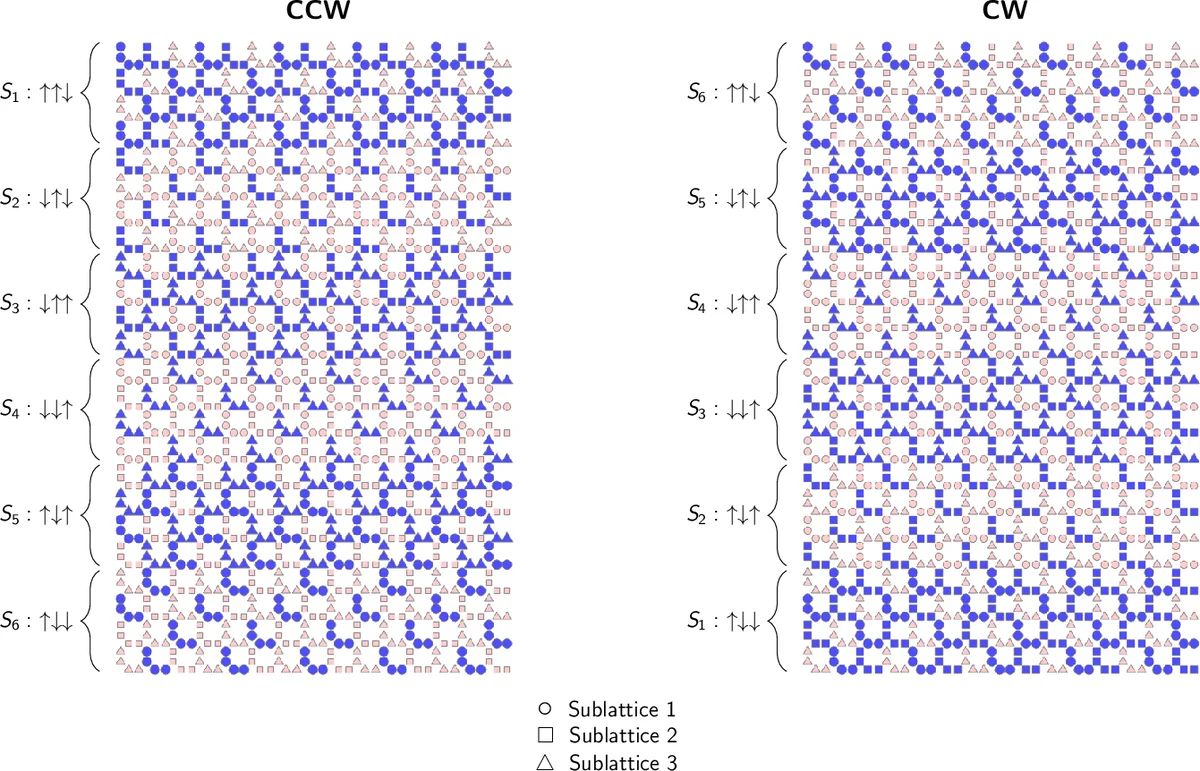
A key methodological innovation is the preparation of topologically obstructed initial states: ordered (all pseudospins aligned) and two twisted states where the pseudospin winds clockwise (CW) or counter‑clockwise (CCW) around the periodic dimension. These twisted states create a global winding that must be unwound for the system to reach equilibrium, dramatically slowing relaxation and allowing microsecond‑resolution observation despite the hardware’s 1 µs control limit.
The QA protocol uses reverse‑annealing cycles: the system is initialized at s = 1 (no quantum or thermal fluctuations), then s is rapidly reduced to a target s* (0.30–0.40) where Γ and the effective coupling J are fixed, and the system evolves for a pause time tₚ = 1–4 µs. After the pause the system is quenched back to s = 1 for readout. Repeating this process many times yields a time series of the order parameter m(t). PIMC simulations employ continuous‑time updates that collectively flip four‑qubit ferromagnetic chains, matching the QA dynamics as closely as possible. Monte Carlo sweeps are treated as a proxy for physical time, enabling a direct comparison of convergence rates.
Both QA and PIMC exhibit exponential relaxation of m(t) toward a steady value m_f, which the authors fit with h_m(t) = (m₀ − m_f) e^{−t/τ}+m_f. Across a broad range of temperatures (13.7–25 mK) and transverse‑field strengths (Γ/J ≈ 0.6–0.8), the equilibrium values obtained from QA agree with quenched PIMC within a tolerance of 0.03, confirming accurate simulation of the target Hamiltonian. However, the relaxation time τ differs dramatically: for the largest system (1440 spins) at T/J = 0.24 and Γ/J = 0.736, QA converges in roughly 3 µs, whereas PIMC requires about 10⁶ µs, a speed‑up of roughly one million‑fold. The advantage grows as the lattice width L increases, temperature decreases, and Γ increases, reflecting that the problem becomes harder for classical sampling while quantum tunneling remains effective.
At very low temperatures and small Γ, disorder in the fabricated couplings (≈1 % variations) suppresses QA order, leading to modest deviations from PIMC; the authors correct for this by applying a local “quench” to the PIMC data, which restores agreement. They also note that programming and readout overheads are excluded from the reported QA times, consistent with prior scaling studies.
The study provides the first experimental evidence that, even for stoquastic Hamiltonians where classical methods are sign‑problem free, quantum annealing can achieve a genuine dynamical scaling advantage in simulating frustrated many‑body systems. This demonstrates that near‑term analog quantum devices can accelerate computational tasks of practical relevance beyond mere proof‑of‑principle optimization, opening the door to quantum‑enhanced studies of complex condensed‑matter phenomena such as spin liquids, topological order, and glassy dynamics. Future work will aim to extend these results to larger lattices, lower temperatures, and error‑mitigated hardware, as well as to explore other classes of frustrated models.
Comments & Academic Discussion
Loading comments...
Leave a Comment