Stable-Matching Voronoi Diagrams: Combinatorial Complexity and Algorithms
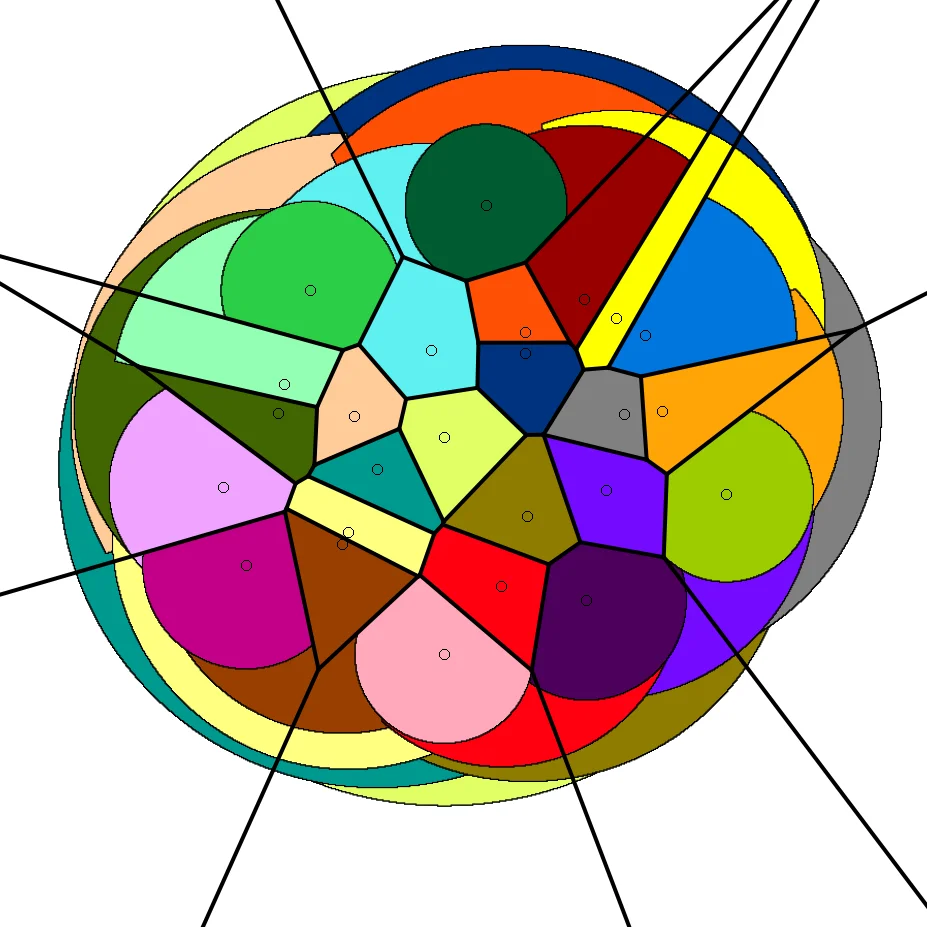
We study algorithms and combinatorial complexity bounds for \emph{stable-matching Voronoi diagrams}, where a set, $S$, of $n$ point sites in the plane determines a stable matching between the points in $\mathbb{R}^2$ and the sites in $S$ such that (i) the points prefer sites closer to them and sites prefer points closer to them, and (ii) each site has a quota or “appetite” indicating the area of the set of points that can be matched to it. Thus, a stable-matching Voronoi diagram is a solution to the well-known post office problem with the added (realistic) constraint that each post office has a limit on the size of its jurisdiction. Previous work on the stable-matching Voronoi diagram provided existence and uniqueness proofs, but did not analyze its combinatorial or algorithmic complexity. In this paper, we show that a stable-matching Voronoi diagram of $n$ point sites has $O(n^{2+\varepsilon})$ faces and edges, for any $\varepsilon>0$, and show that this bound is almost tight by giving a family of diagrams with $\Theta(n^2)$ faces and edges. We also provide a discrete algorithm for constructing it in $O(n^3\log n+n^2f(n))$ time in the real-RAM model of computation, where $f(n)$ is the runtime of a geometric primitive (which we define) that can be approximated numerically, but cannot, in general, be performed exactly in an algebraic model of computation. We show, however, how to compute the geometric primitive exactly for polygonal convex distance functions.
💡 Research Summary
The paper introduces and studies the stable‑matching Voronoi diagram (SMVD), a geometric structure that combines the classic Voronoi partition with the constraints of a one‑to‑many stable matching problem. Given a set S of n point sites in the plane and a positive “appetite” A(s) for each site (interpreted as the exact area that must be assigned to that site), the SMVD is the unique partition of ℝ² into n+1 closed regions such that (i) each site’s region has area A(s), (ii) the assignment is stable in the Gale‑Shapley sense (no site‑point pair would both prefer to be matched to each other over their current matches), and (iii) the remaining points belong to an “unmatched” region.
Geometric interpretation.
The authors view the SMVD as the lower envelope of a family of cones in ℝ³. Each site s is lifted to (x_s, y_s, 0) and a cone of fixed slope is grown upward from that point. The cones expand at the same rate; when the area of the cone’s projection onto the xy‑plane reaches A(s), the cone stops growing. The lower envelope of these truncated cones, viewed from below, exactly yields the SMVD. This picture mirrors the continuous “circle‑growing” process described by Hoffman, Holroyd, and Peres, and provides a clean way to reason about the diagram’s topology.
Combinatorial complexity.
The paper proves that, for any ε>0, a SMVD with n sites has at most O(n^{2+ε}) faces, edges, and vertices. The proof hinges on the notion of a bounding disk B_s for each site s – the smallest closed disk centered at s that contains its entire region. Lemmas show that (1) straight edges must lie on perpendicular bisectors of site pairs, (2) curved edges lie on the boundary of the appropriate bounding disk, and (3) the union of all non‑empty faces equals the union of the bounding disks. From these structural constraints it follows that each bounding disk can intersect O(n) other disks, yielding the quadratic bound. A matching lower bound of Ω(n²) is obtained by constructing a family of instances (even with equal appetites) where Θ(n²) faces and edges appear, establishing that the upper bound is essentially tight.
Algorithmic results.
A key difficulty is that the exact height at which a cone must stop (the value h satisfying area(projection of cone at height h)=A(s)) is defined by a transcendental equation that cannot be solved exactly in an algebraic computation model. The authors therefore define a geometric primitive: given a site s and a target area, compute the corresponding cone height (or equivalently the radius of the bounding disk). This primitive can be approximated numerically, but cannot be performed exactly for Euclidean distance using only algebraic operations.
Using this primitive, they present a discrete algorithm that constructs the SMVD in O(n³ log n + n² f(n)) time on a real‑RAM, where f(n) is the time to evaluate the primitive. The algorithm proceeds iteratively: at each step it finds the site whose cone will finish next, grows that cone to its full height, updates the remaining cones, and records the newly created edges. The O(n³ log n) term comes from maintaining a priority queue of candidate heights and recomputing intersections; the n² f(n) term accounts for invoking the primitive for each pair of sites when necessary.
Exact computation for polygonal convex distance functions.
When the distance metric is a polygonal convex norm (e.g., L₁, L_∞, or any norm whose unit ball is a convex polygon), the cone cross‑sections become polygons rather than circles. In this setting the relationship between cone height and area is piecewise polynomial, allowing the primitive to be computed exactly using standard polygon intersection and area formulas. Consequently, the entire SMVD can be constructed exactly in the same asymptotic time bound.
Impossibility in the Euclidean case.
The authors prove that, under the Euclidean metric, the primitive involves solving equations that contain transcendental functions (e.g., arcsin), which are not representable in the algebraic decision tree model. Hence no exact algorithm exists in that model, justifying the need for numerical approximation or restriction to special distance functions.
Related work and contributions.
The paper situates SMVDs among a rich literature on Voronoi‑type diagrams (power diagrams, weighted Voronoi, etc.) and on stable matching algorithms. Prior work established existence and uniqueness of SMVDs but left their combinatorial and algorithmic aspects open. This work fills that gap by (1) providing tight quadratic bounds on diagram complexity, (2) proving algebraic impossibility for exact Euclidean computation, (3) delivering a concrete O(n³ log n + n² f(n)) construction algorithm, and (4) showing exact solvability for polygonal convex distance functions.
Potential applications and future directions.
Stable‑matching Voronoi diagrams naturally model post‑office allocation, political districting, or any service‑location problem where each facility has a hard capacity limit. The authors suggest that the compactness induced by distance‑based preferences could help mitigate gerrymandering. Future research avenues include extending the model to higher dimensions, handling dynamic changes in appetites, developing faster approximation schemes, and exploring connections with power diagrams and other capacity‑constrained partitioning methods.
Comments & Academic Discussion
Loading comments...
Leave a Comment