Ordinal Compactness
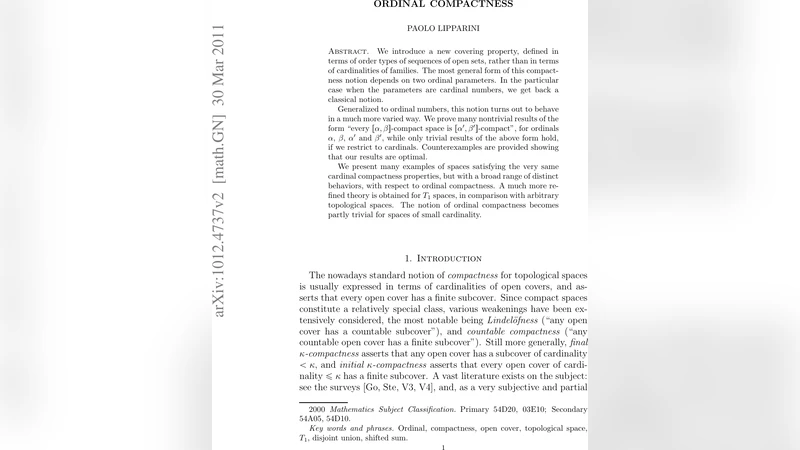
We introduce a new covering property, defined in terms of order types of sequences of open sets, rather than in terms of cardinalities of families. The most general form of this compactness notion depends on two ordinal parameters. In the particular case when the parameters are cardinal numbers, we get back a classical notion. Generalized to ordinal numbers, this notion turns out to behave in a much more varied way. We present many examples of spaces satisfying the very same cardinal compactness properties, but with a broad range of distinct behaviors, with respect to ordinal compactness. A much more refined theory is obtained for $T_1$ spaces, in comparison with arbitrary topological spaces. The notion of ordinal compactness becomes partly trivial for spaces of small cardinality.
💡 Research Summary
The paper introduces a new covering property for topological spaces called ordinal compactness, denoted (r_{\beta,\alpha}\text{-}s\text{-compact}). Classical compactness, Lindelöfness, and the more general (\mu,\lambda)-s-compactness are all expressed in terms of cardinalities of open covers. The authors replace cardinalities by order types of the indexing sets of open covers, thereby obtaining a notion that depends on two ordinal parameters (\beta) and (\alpha).
Definition and basic properties.
A space (X) (or a pair ((X,\tau)) where (\tau) is a family of subsets) is (r_{\beta,\alpha})-compact if for every open cover indexed by an ordinal (\alpha) there exists a sub‑cover whose index set (H\subseteq\alpha) has order type (\le\beta). The definition allows repetitions in the original sequence; an equivalent formulation without repetitions is given later. The authors prove elementary monotonicity (if (\beta\le\beta_1) and (\alpha_1\le\alpha) then (r_{\beta,\alpha}) implies (r_{\beta_1,\alpha_1})), and a crucial equivalence: for any (\gamma) with (\beta\le\gamma\le\alpha), (r_{\beta,\alpha}) is equivalent to (r_{\gamma,\gamma}). Moreover, (r_{\beta,\alpha}) can be split into two successive conditions (r_{\beta,\beta_1}) and (r_{\beta_1,\alpha}) whenever (\beta\le\beta_1\le\alpha). These results constitute Proposition 2.3 and form the backbone of the theory.
Motivation and first examples.
The authors start with a “Lindelöf‑of‑cardinals” example: the smallest cardinal (\lambda) such that every open cover has a subcover of size (\le\lambda). Its ordinal analogue replaces “size (\le\lambda)” by “order type (\le\alpha)”. Even for a regular uncountable cardinal (\kappa), the discrete space (\kappa) and the order topology on (\kappa) have the same Lindelöf‑of‑cardinals (\kappa) but different Lindelöf‑of‑ordinals: the order topology’s ordinal invariant can be as low as (\kappa\cdot\omega). This already shows that ordinal compactness refines the cardinal picture.
Section 3 – rich families of examples and counterexamples.
A large part of the paper is devoted to constructing spaces that separate various ordinal compactness levels while sharing the same cardinal compactness properties. The authors treat disjoint unions, natural sums of ordinals, and a “partial compactification” of infinite disjoint unions. They show that the ordinal compactness of a disjoint union is exactly the natural sum of the compactness ordinals of the summands. This requires careful use of ordinal arithmetic (natural sum vs. ordinary sum) and demonstrates that the new notion interacts non‑trivially with standard topological constructions.
Sections 4–5 – size effects and optimality.
When the underlying set is small (e.g., countable), ordinal compactness collapses: any (r_{\beta,\alpha}) with (\beta\le\alpha) holds automatically. Conversely, for sufficiently large cardinals the authors produce optimal counterexamples showing that the implications proved in Section 2 cannot be strengthened. For instance, (r_{\kappa\cdot\omega,\kappa\cdot\omega}) does not imply (r_{\kappa,\kappa}) in general, and such a counterexample must have cardinality strictly larger than (\kappa). Section 5 gives a complete characterization of the pairs ((\alpha,\beta)) for which (r_{\alpha,\alpha}) forces (r_{\beta,\beta}).
Section 6 – the (T_1) case.
A striking simplification occurs for (T_1) spaces. The authors prove that for any (T_1) space the only possible Lindelöf‑of‑ordinals are either (\le\omega) or (\ge\omega_1) and (\omega)-closed. In particular, countable ordinals behave trivially (Corollary 6.8), and the ordinal compactness of a (T_1) space is invariant under adding or removing intervals of countable length (Corollary 6.11). Thus many of the exotic phenomena seen in arbitrary spaces disappear under the modest separation axiom (T_1). The paper also notes that stronger separation axioms (normality, regularity) do not substantially change the picture, although some open problems remain.
Section 7 – further directions.
The final section sketches possible extensions: model‑theoretic variants of ordinal compactness, adaptations to other categories (e.g., uniform spaces), and several open questions such as whether normal spaces admit finer ordinal compactness distinctions than (T_1) spaces.
Overall contribution.
The work establishes ordinal compactness as a genuinely new and robust refinement of classical compactness notions. By replacing cardinalities with order types, the authors uncover a hierarchy of compactness properties that is sensitive to the fine structure of open covers, interacts richly with ordinal arithmetic, and exhibits markedly different behavior depending on the underlying cardinality and separation axioms. The paper provides a solid foundation—definitions, basic lemmas, a suite of examples, optimality results, and a detailed analysis for (T_1) spaces—opening a promising line of research in both general topology and set‑theoretic aspects of covering properties.
Comments & Academic Discussion
Loading comments...
Leave a Comment