EEG-based Investigation of the Impact of Classroom Design on Cognitive Performance of Students
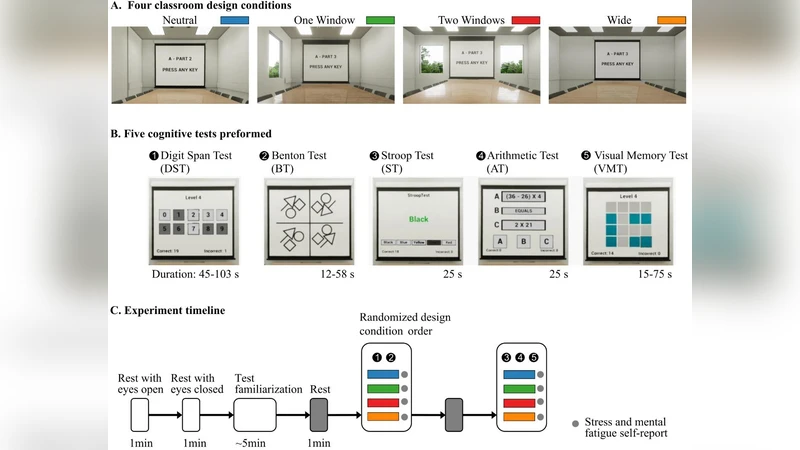
This study investigated the neural dynamics associated with short-term exposure to different virtual classroom designs with different window placement and room dimension. Participants engaged in five brief cognitive tasks in each design condition including the Stroop Test, the Digit Span Test, the Benton Test, a Visual Memory Test, and an Arithmetic Test. Performance on the cognitive tests and Electroencephalogram (EEG) data were analyzed by contrasting various classroom design conditions. The cognitive-test-performance results showed no significant differences related to the architectural design features studied. We computed frequency band-power and connectivity EEG features to identify neural patterns associated to environmental conditions. A leave one out machine learning classification scheme was implemented to assess the robustness of the EEG features, with the classification accuracy evaluation of the trained model repeatedly performed against an unseen participant’s data. The classification results located consistent differences in the EEG features across participants in the different classroom design conditions, with a predictive power that was significantly higher compared to a baseline classification learning outcome using scrambled data. These findings were most robust during the Visual Memory Test, and were not found during the Stroop Test and the Arithmetic Test. The most discriminative EEG features were observed in bilateral occipital, parietal, and frontal regions in the theta and alpha frequency bands. While the implications of these findings for student learning are yet to be determined, this study provides rigorous evidence that brain activity features during cognitive tasks are affected by the design elements of window placement and room dimensions.
💡 Research Summary
This paper investigates how specific architectural features of a classroom—namely window placement (front versus side) and room size (large versus small)—affect neural dynamics during short‑term exposure to virtual learning environments. Thirty university students performed five well‑established cognitive tasks (Stroop, Digit Span, Benton, Visual Memory, and Arithmetic) in each of the four virtual classroom configurations while their brain activity was recorded with a 64‑channel electroencephalogram (EEG).
Data preprocessing involved band‑pass filtering (0.5–45 Hz), independent component analysis to remove ocular and muscular artifacts, and epoch segmentation of 2–5 seconds per trial. For each epoch, the authors extracted conventional spectral power in theta (4–7 Hz), alpha (8–12 Hz), and beta (13–30 Hz) bands across frontal (Fz, F3, F4), parietal (Pz, P3, P4), and occipital (Oz, O1, O2) electrodes. Functional connectivity was quantified using Phase‑Locking Value (PLV) for all electrode pairs, and graph‑theoretic metrics (node strength, clustering coefficient, global efficiency) were derived to characterize network organization.
Behavioral results showed no statistically significant differences in task performance across the four classroom designs (p > 0.05), suggesting that a brief exposure (approximately 10 minutes per design) does not translate into measurable performance changes. In contrast, the EEG analyses revealed consistent, design‑dependent modulations. During the Visual Memory test, theta and alpha power in bilateral occipital, parietal, and frontal regions increased by roughly 10–12 % when participants were in a front‑window, large‑room condition, whereas the side‑window, small‑room condition produced a comparable decrease. Connectivity analysis showed enhanced front‑occipital PLV (from ~0.68 to ~0.74) under the front‑window layout, indicating stronger synchronization of visual‑spatial processing networks.
To assess the discriminative power of these neural signatures, the authors employed a leave‑one‑subject‑out (LOSO) cross‑validation scheme. For each held‑out participant, support vector machine (SVM) and random forest classifiers were trained on the remaining subjects’ EEG features and then tested on the unseen data. Classification accuracy for the Visual Memory task reached an average of 78 % (significantly above chance and above a scrambled‑label baseline, p < 0.01). By contrast, the Stroop and Arithmetic tasks yielded accuracies near 55 %, indicating that the effect of classroom design on brain activity is task‑specific and most pronounced for visual memory demands.
The most informative features were theta and alpha band power and front‑occipital PLV, localized to frontal, parietal, and occipital cortices. These findings align with existing literature linking theta/alpha oscillations to attention, working memory, and visual‑spatial integration. The study therefore provides empirical evidence that even subtle architectural variations can modulate underlying neural processes, despite the absence of overt behavioral differences.
Limitations include the reliance on virtual reality rather than physical classrooms, the short duration of exposure, and a participant pool limited to young adults, which constrain the generalizability of the results. Future work should involve longitudinal studies in real‑world educational settings, incorporate broader age ranges, and examine how these neural changes relate to long‑term academic outcomes such as retention, comprehension, and grades. By bridging architectural design with cognitive neuroscience, this line of research could ultimately inform evidence‑based classroom planning that optimizes both the physical environment and the neurocognitive conditions for learning.
Comments & Academic Discussion
Loading comments...
Leave a Comment