Learning to Isolate Muons
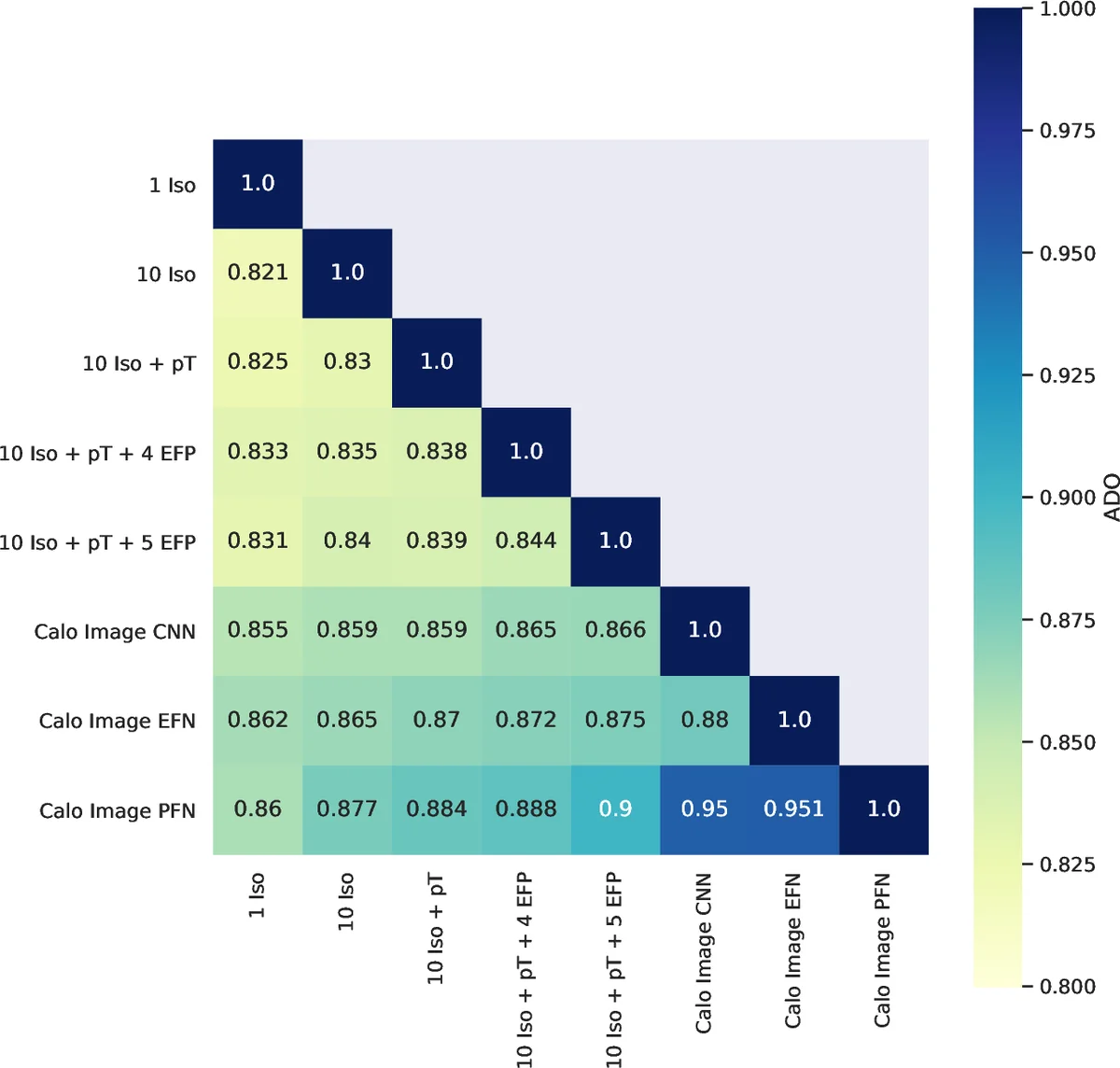
Distinguishing between prompt muons produced in heavy boson decay and muons produced in association with heavy-flavor jet production is an important task in analysis of collider physics data. We explore whether there is information available in calorimeter deposits that is not captured by the standard approach of isolation cones. We find that convolutional networks and particle-flow networks accessing the calorimeter cells surpass the performance of isolation cones, suggesting that the radial energy distribution and the angular structure of the calorimeter deposits surrounding the muon contain unused discrimination power. We assemble a small set of high-level observables which summarize the calorimeter information and close the performance gap with networks which analyze the calorimeter cells directly. These observables are theoretically well-defined and can be studied with collider data.
💡 Research Summary
The paper addresses the long‑standing problem of distinguishing prompt muons—those originating from the decay of heavy electroweak bosons such as W, Z, or potential new resonances—from non‑prompt muons that arise inside heavy‑flavor jets. Traditionally, experiments rely on a single isolation variable Iµ(R₀), which sums the transverse energy deposited in a cone of radius R₀ around the muon. While this scalar captures the intuitive idea that prompt muons are “isolated,” it discards the detailed spatial pattern of calorimeter energy, potentially losing discriminating power.
To investigate whether useful information is hidden in the calorimeter, the authors generate a realistic Monte‑Carlo dataset. Prompt muons are produced via pp → Z⁰ → µ⁺µ⁻ with a Z mass of 20 GeV, and non‑prompt muons via pp → b b̄. Events are simulated with MadGraph5, showered with Pythia 8.235, and passed through a Delphes 3.4.1 detector model that mimics ATLAS/CMS calorimeter granularity. An average pile‑up of µ = 50 interactions per bunch crossing is overlaid to emulate LHC Run 2 conditions. Muons are required to have pₜ ∈
Comments & Academic Discussion
Loading comments...
Leave a Comment