Edvertisements: Adding Microlearning to Social News Feeds and Websites
💡 Research Summary
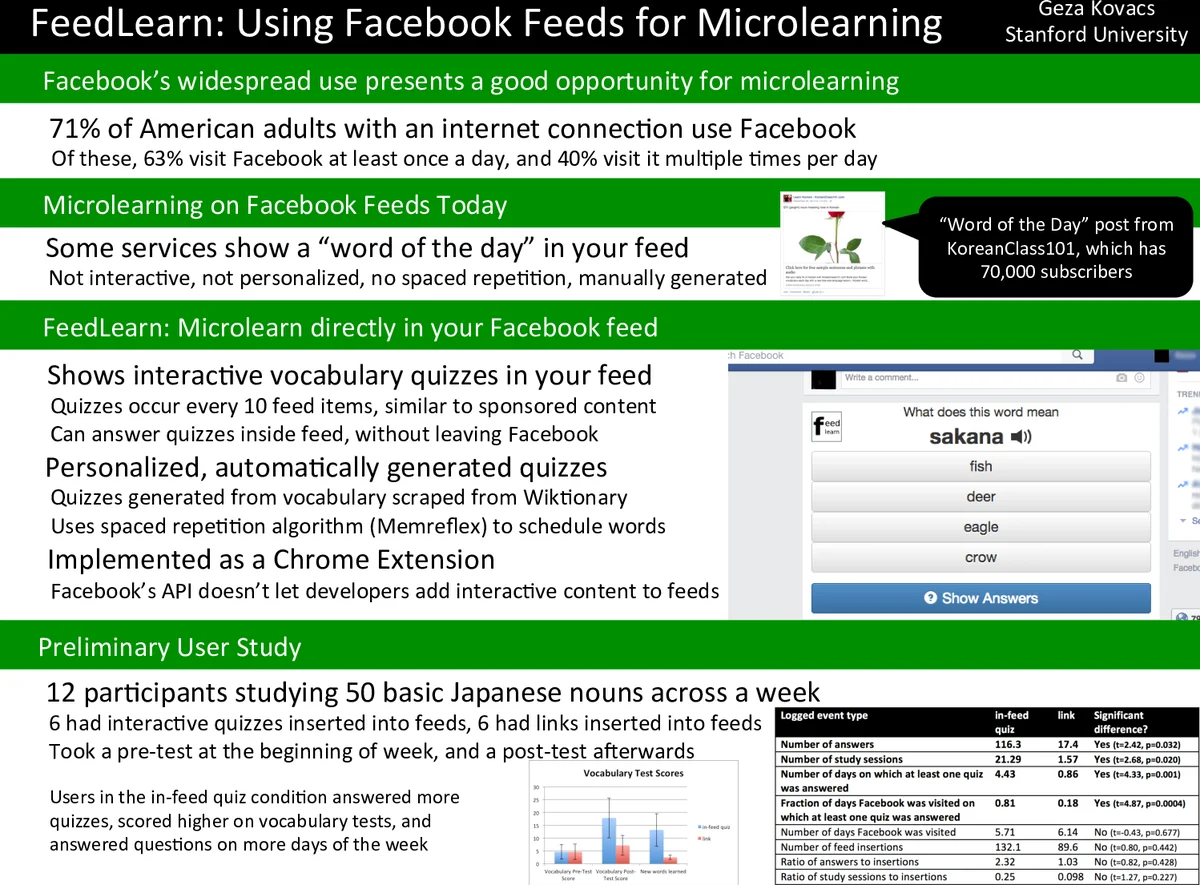
The paper introduces “Edvertisements,” a micro‑learning approach that embeds short vocabulary quizzes directly into users’ Facebook news feeds and replaces traditional web advertisements with interactive learning tasks. Implemented as a browser extension (initially for Chrome, later ported to Firefox and compatible with other major browsers), the system presents quizzes in two contexts: (1) within the Facebook feed as rectangular cards that mimic regular posts, inserted at a ratio of one quiz per ten feed items; and (2) on arbitrary websites by detecting ad slots using EasyList patterns (the same technique employed by ad‑blockers) and swapping them with quizzes sized to match IAB standard ad units (e.g., 300×250, 200×90).
The learning material focuses on Japanese nouns drawn from Wiktionary’s “1000 Basic Japanese Words.” After filtering out loanwords and homographs, 50 nouns were selected. Because participants could not read Japanese script, the words are displayed in Romanized form. Two multiple‑choice quiz types are provided: English‑to‑Japanese and Japanese‑to‑English, each requiring a single click to answer. Correct answers trigger an immediate replacement with a new item, allowing users to continue studying as long as they wish without leaving the page.
To promote long‑term retention, the authors adapt the MemReflex spaced‑repetition algorithm. Instead of always presenting the most overdue item, the modified version selects the word that has been unseen for the longest time, or introduces a new word if none are overdue. This ensures a balanced mix of new and review items even when users skim without answering every quiz.
A preliminary user study involved 14 university students (median age 20) who had not previously studied Japanese but expressed interest in basic vocabulary. Participants completed a pre‑test matching 50 Japanese words to English definitions, installed the extension, and used Facebook for a week while the system injected either (a) in‑feed quizzes or (b) static links to an external quiz site (the control condition). Both conditions received items at the same 1:10 frequency, and the quiz interface was identical. After one week, a post‑test measured vocabulary gain.
Results showed that the in‑feed quiz group learned an average of 13.2 new words versus 2.4 for the link group; the difference did not reach statistical significance (t = 1.38, p = 0.20) due to the small sample size. However, engagement metrics differed markedly: the in‑feed group answered an average of 116 quizzes across 21 study sessions, interacted on 4.4 of the 5.7 days they visited Facebook, and logged significantly more quiz attempts and sessions than the link group. Qualitative feedback indicated a desire for brief introductions of new words before they appear in quizzes and highlighted that even non‑interacted impressions might aid memory, suggesting the need for passive reinforcement mechanisms.
The authors discuss broader implications, noting that ad‑blocking rates are rising and that users exhibit “banner blindness,” making traditional ads ineffective. By repurposing ad space for learning, Edvertisements could both improve user experience and open new monetization pathways, such as sponsored educational ads (e.g., a gym promoting a workout routine). Future work includes extending the approach to other contexts (YouTube interstitials, e‑book chapters, email), supporting additional subjects and languages, personalizing content based on browsing history and social signals, and exploring commercial sponsorship models.
In summary, the study demonstrates that embedding micro‑learning tasks directly into social feeds and ad slots can increase user engagement and modestly improve short‑term vocabulary acquisition, offering a promising direction for integrating education into everyday web interactions without disrupting users’ habitual browsing behavior.
Comments & Academic Discussion
Loading comments...
Leave a Comment