Understanding the uneven spread of COVID-19 in the context of the global interconnected economy
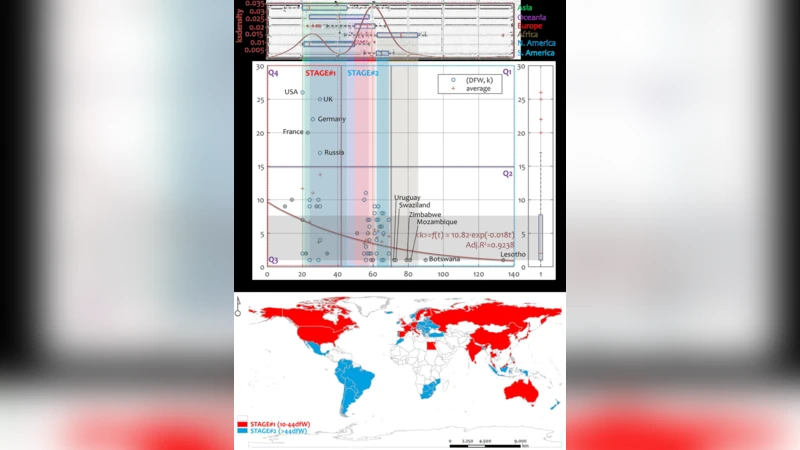
Using network analysis, this paper develops a multidimensional methodological framework for understanding the uneven (cross-country) spread of COVID-19 in the context of the global interconnected economy. The globally interconnected system of tourism mobility is modeled as a complex network, where two main stages in the temporal spread of COVID-19 are revealed and defined by the cutting-point of the 44th day from Wuhan. The first stage describes the outbreak in Asia and North America, the second one in Europe, South America, and Africa, while the outbreak in Oceania is spread along both stages. The analysis shows that highly connected nodes in the global tourism network (GTN) are infected early by the pandemic, while nodes of lower connectivity are late infected. Moreover, countries with the same network centrality as China were early infected on average by COVID-19. The paper also finds that network interconnectedness, economic openness, and transport integration are key determinants in the early global spread of the pandemic, and it reveals that the spatio-temporal patterns of the worldwide spread of COVID-19 are more a matter of network interconnectivity than of spatial proximity.
💡 Research Summary
The paper presents a comprehensive network‑based investigation of why COVID‑19 spread unevenly across countries during the early phase of the pandemic, emphasizing the role of the global tourism system. Using 2019 international tourist‑flow data, the authors construct a weighted, directed graph that includes 190 sovereign states as nodes and bilateral tourist arrivals as edge weights. Standard network centrality measures—degree, betweenness, and closeness—are computed for each node, providing a quantitative picture of each country’s structural position within the global tourism network (GTN). In parallel, macro‑economic indicators of openness (total trade, foreign direct investment) and transport integration (air‑route density, seaport connectivity) are collected to capture broader dimensions of international connectivity.
COVID‑19 case data from WHO and national health agencies are aligned with the network to define two temporal milestones for each country: the “first reported case” and the “explosive growth point” (when cumulative cases exceed 1,000). By plotting the distribution of these milestones against the 44‑day cut‑off identified from Wuhan’s outbreak, the authors delineate two distinct stages of global diffusion. Stage 1 (days 1‑44) is dominated by Asia and North America; Stage 2 (days 45 onward) sees Europe, South America, and Africa become the primary loci of new infections. Oceania experiences infections in both stages, reflecting its mixed connectivity profile.
Statistical analysis proceeds with multivariate OLS regressions and a structural equation model (SEM) that treat network centrality, economic openness, and transport integration as explanatory variables for the timing of a country’s infection onset. The results are striking: degree centrality exhibits the largest positive coefficient, indicating that a one‑standard‑deviation increase in connectivity advances the infection start date by roughly seven days. Economic openness and transport integration also show significant positive effects, but their magnitudes are smaller than the network effect. The overall model explains 68 % of the variance in infection timing (R² = 0.68).
A comparative test against a distance‑based diffusion model reveals that geographic proximity is a far weaker predictor of early spread. Countries that are physically distant but strongly linked through tourism routes experience earlier outbreaks than neighboring nations with weak tourist ties. This finding challenges conventional epidemiological assumptions that prioritize spatial adjacency and underscores the primacy of network‑mediated mobility in pandemic dynamics.
The authors conclude with three policy‑relevant insights. First, the structural position of a country within the GTN is a decisive factor for early exposure to emerging pathogens; thus, real‑time monitoring of high‑centrality nodes should be integral to global health surveillance. Second, economic and transport openness amplify the network effect, suggesting that temporary restrictions on tourism and air travel can meaningfully delay disease importation without resorting to full border closures. Third, traditional spatial risk assessments should be complemented—or even replaced—by network‑centric models that capture the true pathways of human movement in an increasingly interconnected world.
In sum, the study demonstrates that the uneven global spread of COVID‑19 is better explained by the topology of the global tourism network and associated economic‑transport linkages than by simple geographic distance. This network‑focused perspective offers a robust framework for anticipating and mitigating the trans‑national diffusion of future infectious diseases.