Fourier and Circulant Matrices are Not Rigid
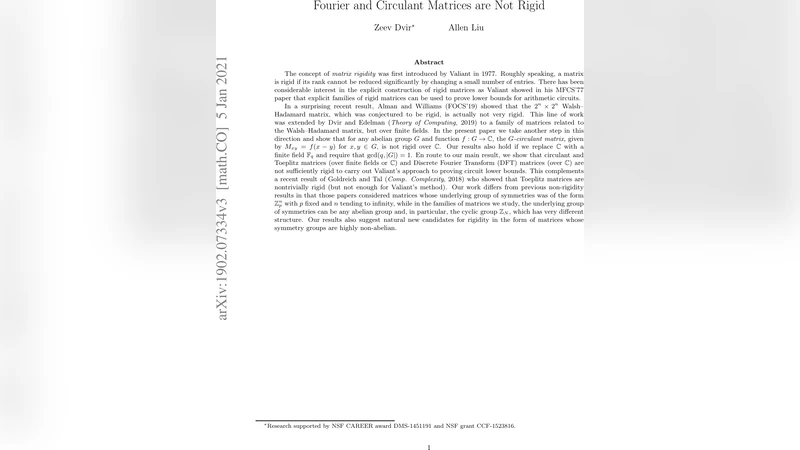
The concept of matrix rigidity was first introduced by Valiant in 1977. Roughly speaking, a matrix is rigid if its rank cannot be reduced significantly by changing a small number of entries. There has been extensive interest in rigid matrices as Valiant showed in his MFCS'77 paper that rigidity can be used to prove arithmetic circuit lower bounds. In a surprising result, Alman and Williams (FOCS'19) showed that the (real valued) Hadamard matrix, which was conjectured to be rigid, is actually not very rigid. This line of work was extended by Dvir and Edelman (\emph{Theory of Computing}, 2019) to a family of matrices related to the Hadamard matrix, but over finite fields. In our work, we take another step in this direction and show that for any abelian group $G$ and function $f:G \rightarrow \mathbb{C}$, the matrix given by $M_{xy} = f(x - y)$ for $x,y \in G$ is not rigid. In particular, we get that complex valued Fourier matrices, circulant matrices, and Toeplitz matrices are all not rigid and cannot be used to carry out Valiant’s approach to proving circuit lower bounds. Our results also hold when we consider matrices over a fixed finite field instead of the complex numbers. This complements a recent result of Goldreich and Tal (\emph{Comp. Complexity}, 2018) who showed that Toeplitz matrices are nontrivially rigid (but not enough for Valiant’s method). Our work differs from previous non-rigidity results in that those works considered matrices whose underlying group of symmetries was of the form $\mathbb{F}_p^n$ with $p$ fixed and $n$ tending to infinity, while in the families of matrices we study, the underlying group of symmetries can be any abelian group and, in particular, the cyclic group $\mathbb{Z}_N$, which has very different structure. Our results also suggest natural new candidates for rigidity in the form of matrices whose symmetry groups are highly non-abelian.
💡 Research Summary
The paper investigates the rigidity of several highly structured families of matrices—Fourier (DFT) matrices, circulant matrices, Toeplitz matrices, and the more general G‑circulant matrices defined by M_{xy}=f(x−y) for a function f on an abelian group G. Matrix rigidity, introduced by Valiant (1977), measures how many entries must be altered to reduce a matrix’s rank below a given threshold; Valiant showed that sufficiently rigid matrices would yield strong lower bounds for arithmetic circuits.
Recent breakthroughs (Alman‑Williams 2019; Dvir‑Edelman 2019) demonstrated that the Walsh–Hadamard matrix and certain G‑circulant matrices over finite fields are not Valiant‑rigid. This work extends those results in three major directions. First, it proves that for any finite abelian group G and any field F (either the complex numbers ℂ or a finite field 𝔽_q with gcd(q,|G|)=1), the family of G‑circulant matrices is quasipolynomially non‑rigid (QNR). QNR means that for every ε>0, the regular‑rigidity r_F(M) of an N×N matrix M can be reduced to N^{ε}·exp(ε·c·(log N)^{c′}) for suitable constants c,c′; such a bound is far weaker than Valiant’s rigidity requirement, implying that these matrices cannot be used to prove circuit lower bounds via Valiant’s method.
The technical core proceeds in stages. The authors introduce generalized Walsh–Hadamard (GWH) matrices H_{d,n} of size d^{n}×d^{n}, whose entries are ω^{i·j} with ω=e^{2πi/d}. They show (Theorem 1.8) that for any fixed base d and sufficiently large n, H_{d,n} can be made low‑rank by changing only d^{n·ε} entries, a direct generalization of the d=2 case handled by Alman‑Williams. This result already yields non‑rigidity for any matrix of the form M_{xy}=f(x−y) over the additive group ℤ_{d}^{n}.
Next, the paper tackles DFT matrices. For integers N that are “well‑factorable” (products of distinct primes whose each p_i−1 lacks large prime‑power divisors), the N×N DFT_N matrix can be partitioned into submatrices possessing a GWH‑type additive structure. Applying the previous non‑rigidity argument to each submatrix and aggregating the modifications yields QNR for all well‑factorable N (Theorem 1.11). To extend beyond this special class, the authors embed a smaller DFT_{N′} (with N′>N/(log N)^2) into an N×N circulant matrix after appropriate scaling. Since circulant matrices are simultaneously diagonalized by the DFT matrix, Lemma 2.21 shows that non‑rigidity of the larger circulant matrix transfers to the embedded DFT_{N′}. Consequently, every DFT matrix is QNR over ℂ.
The authors then generalize from cyclic groups to arbitrary finite abelian groups. Using the fundamental theorem of finite abelian groups, any G decomposes as a direct product of cyclic groups. By taking tensor products of the corresponding circulant/DFT blocks, the QNR property lifts to the full G‑circulant family (Theorem 1.4). The same argument works over finite fields provided the characteristic is coprime to |G|, because the diagonalizing Fourier matrix remains invertible in that setting.
Because circulant matrices are a special case of G‑circulant matrices, the same non‑rigidity holds for Toeplitz matrices (which are essentially circulant up to a shift). The paper also notes corollaries: Paley‑Hadamard matrices and Vandermonde matrices with geometric‑progression nodes are QNR over ℂ.
Overall, the work demonstrates that high symmetry under abelian groups is incompatible with Valiant‑rigidity. It suggests that future candidates for rigid matrices should involve non‑abelian symmetry groups or substantially less structured constructions. The results close a line of inquiry that began with conjectures of rigidity for Fourier‑type matrices and now establishes their non‑rigidity across a broad algebraic landscape.
Comments & Academic Discussion
Loading comments...
Leave a Comment