A Game-Theoretic Analysis of the Social Impact of Connected and Automated Vehicles
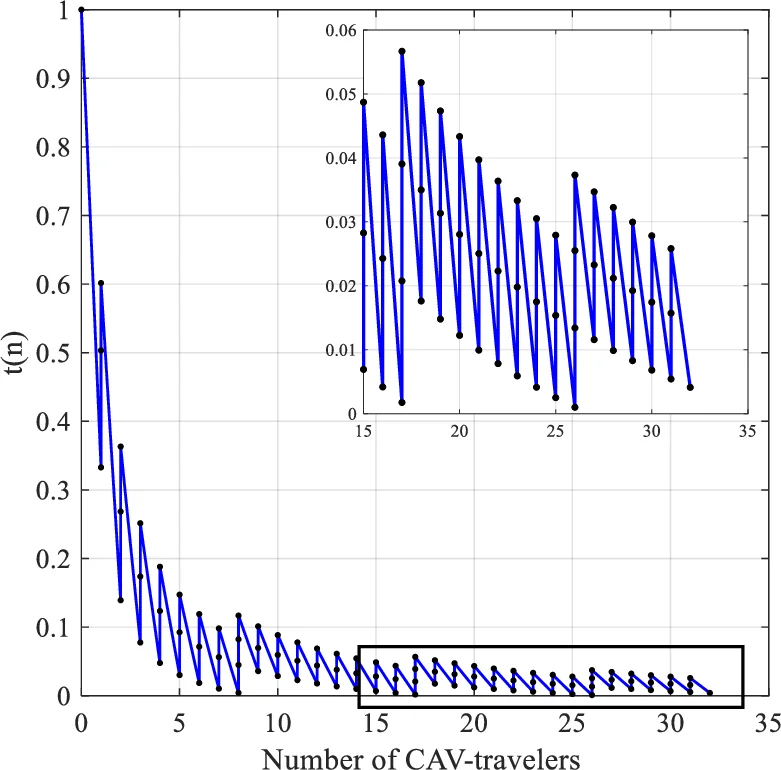
In this paper, we address the much-anticipated deployment of connected and automated vehicles (CAVs) in society by modeling and analyzing the social-mobility dilemma in a game-theoretic approach. We formulate this dilemma as a normal-form game of players making a binary decision: whether to travel with a CAV (CAV travel) or not (non-CAV travel) and by constructing an intuitive payoff function inspired by the socially beneficial outcomes of a mobility system consisting of CAVs. We show that the game is equivalent to the Prisoner’s dilemma, which implies that the rational collective decision is the opposite of the socially optimum. We present two different solutions to tackle this phenomenon: one with a preference structure and the other with institutional arrangements. In the first approach, we implement a social mechanism that incentivizes players to non-CAV travel and derive a lower bound on the players that ensures an equilibrium of non-CAV travel. In the second approach, we investigate the possibility of players bargaining to create an institution that enforces non-CAV travel and show that as the number of players increases, the incentive ratio of non-CAV travel over CAV travel tends to zero. We conclude by showcasing the last result with a numerical study.
💡 Research Summary
The paper presents a rigorous game‑theoretic analysis of the social‑mobility dilemma that is expected to arise with the widespread deployment of connected and automated vehicles (CAVs). The authors model a society of n travelers ( n > 2) as rational players in a normal‑form game. Each player chooses between two mutually exclusive actions: travel in a CAV (C) or travel by any non‑CAV mode (NC). All travelers receive a baseline benefit c > 0 from commuting. Choosing a CAV adds an extra personal benefit d > 0 (reflecting flexibility, privacy, convenience) but also imposes a negative externality e > 0 on the shared road infrastructure. This externality is assumed to be equally shared among all n players, giving each player a per‑person damage φ = e/n.
The payoff functions are therefore: - f_i(C, k) = c + d − (n − k)φ, - f_i(NC, k) = c − (n − k − 1)φ, where k is the number of other players who choose NC. The difference α = f_i(C, k) − f_i(NC, k) = d − φ is strictly positive and independent of k, meaning that for any configuration C strictly dominates NC from an individual perspective. However, the socially optimal outcome is the opposite: when every player chooses NC, each receives f_i(NC, n‑1) = c, which exceeds the payoff under universal CAV travel, f_i(C, 0) = c − 1. Thus the game exhibits the classic Prisoner’s Dilemma (PD) structure—individual rationality leads to a collectively sub‑optimal equilibrium.
The authors formally prove (Theorem 1) that their game G is equivalent to the PD in terms of incentive structure, and (Corollary 1) that the equilibrium outcomes coincide. They also demonstrate that the payoff function is non‑negative for all k and that mutual NC strictly Pareto‑dominates mutual C.
To address the dilemma, two solution frameworks are proposed:
-
Preference‑Structure (Incentive) Mechanism
By introducing policy‑driven subsidies for NC travel or taxes on CAV use, the payoff difference α can be reduced, potentially becoming negative. The authors derive a critical integer k* (2 ≤ k* ≤ n) that represents the minimum number of NC travelers required for NC to become a Nash equilibrium. The corresponding fraction β = k*/n serves as a lower bound: if at least β of the population adopts NC, the equilibrium shifts to the socially optimal outcome. Analytical expressions for the required subsidy/tax levels are provided, and a numerical example shows that modest incentives can dramatically lower k*. -
Institutional Arrangement (Bargaining) Mechanism
Players are allowed to pre‑game bargain and create an institution that enforces NC travel, with penalties for deviation. The paper models the bargaining power as inversely proportional to the population size. It proves (Proposition 2) that the incentive ratio γ = (benefit of NC − benefit of C)/benefit of C converges to zero as n → ∞. Consequently, in large societies the mere existence of a binding institution is sufficient to suppress CAV travel almost completely, without the need for large monetary transfers. The analysis includes a discussion of the stability of the institutional equilibrium and the conditions under which collective enforcement is self‑sustaining.
A numerical case study illustrates the theory. With parameters n = 25, c = 4.2827, d = 2.2827, e = d + 1, the authors compute φ and plot the payoff surface (Figure 1). The plot shows that when roughly five players choose NC (k* ≈ 5), the NC payoff exceeds the C payoff, confirming the existence of a social dilemma. Applying the incentive mechanism reduces the required k* to as low as two, while the institutional mechanism yields an incentive ratio γ ≈ 0.04, effectively eliminating the incentive to choose C.
The paper concludes that, left unchecked, the selfish incentives embedded in CAV adoption will lead to over‑utilization of road capacity, increased congestion, pollution, and a welfare loss relative to the socially optimal state. Policy makers must therefore design either targeted financial incentives or robust institutional frameworks to align individual choices with the collective good. The authors suggest future work on dynamic multi‑modal networks, stochastic demand, and empirical validation using real‑world CAV deployment data.
Overall, the study provides a clear, mathematically grounded demonstration that the emergence of CAVs creates a Prisoner’s Dilemma in travel mode choice, and it offers concrete, analytically justified policy levers to mitigate the associated social inefficiencies.
Comments & Academic Discussion
Loading comments...
Leave a Comment