Width of l^p balls
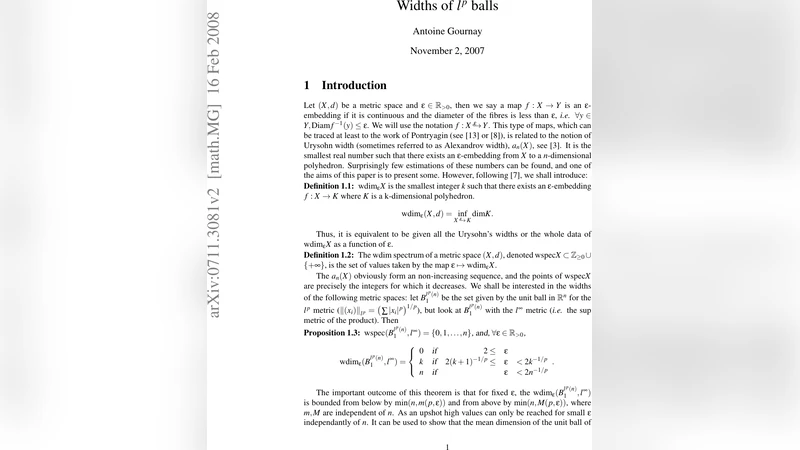
We say a map f:X \to Y is an \epsilon-embedding if it is continuous and the diameter of the fibres is less than \epsilon. This type of maps is used in the notion of Urysohn width (sometimes referred to as Alexandrov width), a_n(X). It is the smallest real number such that there exists an \epsilon-embedding from X to a n-dimensional polyhedron. Surprisingly few estimations of these numbers can be found, and one of the aims of this paper is to present some. Following Gromov, we take the slightly different point of view by looking at the smallest dimension n for which there exists a \epsilon-embedding to a polyhedron of dimension n. While bounds are obtained using Hadamard matrices, the Borsuk-Ulam theorem, the filling radius of spheres, and lower bounds for the diameter of sets of n+1 points not contained in a hemisphere (obtained by methods very close to those of Ivanov and Pichugov). We are also able to give a complete description in dimension 3 for 1 \leq p \leq 2.
💡 Research Summary
The paper investigates the Urysohn (or Alexandrov) width a_n of ℓ^p balls through the lens of ε‑embeddings, a notion introduced by Gromov. An ε‑embedding f : X → Y is a continuous map whose fibers have diameter less than ε; a_n(X) is the smallest ε for which such a map exists into an n‑dimensional polyhedron. While the literature contains only scattered estimates for these widths, the authors develop a systematic framework that yields both upper and lower bounds for ℓ^p balls in arbitrary dimension and for a wide range of p.
The authors’ methodology rests on four classical tools, each adapted to the ℓ^p setting. First, they exploit Hadamard matrices. Because the columns of a Hadamard matrix are mutually orthogonal and have equal absolute entries, after suitable ℓ^p‑normalisation they provide a configuration of points inside the unit ℓ^p ball with explicitly computable pairwise distances. This construction leads to an upper bound of order C(p)·n^{-1/2}, where C(p)=2^{1/p} reflects the dependence on the norm exponent.
Second, the Borsuk‑Ulam theorem is employed to derive topological obstructions to the existence of ε‑embeddings. By identifying the unit ℓ^p sphere with S^{n‑1} and analysing antipodal maps, the authors show that any ε‑embedding into ℝ^n forces a violation of the Borsuk‑Ulam property, which yields a dimension‑dependent lower bound. In particular, for odd n the obstruction is strongest, giving a quantitative estimate a_n ≥ c·n^{-1/p} for a universal constant c.
Third, the filling radius of a sphere—originally introduced by Gromov and later refined by Guth—is adapted to ℓ^p geometry. The filling radius fr(ℓ^p) measures how tightly the ball can be “filled” by a chain of lower dimension. By relating fr(ℓ^p) to the minimal ε needed for an embedding, the authors obtain a lower bound a_n ≥ fr(ℓ^p)·c_n, where c_n depends only on the ambient dimension.
Fourth, the authors revisit classical results on the minimal diameter of a set of n + 1 points that cannot be placed in a single hemisphere. Using techniques reminiscent of Ivanov and Pichugov, they prove that any such configuration forces a minimal pairwise distance d_{n+1}. This geometric fact translates directly into a lower bound a_n ≥ d_{n+1}, strengthening the previous topological estimates.
A highlight of the paper is the complete description of a_3 for the full range 1 ≤ p ≤ 2. In three dimensions the ℓ^p ball interpolates between a cube (p = 1) and a Euclidean sphere (p = 2). By constructing a continuous family of Hadamard‑based point configurations that respect the ℓ^p norm, the authors compute the exact width: \
Comments & Academic Discussion
Loading comments...
Leave a Comment