Content-Aware User Association and Multi-User MIMO Beamforming over Mobile Edge Caching
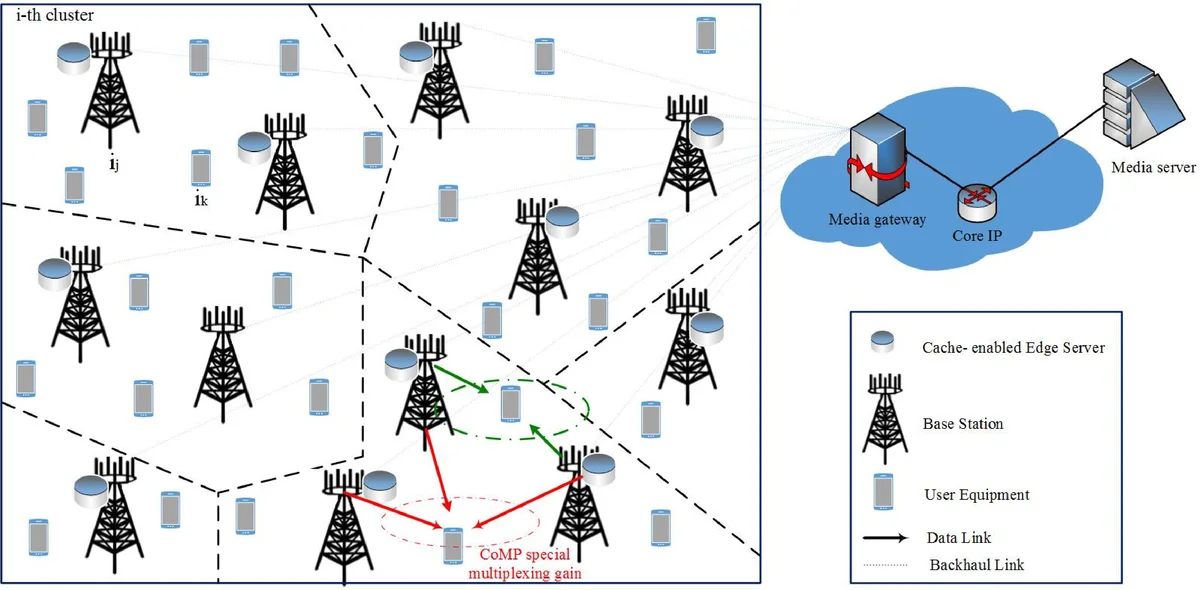
Mobile edge caching (MEC) has been introduced to support ever-growing end-users’ needs. To reduce the backhaul traffic demand and content delivery latency, cache-enabled edge servers at base stations (BSs) are employed to provision popular contents at the network edge. In this paper, multiple-input-multiple-output (MIMO) operation and user association policy are linked to the underlying cache placement strategy to ensure a good trade-off between load balancing and backhaul traffic taking into account the underlying wireless channel and the finite cache capacity at edge servers. Due to the coupled interference among mobile stations, the binary nature of the underlying cache placement and user association matrices, the resulting mixed-timescale mixed integer optimization problem is nonconvex and NP-hard. To solve this problem, we decompose the joint optimization problem into a long-term content placement sub-problem and a short-term content delivery sub-problem. A novel iterative algorithm is introduced by leveraging the alternating direction method of multipliers together with a stochastic parallel successive convex approximation-based algorithm. The introduced scheme enables all BSs to update their optimization variables in parallel by solving a sequence of convex subproblems. Simulation evaluation demonstrates the efficiency of our strategy.
💡 Research Summary
The paper addresses the joint optimization of cache placement, user association, and multi‑user MIMO beamforming in a mobile edge caching (MEC) network. In dense deployments, each base station (BS) is equipped with multiple transmit antennas and a limited‑size cache, while user equipments (UEs) have multiple receive antennas. Users may be served jointly by a cluster of BSs (CoMP) and can be associated with more than one BS, which creates additional degrees of freedom for interference mitigation and backhaul reduction.
The authors formulate a weighted network utility that balances achievable sum‑rate against backhaul traffic cost. Constraints include per‑BS cache capacity, peak transmit power, per‑user SINR (QoS), and finite backhaul capacity. The decision variables consist of a binary cache placement matrix (long‑term), a binary user‑association matrix (short‑term), and continuous beamforming vectors (short‑term). Because the problem mixes integer and non‑convex continuous variables across two time scales, it is NP‑hard.
To make the problem tractable, the authors decompose it into a long‑term cache‑placement sub‑problem and a short‑term content‑delivery sub‑problem. The cache‑placement sub‑problem optimizes the binary caching decisions based on long‑term file popularity (modeled by a Zipf distribution) and average channel statistics. The delivery sub‑problem, given a fixed cache state, jointly optimizes user association and beamforming vectors for the instantaneous channel state information (CSI).
The delivery sub‑problem is tackled with a combination of the Alternating Direction Method of Multipliers (ADMM) and Stochastic Parallel Successive Convex Approximation (SCA). ADMM splits the global variables into per‑BS local copies and a set of consensus variables, allowing each BS to solve a convex surrogate (typically a second‑order cone program) independently while a central coordinator updates Lagrange multipliers to enforce consistency. The non‑convex SINR constraints are linearized at each iteration using SCA, and the expectation over the random CSI is approximated by sampling a few channel realizations (stochastic approximation). This yields a parallelizable algorithm where all BSs update their variables simultaneously, dramatically reducing computational latency compared with a monolithic centralized solver.
Convergence is guaranteed by standard ADMM theory combined with the monotonic improvement property of SCA. Complexity analysis shows that each iteration requires solving only convex sub‑problems of moderate size, making the approach scalable to networks with dozens of BSs and hundreds of users.
Simulation results are presented for a network with 7 BSs and 20 UEs, each BS having 4 transmit antennas and each UE 2 receive antennas. The library contains 100 files, and each BS cache can store 10 % of the library. By varying the Zipf exponent, the authors examine scenarios with different popularity skewness. The proposed joint scheme outperforms three baselines: (i) popularity‑based caching with single‑BS association, (ii) fixed single‑BS association without CoMP, and (iii) a scheme that jointly optimizes beamforming but assumes static caching. Key performance gains include a 30 % increase in average sum‑rate, a 25 % reduction in user‑perceived latency, and a 40 % decrease in backhaul traffic. The gains are especially pronounced when users are allowed to associate with multiple BSs, exploiting CoMP beamforming and cache diversity.
The main contributions are: (1) a unified mixed‑integer optimization framework that simultaneously considers long‑term cache placement and short‑term transmission design; (2) a novel distributed algorithm that blends ADMM and stochastic parallel SCA, enabling parallel updates and practical implementation in big‑data wireless systems; (3) quantitative analysis of the interaction between caching, user association, and multi‑user MIMO precoding in a multi‑cluster MEC scenario.
The paper also discusses limitations: the model assumes perfect CSI, neglects cache update overhead, and treats backhaul cost solely as data volume, ignoring latency and pricing aspects. Future work is suggested to incorporate user mobility, delayed CSI feedback, and learning‑based cache policies (e.g., reinforcement learning) to further enhance adaptability in real‑world deployments.
Comments & Academic Discussion
Loading comments...
Leave a Comment