Physics, Topology, Logic and Computation: A Rosetta Stone
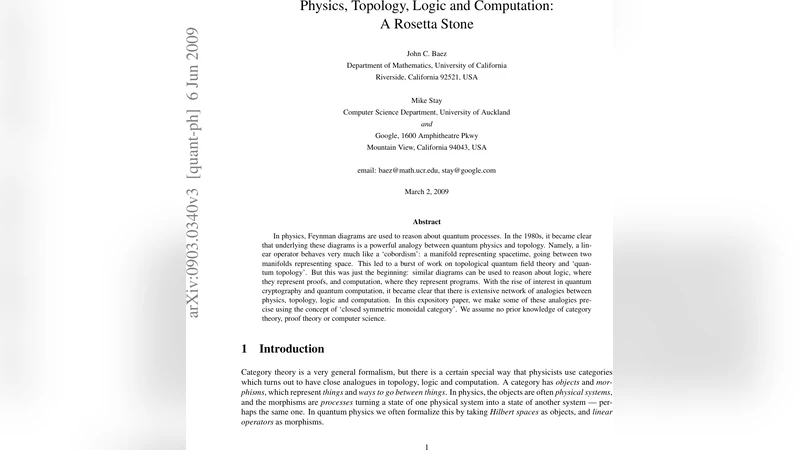
In physics, Feynman diagrams are used to reason about quantum processes. In the 1980s, it became clear that underlying these diagrams is a powerful analogy between quantum physics and topology: namely, a linear operator behaves very much like a “cobordism”. Similar diagrams can be used to reason about logic, where they represent proofs, and computation, where they represent programs. With the rise of interest in quantum cryptography and quantum computation, it became clear that there is extensive network of analogies between physics, topology, logic and computation. In this expository paper, we make some of these analogies precise using the concept of “closed symmetric monoidal category”. We assume no prior knowledge of category theory, proof theory or computer science.
💡 Research Summary
The paper “Physics, Topology, Logic and Computation: A Rosetta Stone” presents a unified categorical framework that brings together four seemingly disparate disciplines—quantum physics, topology, proof theory, and computer science—by exploiting the structure of a closed symmetric monoidal category (CSMC). The authors begin by recalling the historical emergence of analogies: Feynman diagrams in quantum field theory, cobordisms in low‑dimensional topology, proof nets in linear logic, and string diagrams in programming language semantics. Each of these graphical formalisms, although developed in isolation, obeys the same compositional rules: a binary tensor product (⊗) for parallel composition, a unit object I for the empty system, symmetry isomorphisms σ_{A,B}:A⊗B→B⊗A, and an internal hom (⇒) that captures functional abstraction.
In the first technical section the paper defines a CSMC rigorously, emphasizing that the existence of an internal hom makes the category “closed” and that the symmetry makes it “symmetric”. The authors illustrate the abstract definition with concrete examples: the category FdHilb of finite‑dimensional Hilbert spaces (objects) and linear maps (morphisms) for quantum physics; the cobordism category Cob_n whose objects are (n‑1)‑manifolds and morphisms are n‑dimensional cobordisms for topology; the category of linear logic proofs where formulas are objects and cut‑free proof transformations are morphisms; and the category of typed λ‑calculi where types are objects and terms are morphisms. In each case the tensor product corresponds to parallel composition (tensor product of Hilbert spaces, disjoint union of manifolds, multiplicative conjunction, or product type), while composition corresponds to sequential execution (time evolution, gluing of cobordisms, cut‑elimination, or function composition).
The quantum‑physics section shows how Feynman diagrams become morphisms in a dagger‑compact CSMC. The “cup” and “cap” morphisms generate entangled states and their adjoints, providing a categorical account of quantum teleportation, Bell‑state preparation, and measurement. The compact structure supplies a trace‑like operation that models the partial trace over subsystems, a crucial ingredient for describing open quantum systems.
The topology section treats cobordisms as morphisms in Cob_n. The authors explain how gluing two cobordisms along a common boundary implements categorical composition, while disjoint union implements the tensor product. They point out that the same compact structure appears: a pair of pants surface is a morphism from two circles to one, mirroring the “merge” operation in quantum circuits.
In the logic section the paper revisits Girard’s linear logic, where the multiplicative conjunction (⊗) and its dual (⅋) correspond to the tensor and its internal hom. Proof nets are shown to be exactly the string diagrams of a CSMC, and cut‑elimination coincides with diagrammatic rewriting that respects the monoidal axioms. The authors stress that the “closed” aspect of the category captures linear implication (A ⊸ B) as an internal hom, thereby formalizing the Curry‑Howard‑Lambek correspondence for linear logic.
The computation section connects the categorical picture to programming languages. Typed λ‑calculus terms are interpreted as morphisms, β‑reduction as diagrammatic rewriting, and higher‑order functions as internal homs. The authors extend this to quantum programming languages (e.g., Quipper, Q#) by employing dagger‑compact structure to model unitary gates and measurement. They argue that a single diagrammatic language can simultaneously express classical control flow, quantum data flow, and logical reasoning about programs.
The “Rosetta Stone” table synthesizes the analogies:
| Discipline | Objects | Morphisms | Tensor (⊗) | Unit (I) | Internal Hom (⇒) | Compact Structure |
|---|---|---|---|---|---|---|
| Quantum Physics | Hilbert spaces | Linear maps | Tensor product | ℂ (scalar) | Space of linear maps | Cups & caps (entanglement) |
| Topology | (n‑1)-manifolds | n‑cobordisms | Disjoint union | Empty manifold | Cobordisms with boundary | Pants surface |
| Logic | Linear formulas | Cut‑free proofs | Multiplicative conjunction | ⊤ | Linear implication | Proof nets for duality |
| Computation | Types | Programs/terms | Product type | Unit type | Function type | Dagger for reversible/quantum ops |
The final sections discuss research directions. The authors suggest that extending the framework to traced monoidal categories could capture feedback loops common in both quantum circuits and recursive programs. They also propose leveraging the categorical semantics for formal verification of quantum algorithms, for designing topological quantum computers, and for developing new logics that simultaneously reason about resources, space‑time, and computation.
In conclusion, the paper demonstrates that closed symmetric monoidal categories provide a powerful “Rosetta Stone” that translates concepts, proofs, and constructions across physics, topology, logic, and computation. By making the analogies precise, the authors open the door to cross‑disciplinary tools: topological intuition for quantum algorithm design, logical proof techniques for program verification, and categorical semantics for unified language design. The work thus lays a solid foundation for future interdisciplinary research at the intersection of these fields.
Comments & Academic Discussion
Loading comments...
Leave a Comment