tt*-Geometry on the big phase space
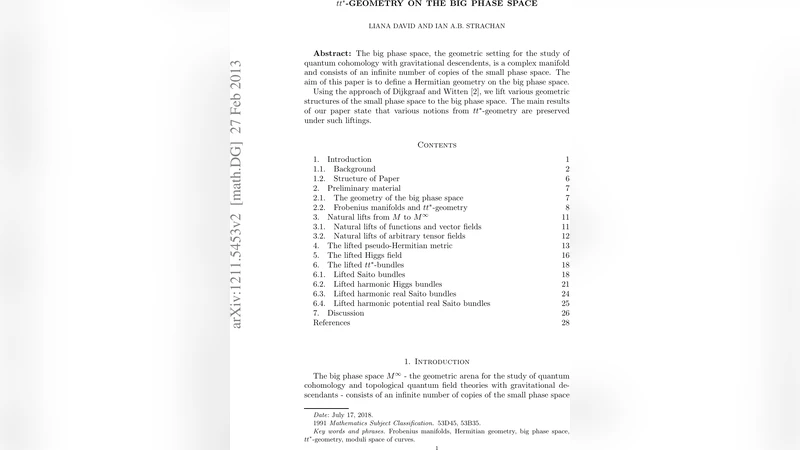
The big phase space, the geometric setting for the study of quantum cohomology with gravitational descendents, is a complex manifold and consists of an infinite number of copies of the small phase space. The aim of this paper is to define a Hermitian geometry on the big phase space. Using the approach of Dijkgraaf and Witten, we lift various geometric structures of the small phase space to the big phase space. The main results of our paper state that various notions from tt*-geometry are preserved under such liftings.
💡 Research Summary
The paper “tt*-Geometry on the big phase space” addresses the problem of extending the rich tt* (topological‑anti‑topological fusion) geometry, originally formulated on the finite‑dimensional small phase space of quantum cohomology, to the infinite‑dimensional big phase space that incorporates all gravitational descendants. The authors begin by recalling the essential ingredients of tt* geometry: a Hermitian metric, a flat Chern connection, a Higgs‑type multiplication operator, and a real structure satisfying a set of non‑linear differential equations (the tt* equations). These structures encode the interaction between the holomorphic and anti‑holomorphic sectors of two‑dimensional N=2 supersymmetric field theories and have deep connections with integrable systems, harmonic bundles, and variations of Hodge structure.
The central difficulty in moving to the big phase space lies in its infinite‑dimensional nature: the coordinates are labeled not only by cohomology classes but also by a non‑negative integer indicating the power of the ψ‑class (the gravitational descendant). Consequently, the naive lift of the small‑space metric or connection would be ill‑defined, and the tt* equations could fail to hold. To overcome this, the authors adopt the Dijkgraaf‑Witten “lifting” paradigm. They construct a countable family of copies of the small phase space, each copy corresponding to a fixed descendant level, and then define the big‑space objects as direct sums (or orthogonal products) of the small‑space counterparts.
Specifically, the Hermitian metric g on the small space is lifted to a block‑diagonal metric G on the big space, where each block is a copy of g and the off‑diagonal blocks vanish. This construction preserves positivity and Kählerness because each block remains Kähler and the direct sum of Kähler manifolds is again Kähler. The real structure κ, which implements complex conjugation combined with an involution, is lifted component‑wise, yielding a real structure κ̂ that commutes with the lifted connection. The Chern connection ∇ of the small space is lifted to a connection ∇̂ that acts independently on each descendant level; the authors prove that ∇̂ remains flat and compatible with both G and κ̂.
The Higgs field Φ, encoding the quantum product, is lifted by extending the three‑point Gromov‑Witten invariants to include descendant insertions. The lifted Higgs field Φ̂ retains the same algebraic relations as Φ, and the authors verify that the tt* curvature equations (∂̄Φ = 0,
Comments & Academic Discussion
Loading comments...
Leave a Comment