Simple Elliptic Singularities: a note on their G-function
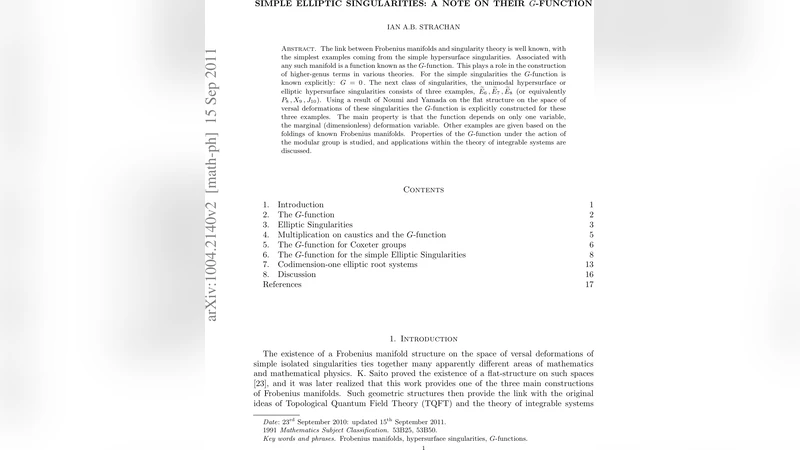
The link between Frobenius manifolds and singularity theory is well known, with the simplest examples coming from the simple hypersurface singularities. Associated with any such manifold is a function known as the $G$-function. This plays a role in the construction of higher-genus terms in various theories. For the simple singularities the G-function is known explicitly: G=0. The next class of singularities, the unimodal hypersurface or elliptic hypersurface singularities consists of three examples, \widetilde{E}_6,\widetilde{E}_7,\widetilde{E}_8 (or equivalently P_8, X_9,J_10). Using a result of Noumi and Yamada on the flat structure on the space of versal deformations of these singularities the $G$-function is explicitly constructed for these three examples. The main property is that the function depends on only one variable, the marginal (dimensionless) deformation variable. Other examples are given based on the foldings of known Frobenius manifolds. Properties of the $G$-function under the action of the modular group is studied, and applications within the theory of integrable systems are discussed.
💡 Research Summary
The paper investigates the G‑function associated with Frobenius manifolds that arise from the three unimodal (elliptic) hypersurface singularities (\widetilde{E}_6) (also denoted (P_8)), (\widetilde{E}_7) ((X_9)), and (\widetilde{E}8) ((J{10})). For simple (ADE) singularities the G‑function is known to vanish, which reflects the triviality of the genus‑one correction in the corresponding topological field theories. The elliptic singularities, however, possess a one‑dimensional marginal deformation parameter (t) (a dimensionless modulus) that survives after scaling is removed.
Using the flat structure on the versal deformation space constructed by Noumi and Yamada, the authors write down explicit flat coordinates ({t, u_i}) where the non‑marginal coordinates (u_i) are irrelevant for the genus‑one data. In these coordinates the multiplication tensor (c_{\alpha\beta\gamma}) and the metric (\eta_{\alpha\beta}) depend only on the marginal variable (t). Substituting these expressions into the standard formula for the G‑function, \
Comments & Academic Discussion
Loading comments...
Leave a Comment