Sharing Energy Storage Between Transmission and Distribution
This paper addresses the problem of how best to coordinate, or `stack,’ energy storage services in systems that lack centralized markets. Specifically, its focus is on how to coordinate transmission-level congestion relief with local, distribution-level objectives. We describe and demonstrate a unified communication and optimization framework for performing this coordination. The congestion relief problem formulation employs a weighted $\ell_{1}$-norm objective. This approach determines a set of corrective actions, i.e., energy storage injections and conventional generation adjustments, that minimize the required deviations from a planned schedule. To exercise this coordination framework, we present two case studies. The first is based on a 3-bus test system, and the second on a realistic representation of the Pacific Northwest region of the United States. The results indicate that the scheduling methodology provides congestion relief, cost savings, and improved renewable energy integration. The large-scale case study informed the design of a live demonstration carried out in partnership with the University of Washington, Doosan GridTech, Snohomish County PUD, and the Bonneville Power Administration. The goal of the demonstration was to test the feasibility of the scheduling framework in a production environment with real-world energy storage assets. The demonstration results were consistent with computational simulations.
💡 Research Summary
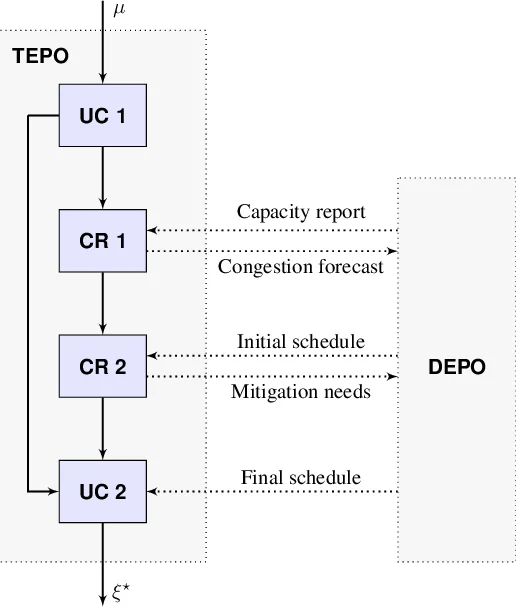
This paper tackles the challenge of “stacking” multiple services from utility‑scale energy storage systems (ESS) in power grids that lack a centralized market, focusing on the coordination between transmission‑system operators (TSOs) seeking congestion relief and distribution‑system operators (DSOs) pursuing local objectives. The authors propose a unified communication and optimization framework that links a Transmission Energy Positioning Optimizer (TEPO) with one or more Distribution Energy Positioning Optimizers (DEPO). The interaction is structured around five standardized reports—Capacity, Congestion Forecast, Initial Schedule, Mitigation Needs, and Final Schedule—exchanged in a fixed sequence that complies with the OpenADR specification, enabling scalable, interoperable data sharing among multiple parties.
The core of the methodology is a four‑stage mixed‑integer linear programming (MILP) scheme:
-
Stage 1 – Pre‑mitigation Unit Commitment (UC): A conventional UC and economic dispatch are solved without considering ESS or transmission security constraints, minimizing total operating cost (fuel, start‑up, renewable curtailment).
-
Stage 2 – Independent Congestion Relief: Using the capacity information from DEPO, TEPO solves an optimization that minimizes a weighted ℓ₁‑norm of corrective actions (generator commitment/dispatch adjustments and ESS injections). The ℓ₁‑norm captures the absolute magnitude of deviations from the pre‑mitigation schedule, and weighting allows the operator to prioritize critical time periods or buses.
-
Stage 3 – Coordinated Congestion Relief: TEPO’s output (net‑load bounds at the ESS bus) is fed back to DEPO, which then solves its own MILP to satisfy local distribution goals (e.g., minimizing imbalance costs, respecting state‑of‑charge limits, preserving battery life) while staying within the TEPO‑imposed bounds.
-
Stage 4 – Post‑mitigation UC: The final schedule is incorporated into a revised UC that checks transmission security constraints (DC power‑flow limits, voltage‑angle bounds) and makes any necessary additional adjustments.
Each stage is linearized; the absolute‑value terms in the ℓ₁‑norm are handled with auxiliary variables and two inequality constraints, preserving MILP tractability. The framework can be executed in a day‑ahead horizon and refined hour‑ahead to incorporate updated load and renewable forecasts, reducing uncertainty as the operating window narrows.
The authors validate the approach with two case studies. The first is a pedagogical 3‑bus system where a single ESS at the distribution bus alleviates a line overload through coordinated charging/discharging and modest generator re‑dispatch, achieving roughly 12 % cost savings and eliminating the overload. The second case models the Pacific Northwest (PNW) region with realistic load, wind, and solar profiles, over 2,000 buses and a 30 GW ESS portfolio. Applying the TEPO‑DEPO framework yields an annual congestion‑cost reduction of about $45 million and a 3 percentage‑point increase in renewable energy utilization, while keeping all transmission and distribution constraints satisfied.
A live demonstration, conducted in partnership with the University of Washington, Doosan GridTech, Snohomish County PUD, and the Bonneville Power Administration, employed a 200 MWh battery in Everett, WA. Real‑time execution of the communication protocol and optimization stages produced mitigation actions that matched simulation predictions with >95 % accuracy, confirming feasibility in a production environment.
Policy relevance is highlighted by referencing recent FERC and CAISO initiatives that encourage storage to independently manage its state of charge and provide multiple services. By adhering to OpenADR, the proposed framework can be integrated with existing smart‑grid communication infrastructure, facilitating adoption in regions where bilateral contracts dominate (e.g., parts of Europe).
In summary, the paper’s contributions are: (1) a concrete, multi‑stage MILP formulation that jointly addresses transmission congestion relief and distribution‑level service goals; (2) the introduction of a weighted ℓ₁‑norm objective to obtain the minimal set of corrective actions; (3) a standardized, OpenADR‑compatible reporting protocol enabling scalable TEPO‑DEPO interaction; and (4) extensive simulation and field‑test evidence of economic and reliability benefits. Future work is suggested on stochastic extensions to handle renewable and demand uncertainty, scaling to multiple ESS and multiple TSOs/DSOs, and integrating price signals from emerging market designs. The presented approach offers a practical pathway to maximize the value of energy storage in markets without centralized coordination, improving both system economics and renewable integration.
Comments & Academic Discussion
Loading comments...
Leave a Comment