NGC 1624-2: A slowly rotating, X-ray luminous Of?cp star with an extraordinarily strong magnetic field
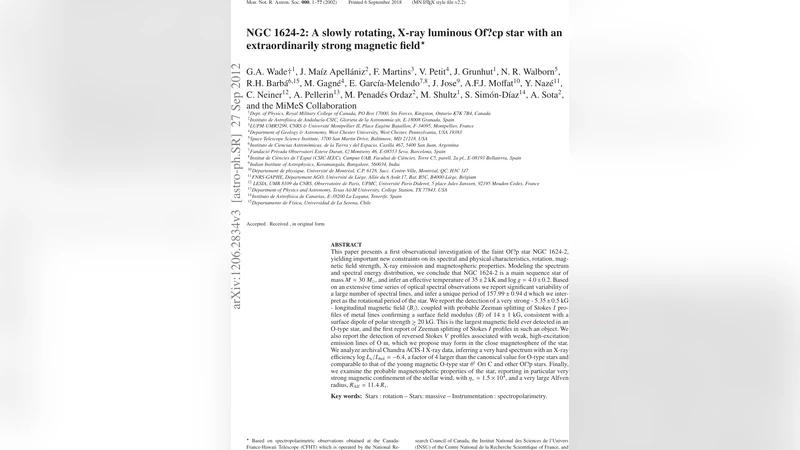
This paper presents a first observational investigation of the faint Of?cp star NGC 1624-2, yielding important new constraints on its spectral and physical characteristics, rotation, magnetic field strength, X-ray emission and magnetospheric properties. Modeling the spectrum and spectral energy distribution, we conclude that NGC 1624-2 is a main sequence star of mass M {\simeq} 30 M{\odot}, and infer an effective temperature of 35 {\pm} 2 kK and log g = 4.0 {\pm} 0.2. Based on an extensive time series of optical spectral observations we report significant variability of a large number of spectral lines, and infer a unique period of 157.99 {\pm} 0.94 d which we interpret as the rotational period of the star. We report the detection of a very strong - 5.35 {\pm} 0.5 kG - longitudinal magnetic field
💡 Research Summary
This paper presents the first comprehensive observational study of the faint Of?p star NGC 1624‑2, delivering new constraints on its fundamental stellar parameters, rotation, magnetic field, X‑ray emission, and magnetospheric structure. Using non‑LTE CMFGEN modelling of high‑resolution optical/infrared spectra together with multi‑band photometry, the authors determine that NGC 1624‑2 is a main‑sequence O‑type star with a mass of roughly 30 M⊙, an effective temperature of 35 ± 2 kK, surface gravity log g = 4.0 ± 0.2, a radius of about 10 R⊙, a mass‑loss rate of ~10⁻⁶·⁵ M⊙ yr⁻¹, and a terminal wind speed near 2600 km s⁻¹.
A dense time‑series of 30 high‑resolution spectra obtained between 2008 and 2015 reveals periodic variability in numerous diagnostic lines (Hα, He II λ4686, C III λ4650, Si IV, etc.). Lomb‑Scargle analysis yields a single, highly significant period of 157.99 ± 0.94 days, which the authors interpret as the stellar rotation period. This makes NGC 1624‑2 one of the slowest rotating O‑type stars known, with v sin i ≈ 5 km s⁻¹.
Magnetic diagnostics were performed with ESPaDOnS and Narval spectropolarimetry. Least‑Squares Deconvolution of the Stokes V spectra gives a longitudinal field
Archival Chandra ACIS‑I data were re‑analysed. A two‑temperature plasma model (kT₁ ≈ 0.8 keV, kT₂ ≈ 3 keV) provides the best fit, yielding an X‑ray luminosity L_X ≈ 10³²·⁸ erg s⁻¹ and an X‑ray efficiency log (L_X/L_bol) = ‑6.4. This efficiency is about four times higher than the canonical value for non‑magnetic O stars and comparable to the magnetic O‑type star θ¹ Ori C and other Of?p objects. The hard spectrum and elevated luminosity are interpreted as the result of magnetically confined wind shocks within a large Alfvén radius.
Using the derived wind parameters and magnetic field strength, the magnetic confinement parameter is calculated as η_* ≈ 1.5 × 10⁴, indicating extremely strong wind confinement. The Alfvén radius is R_Alf ≈ 11.4 R_*, implying that the wind is forced to follow closed magnetic loops out to more than ten stellar radii. Within this region, wind streams from opposite hemispheres collide near the magnetic equator, producing strong shocks that generate the observed hard X‑rays. The authors also detect reversed Stokes V signatures in weak, high‑excitation O III emission lines, suggesting that these lines form in the close magnetosphere where the magnetic field dominates the dynamics.
The paper concludes that NGC 1624‑2 represents a unique laboratory: an O‑type star with an ultra‑strong, dipolar magnetic field, an exceptionally long rotation period, and a highly efficient X‑ray emitting, magnetically confined wind. These characteristics make it an ideal test case for theories of magnetic braking, wind confinement, and magnetospheric X‑ray production in massive stars. The authors recommend future high‑resolution spectropolarimetric monitoring and deeper X‑ray observations to map the magnetic topology, probe the dynamics of the confined wind, and refine models of magnetically driven high‑energy emission in massive stars.
Comments & Academic Discussion
Loading comments...
Leave a Comment