The Chandra Carina Complex Project: Deciphering the Enigma of Carinas Diffuse X-ray Emission
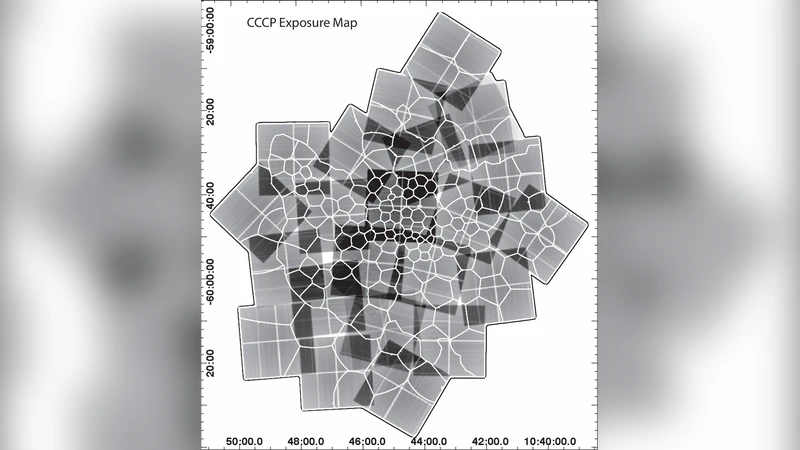
We present a 1.42 square degree mosaic of diffuse X-ray emission in the Great Nebula in Carina from the Chandra X-ray Observatory Advanced CCD Imaging Spectrometer camera. After removing >14,000 X-ray point sources from the field, we smooth the remaining unresolved emission, tessellate it into segments of similar apparent surface brightness, and perform X-ray spectral fitting on those tessellates to infer the intrinsic properties of the X-ray-emitting plasma. By modeling faint resolved point sources, we estimate the contribution to the extended X-ray emission from unresolved point sources and show that the vast majority of Carina’s unresolved X-ray emission is truly diffuse. Line-like correlated residuals in the X-ray spectral fits suggest that substantial X-ray emission is generated by charge exchange at the interfaces between Carina’s hot, rarefied plasma and its many cold neutral pillars, ridges, and clumps.
💡 Research Summary
The Chandra Carina Complex Project (CCCP) presents a comprehensive study of the diffuse X‑ray emission in the Great Nebula of Carina, covering a 1.42 square‑degree field with the ACIS‑I instrument. After detecting and excising more than 14,000 point sources, the authors applied adaptive‑kernel smoothing to the residual emission and then segmented the image using weighted Voronoi tessellation (WVT) to create regions of roughly uniform apparent surface brightness. Two signal‑to‑noise thresholds were employed (S/N ≈ 70 for high‑brightness “inside” regions and S/N ≈ 40 for lower‑brightness “outside” regions), yielding 161 tessellates that together contain roughly 6,000 counts each on average.
Spectral extraction for each tessellate was performed with the ACIS Extract (AE) pipeline, which automatically generates appropriate ARFs and RMFs for the overlapping Chandra observations. Background was modeled using ACIS stowed data combined with local background estimates. The authors fitted the spectra with multi‑component models that include interstellar absorption and at least two thermal plasma components (APEC/VAPEC) with temperatures around 0.2 keV and 0.5–0.6 keV. Metal abundances, particularly of Fe, Si, and S, are modestly enhanced relative to solar, consistent with earlier XMM‑Newton and Suzaku findings.
A key result is that the vast majority (>80 %) of the remaining X‑ray flux is genuinely diffuse; contributions from unresolved point sources, estimated via the luminosity function of detected sources and sensitivity limits, account for less than 10 % of the total. This confirms that the diffuse emission is not an artifact of incompletely removed stellar sources.
Spectral residuals reveal systematic line‑like features in the 0.7–0.9 keV band that cannot be reproduced by pure thermal models. The authors interpret these as signatures of charge‑exchange (CX) processes occurring at interfaces where the hot, low‑density plasma contacts cold neutral structures such as pillars, ridges, and clumps. The spatial distribution of these residuals aligns with visually identified “hooks” and linear filaments, supporting the CX hypothesis.
Morphologically, the diffuse emission is concentrated in the lower (southern) lobe of the Carina superbubble, filling the region between the massive clusters Tr 14 and Tr 16, while the upper (northern) lobe shows little emission. Sharp declines in surface brightness toward the east and south suggest that dense molecular material in the South Pillars either shadows the X‑ray plasma or physically blocks its expansion. The bright central X‑ray structures lack an associated stellar cluster, implying that the hot gas is not solely confined to wind‑blown bubbles around known clusters but pervades a more extended volume.
The paper concludes that Carina’s diffuse X‑ray emission is the product of combined feedback from numerous massive-star winds and possibly one or more past supernova explosions. The presence of two temperature components, modest metal enrichment, and CX‑induced line emission points to a dynamic environment where hot plasma continuously interacts with surrounding cold gas. These findings provide crucial observational constraints for models of stellar feedback, superbubble evolution, and the heating of the interstellar medium in massive star‑forming complexes. Future high‑resolution X‑ray spectroscopy and multi‑wavelength studies are recommended to disentangle the detailed physics of the charge‑exchange interfaces and to refine estimates of the total energy budget injected by massive stars in Carina.
Comments & Academic Discussion
Loading comments...
Leave a Comment