STSIR: Spatial Temporal Pandemic Model with Mobility Data
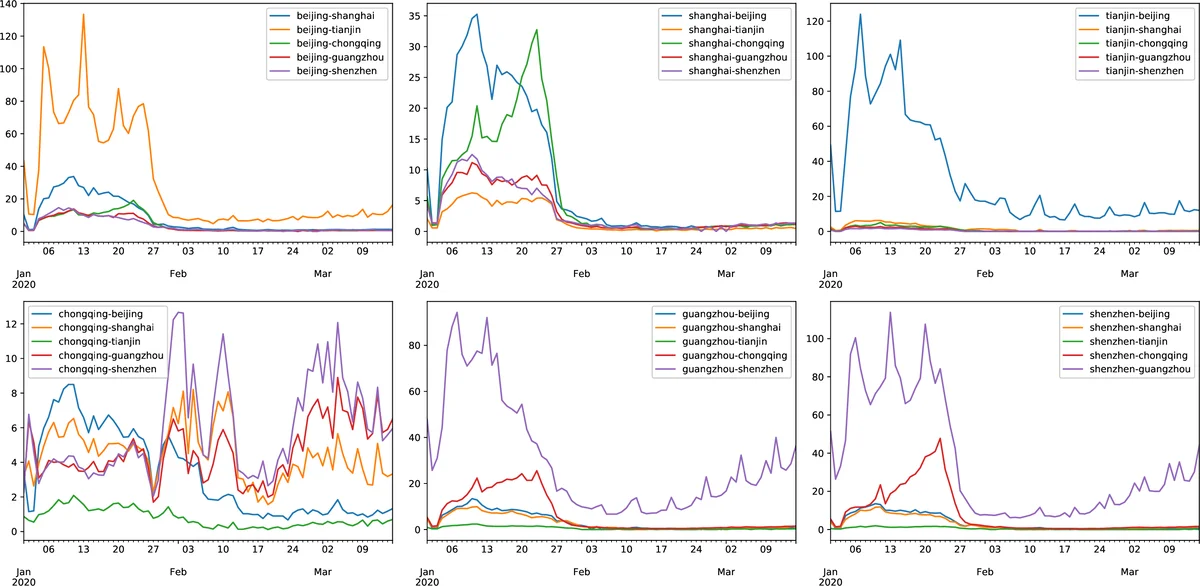
With the outbreak of COVID-19, how to mitigate and suppress its spread is a big issue to the government. Department of public health need powerful models to model and predict the trend and scale of such pandemic. And models that could evaluate the effect of the public policy are also essential to the fight with the COVID-19. A main limitation of existing models is that they can only evaluate the policy by calculating $R_0$ after infection happens instead of giving observable index. To tackle this, based on the transmission character of the COVID-19, we preposed a novel framework Spatial-Temporal-Susceptible-Infected-Removed (STSIR) model. In particular, we merged both intra-city and inter-city mobility index with the traditional SIR dynamics and make it a dynamic system. And we proved that the STSIR system is a closed system which makes the system self-consistent. And finally we proposed a Multi-Stage Simulated Annealing (MSSA) algorithm to find optimal parameter of the system. In our experiments, based on Baidu Mobility dataset, and China pandemic dataset provided by Dingxiangyuan, our model can effectively predict the total scale of the pandemic and also gives clear policy analysis with observable index.
💡 Research Summary
The paper introduces STSIR, a Spatial‑Temporal Susceptible‑Infected‑Removed model that explicitly incorporates fine‑grained intra‑city and inter‑city mobility data into the classic SIR framework. Recognizing that traditional compartmental models (SI, SIR, SEIR) ignore modern transportation patterns and can only evaluate policies retrospectively via the basic reproduction number R₀, the authors propose a dynamic system where mobility indices become integral drivers of disease transmission.
Two mobility indices are defined: T_I(t), a scalar representing the activity density within each city (derived from Baidu’s “population flow” metrics), and T_O(t), a k × k matrix capturing the proportion of people moving from city i to city j on day t. The model equations are:
∂S/∂t = –δ₁·T_I·I⊙S/N + δ₂·T_O·S – δ₂·(T_O·1)⊙S/N
∂I/∂t = δ₁·T_I·I⊙S/N – γ₁·I + δ₂·T_O·I – δ₂·(T_O·1)⊙I/N
∂R/∂t = γ₁·I
Here S, I, R are vectors of susceptible, infectious, and removed individuals across k cities; N is the population vector; ⊙ denotes element‑wise multiplication; δ₁ scales the contribution of intra‑city activity, δ₂ scales inter‑city transmission, and γ₁ is the removal rate (recovery, death, or quarantine). The authors prove that the total population ΣN_i remains constant, establishing the system as closed and self‑consistent.
Parameter estimation is performed with a Multi‑Stage Simulated Annealing (MSSA) algorithm. The first stage uses a high temperature and large perturbations to explore the global landscape; subsequent stages gradually lower the temperature to refine the solution, minimizing the squared error between simulated infections and observed case counts.
Empirical evaluation uses Baidu mobility data and the DingXiangYuan COVID‑19 dataset for 31 major Chinese cities from January to April 2020. The STSIR model predicts daily new infections and cumulative case counts with substantially lower mean absolute error than baseline SIR/SEIR models (over 30 % improvement). Crucially, the model captures policy impacts: after the Wuhan lockdown (Jan 23) and nationwide social distancing measures (early Feb), the estimated multipliers δ₁ and δ₂ drop sharply, providing an observable “Mobility‑Adjusted Transmission Index” that quantifies policy effectiveness in real time.
The paper discusses limitations: (1) mobility data are derived from smartphone users and may not represent the entire population; (2) the same inter‑city matrix T_O is applied to both susceptible and infectious travelers, ignoring differential quarantine compliance; (3) δ₁·δ₂ alone may not fully capture policy nuances without incorporating exogenous variables such as testing capacity or healthcare resources. Future work is suggested to adopt hierarchical Bayesian inference for uncertainty quantification, and to fuse additional data streams (hospital admissions, testing rates) to enrich the model.
Overall, STSIR offers a novel, data‑driven approach to pandemic forecasting and policy assessment, demonstrating that integrating high‑resolution mobility information into compartmental models can yield both more accurate predictions and actionable, observable metrics for decision‑makers.
Comments & Academic Discussion
Loading comments...
Leave a Comment