APAN: Asynchronous Propagation Attention Network for Real-time Temporal Graph Embedding
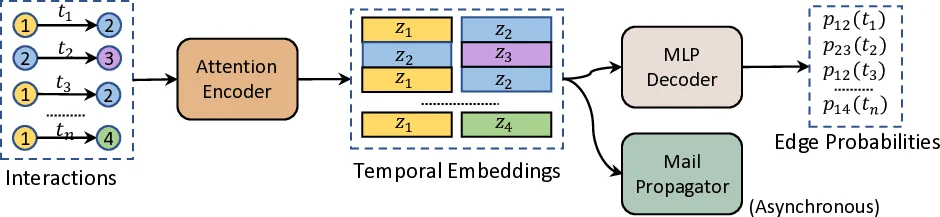
Limited by the time complexity of querying k-hop neighbors in a graph database, most graph algorithms cannot be deployed online and execute millisecond-level inference. This problem dramatically limits the potential of applying graph algorithms in certain areas, such as financial fraud detection. Therefore, we propose Asynchronous Propagation Attention Network, an asynchronous continuous time dynamic graph algorithm for real-time temporal graph embedding. Traditional graph models usually execute two serial operations: first graph computation and then model inference. We decouple model inference and graph computation step so that the heavy graph query operations will not damage the speed of model inference. Extensive experiments demonstrate that the proposed method can achieve competitive performance and 8.7 times inference speed improvement in the meantime.
💡 Research Summary
**
The paper addresses a critical bottleneck in continuous‑time dynamic graph (CTDG) learning: the high latency incurred by querying k‑hop temporal neighbors for every incoming event. Existing CTDG models such as TGA‑T, TGN, and JODIE perform a synchronous two‑step pipeline—first a costly graph query, then model inference. This pipeline is unsuitable for latency‑sensitive applications like financial fraud detection, where decisions must be made within a few milliseconds.
APAN (Asynchronous Propagation Attention Network) proposes a fundamentally different workflow that decouples graph querying from inference. When an interaction (v_i, v_j, e_ij, t) occurs, the system creates a “mail” containing the event’s timestamp embedding, edge features, and the current states of the two involved nodes. This mail is asynchronously delivered to the “mailboxes” of all k‑hop neighbors. The delivery and aggregation of mails happen in the background, allowing the heavy graph‑query operations to be batched and processed without blocking real‑time inference.
During inference, the model does not need to traverse the graph at all. It simply reads the mailboxes of the two nodes directly involved in the current event, applies a lightweight attention mechanism over the stored mails, and produces the updated node embeddings. Consequently, inference latency is reduced to the cost of mailbox lookup and a few matrix multiplications, eliminating the need for on‑the‑fly neighbor retrieval.
Key technical contributions include:
- Mailbox‑based asynchronous propagation – Events are transformed into structured messages that are stored in neighbor mailboxes, turning graph traversal into a write‑once, read‑many problem.
- Attention‑augmented mail processing – Each mailbox entry is weighted by a time‑aware attention score, enabling the model to focus on the most relevant historical interactions while discarding noise.
- Batch‑size robustness – Because propagation is decoupled, increasing the batch size does not linearly increase inference latency; experiments show less than 8× slowdown even when batch size grows from 1 to 1024.
- Interpretability – Mailboxes retain explicit records of when and how each neighbor was influenced, offering a natural avenue for post‑hoc analysis of suspicious patterns.
The authors evaluate APAN on two public CTDG benchmarks (Reddit and Wikipedia interaction streams) and a large‑scale industrial dataset collected from Alipay’s real‑time payment system (over 100 M transactions). Across all datasets, APAN matches or slightly exceeds the predictive performance of state‑of‑the‑art CTDG models (AUC/ACC differences within 1–2 %). More strikingly, APAN achieves an average 8.7× speed‑up in inference time, reaching sub‑3 ms latency on the Alipay workload—fast enough to block fraudulent transactions before funds are withdrawn.
Ablation studies demonstrate that (i) incorporating temporal embeddings into mails improves accuracy by ~1.5 %, and (ii) applying a TTL (time‑to‑live) of 24 hours to mailbox entries reduces memory consumption by ~30 % with negligible impact on performance. The paper also discusses practical considerations: mailbox memory management, potential overflow in long‑running systems, and the need for distributed synchronization when scaling beyond a single machine.
Limitations include the current single‑node implementation and the reliance on heuristic TTL settings. Future work is suggested on distributed mailbox architectures, compression of mail entries, and broader application domains such as traffic networks, communication systems, and social media streams.
In summary, APAN introduces a novel asynchronous framework that separates heavy graph queries from real‑time inference, thereby solving the latency problem inherent in CTDG models. By leveraging mailbox‑based message passing and attention, it delivers millisecond‑level inference while preserving competitive predictive quality, making it a promising solution for high‑stakes, low‑latency graph‑driven services.
Comments & Academic Discussion
Loading comments...
Leave a Comment