Unspecified distribution in single disorder problem
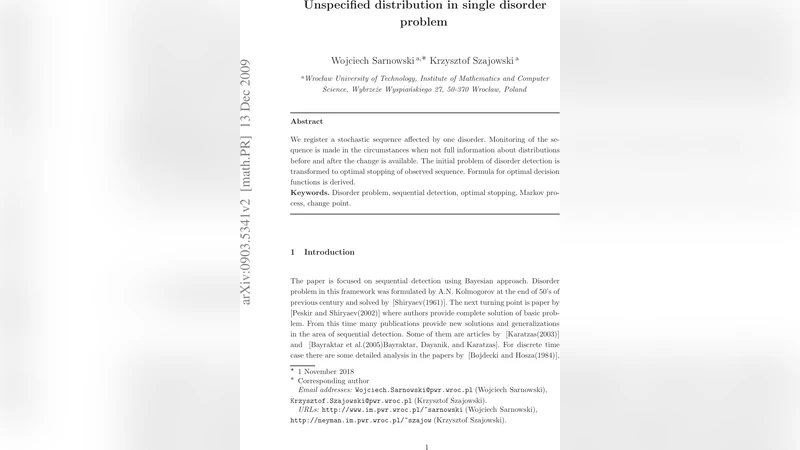
We register a stochastic sequence affected by one disorder. Monitoring of the sequence is made in the circumstances when not full information about distributions before and after the change is available. The initial problem of disorder detection is transformed to optimal stopping of observed sequence. Formula for optimal decision functions is derived.
💡 Research Summary
The paper addresses the classic quickest change‑point (disorder) detection problem under the realistic condition that the probability distributions governing the observations before and after the change are not fully known. A single disorder is assumed to occur at an unknown time θ in a stochastic sequence {Xₙ}. Prior to θ the observations follow a family of distributions {P₀^α : α ∈ 𝔄}, and after θ they follow another family {P₁^β : β ∈ ℬ}. Neither the specific pre‑change parameter α nor the post‑change parameter β is known; only the families and possibly non‑informative priors π₀ and π₁ on the parameters are available.
The authors formulate the detection task as a Bayesian optimal stopping problem. They define a risk function that penalizes detection delay (cost c₁ per unit time after the change) and false alarms (cost c₂ if stopping occurs before the change). By integrating the likelihoods over the unknown parameters with respect to the priors, they obtain a posterior probability process Πₙ = P(θ ≤ n | 𝔽ₙ) that can be updated recursively. The key statistic is a “mixed likelihood ratio”
Λₙ =
Comments & Academic Discussion
Loading comments...
Leave a Comment