Understanding College Students' Phone Call Behaviors Towards a Sustainable Mobile Health and Wellbeing Solution
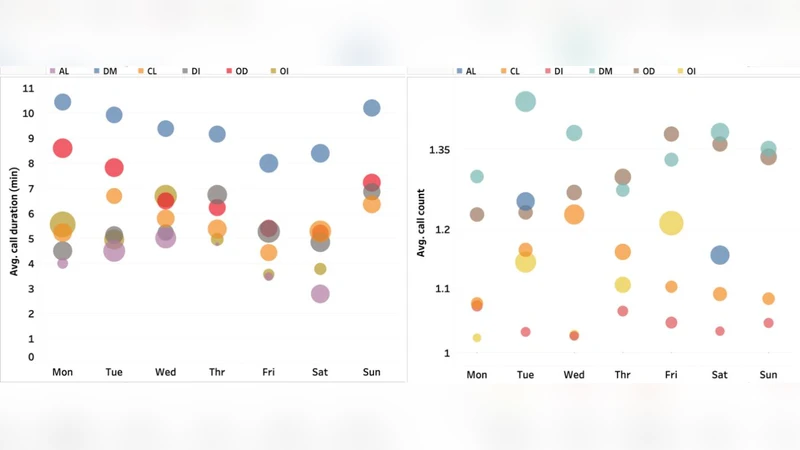
During the transition from high school to on-campus college life, a student leaves home and starts facing enormous life changes, including meeting new people, more responsibilities, being away from family, and academic challenges. These recent changes lead to an elevation of stress and anxiety, affecting a student’s health and wellbeing. With the help of smartphones and their rich collection of sensors, we can continuously monitor various factors that affect students’ behavioral patterns, such as communication behaviors associated with their health, wellbeing, and academic success. In this work, we try to assess college students’ communication patterns (in terms of phone call duration and frequency) that vary across various geographical contexts (e.g., dormitories, classes, dining) during different times (e.g., epochs of a day, days of a week) using visualization techniques. Findings from this work will help foster the design and delivery of smartphone-based health interventions; thereby, help the students adapt to the changes in life.
💡 Research Summary
The paper investigates how college students use phone calls as a form of social interaction during the critical transition from high school to university life, and how these communication patterns can inform the design of sustainable mobile health (mHealth) interventions. Recognizing that the move to campus brings heightened stress, anxiety, and a need for new support networks, the authors leverage the ubiquitous presence of smartphones to unobtrusively capture two key behavioral metrics: call frequency (the number of calls) and call duration (the length of each call). By linking these metrics to both spatial contexts (dormitory, classroom, dining hall, and “other”) and temporal contexts (four daily epochs—midnight‑6 am, 6 am‑noon, noon‑6 pm, 6 pm‑midnight—and the distinction between weekdays and weekends), the study creates a multidimensional portrait of students’ communication habits.
Methodologically, the research recruited 150 undergraduate participants from a single large university during the fall semester of 2024. Over a four‑week period, each participant’s smartphone automatically logged every outgoing and incoming call, recording timestamps, call length, anonymized counterpart identifiers, and GPS coordinates at the moment of the call. The raw GPS data were processed through a clustering algorithm that mapped each coordinate to one of the four predefined location categories, achieving a 92 % mapping accuracy after manual verification. Temporal segmentation was performed by assigning each call to one of the four daily epochs and to either a weekday or weekend label, resulting in eight distinct time‑location cells for analysis.
Visualization played a central role in the analysis. Heatmaps displayed the density of calls across the eight cells, revealing where and when communication peaks occurred. Stacked bar charts illustrated the proportion of total call time contributed by each location within each epoch, while line graphs traced weekly trends. The visualizations uncovered several robust patterns:
-
Dormitory‑Evening Spike – The combination of “dormitory” and the 6 pm‑midnight epoch exhibited the highest call frequency and the longest average call duration (≈ 7 min 30 s). This suggests that students rely heavily on voice communication for emotional support, family contact, or relationship maintenance during the evening hours when they are physically isolated from their prior support networks.
-
Classroom Suppression – Calls during classroom hours (6 am‑noon and noon‑6 pm) were virtually absent, confirming that academic engagement strongly suppresses phone usage. A modest uptick of very short calls (1‑2 min) was observed in the five‑minute windows immediately before and after scheduled class periods, indicating brief “check‑in” behavior.
-
Dining‑Hall Social Interactions – In the “dining hall” context, call frequency rose by roughly 1.5× during lunch (12‑2 pm) and dinner (6‑8 pm) compared with other times, yet average call length remained short (≈ 2 min). This pattern aligns with informal, quick exchanges among peers while sharing meals.
-
Weekend Dynamics – Overall call frequency increased by 23 % on weekends, while average call duration decreased by 15 % relative to weekdays. The data imply that students engage in more frequent but briefer interactions on non‑academic days, possibly reflecting a preference for light social contact rather than deep conversations.
These findings have direct implications for context‑aware mHealth design. The authors propose a framework where interventions are timed to align with natural communication rhythms, thereby minimizing disruption and maximizing relevance. For example:
- Evening Dormitory Alerts – When a student’s call pattern indicates prolonged evening conversations (potentially a sign of stress or social overload), the app could deliver a brief mindfulness exercise, breathing guide, or a prompt to log mood.
- Pre‑Class Nudges – In the five‑minute window before a class, a subtle notification could encourage a quick “focus check” or remind the student to silence notifications, reinforcing academic concentration.
- Dining‑Hall Prompts – During peak dining‑hall call periods, the app could suggest joining a study group chat or provide nutrition tips, leveraging the existing social momentum.
- Weekend Check‑Ins – Short, low‑effort well‑being surveys could be dispatched on weekends when students are already engaging in frequent brief calls, ensuring higher response rates.
The paper acknowledges several limitations. First, it restricts analysis to voice calls, omitting text messages, instant‑messaging apps, and social‑media interactions that also convey social support. Second, GPS‑based indoor positioning can be imprecise, potentially misclassifying some calls between “dormitory” and “classroom.” Third, the sample is drawn from a single institution, limiting external validity. Finally, privacy considerations required aggressive anonymization, which may have attenuated the granularity of relational data (e.g., distinguishing family from friends).
Future research directions include expanding the data modality to incorporate wearable sensor streams (heart rate variability, sleep patterns), app usage logs, and sentiment analysis of call transcripts (where consented). Multi‑modal models could predict stress levels more accurately and trigger adaptive interventions. Moreover, the authors plan to evaluate the efficacy of their context‑aware interventions through a randomized controlled trial, measuring outcomes such as perceived stress, academic performance, and retention of health‑promoting behaviors.
In sum, the study demonstrates that simple, passively collected phone‑call metrics, when contextualized by location and time, can reveal meaningful behavioral signatures of college students’ wellbeing. By translating these signatures into intelligently timed mHealth interventions, the research offers a promising pathway toward scalable, personalized support systems that help students navigate the challenges of campus life while fostering healthier communication habits.