Diffusion Structures for Architectural Stripe Pattern Generation
💡 Research Summary
The paper introduces “Diffusion Structures,” a novel framework for generating architecturally relevant stripe patterns that are both aesthetically appealing and structurally informed. The authors ground their approach in Michell’s theorem (1904), which states that optimal material layout aligns with the principal stress directions of a domain under load. Rather than solving a costly non‑linear optimization problem, the method proceeds through a series of linear and eigenvalue computations that can be performed in seconds and explored interactively.
First, a thin‑shell finite‑element model is built from an input 2‑D manifold (open or closed). The elastic energy combines a discrete Willmore bending term and an extrinsic St. Venant‑Kirchhoff membrane term. By linearizing this energy around the undeformed configuration and applying Dirichlet boundary conditions, a single sparse linear system H u = f_ext is solved to obtain vertex displacements. From these displacements, per‑triangle Cauchy stress tensors σ are computed.
Because σ contains signed eigenvalues (compressive vs. tensile), the authors construct a modified tensor σ′ that shares σ’s eigenvectors but replaces each eigenvalue with its absolute magnitude. To avoid numerical instability in highly anisotropic regions, tensors are classified as isotropic or anisotropic based on the ratio of their two in‑plane eigenvalues. Isotropic tensors are set to the identity, while anisotropic tensors are rescaled using a fixed anisotropy ratio r (empirically chosen between 10 and 100). This yields a diffusion tensor field D that encodes the desired directional bias.
Two anisotropic diffusion operators are then assembled: L_U penalizes diffusion along the primary eigenvector of σ′, encouraging material flow orthogonal to it; L_W penalizes diffusion along the secondary eigenvector, providing complementary support. Directly solving ∇·(D∇α)=0 would only admit trivial solutions, so the authors instead compute low‑energy diffusion modes by solving two generalized eigenproblems:
L_U U = λ M U and L_W W = λ M W,
where M is the Voronoi mass matrix and the eigenvectors are orthonormal (UᵀU = I, WᵀW = I). The resulting eigenvectors U and W form orthogonal families of scalar fields that serve as the basis for stripe patterns. By adjusting a small set of parameters (number of modes, amplitudes, anisotropy ratio r), designers can interactively blend these modes in a GPU fragment shader, instantly visualizing a binary “material‑presence” texture on the surface.
The authors compare Diffusion Structures to traditional structural optimization techniques such as Ground Structure Methods and topology optimization. Those methods typically produce a single optimal design, require careful graph initialization, involve many design variables, and are computationally expensive, limiting real‑time exploration. In contrast, Diffusion Structures generate a rich, high‑resolution design space in seconds, avoid singularities associated with integrating orthogonal frame fields, and allow continuous, real‑time manipulation.
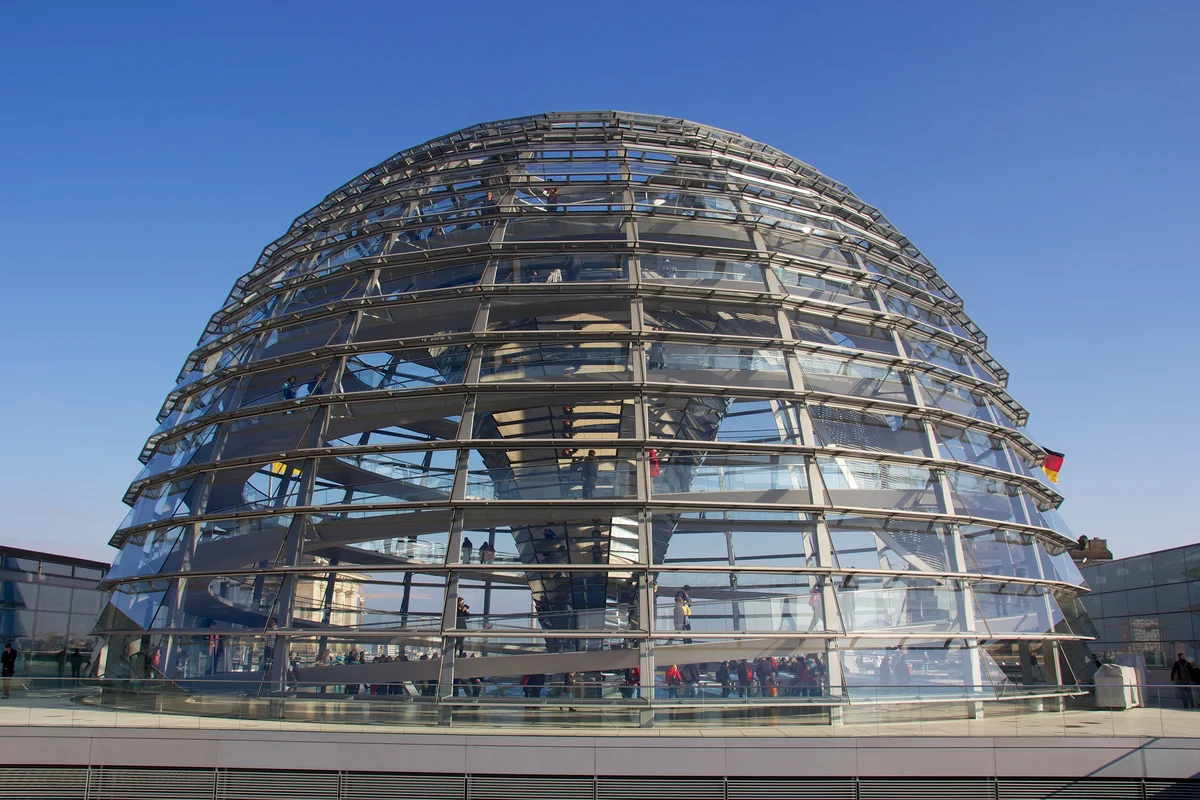
Experimental results include the Reichstag dome, a sculptural “Bob” statue, and a pavilion geometry. In each case, the computed stress field guides the stripe orientation, producing patterns that naturally follow load paths while forming visually coherent networks. The method demonstrates robustness across open and closed surfaces, supports complex topologies (e.g., tree‑like structures), and yields patterns that can serve as an initial layout for downstream engineering processes such as material reinforcement or fabrication planning.
In conclusion, Diffusion Structures provide an efficient, physics‑driven design tool that bridges the gap between structural performance and aesthetic exploration. By leveraging linear FEM, anisotropic diffusion, and sparse eigenanalysis, the approach offers a fast, interactive alternative to conventional optimization, enabling architects and engineers to prototype structurally sensible, ornamented surfaces in real time. Future work may extend the framework to multi‑load scenarios, integrate material fabrication constraints, and couple the generated patterns with downstream structural analysis for full‑scale validation.
Comments & Academic Discussion
Loading comments...
Leave a Comment