A semi-structured approach to curvilinear mesh generation around streamlined bodies
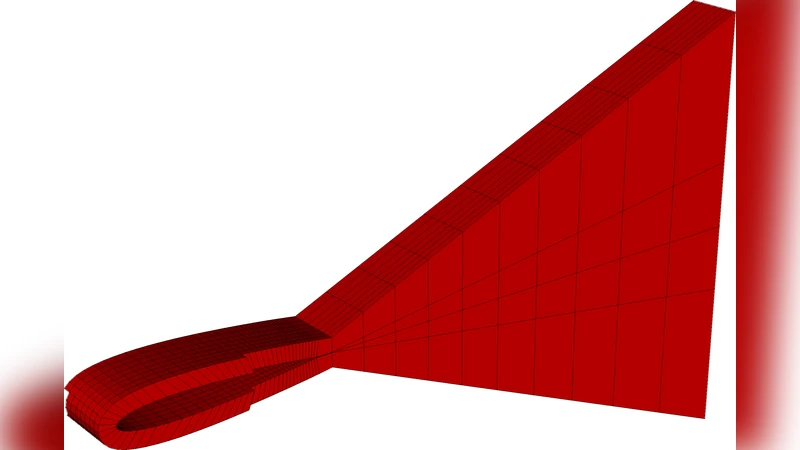
We present an approach for robust high-order mesh generation specially tailored to streamlined bodies. The method is based on a semi-sructured approach which combines the high quality of structured meshes in the near-field with the flexibility of unstructured meshes in the far-field. We utilise medial axis technology to robustly partition the near-field into blocks which can be meshed coarsely with a linear swept mesher. A high-order mesh of the near-field is then generated and split using an isoparametric approach which allows us to obtain highly stretched elements aligned with the flow field. Special treatment of the partition is performed on the wing root juntion and the trailing edge — into the wake — to obtain an H-type mesh configuration with anisotropic hexahedra ideal for the strong shear of high Reynolds number simulations. We then proceed to discretise the far-field using traditional robust tetrahedral meshing tools. This workflow is made possible by two sets of tools: CADfix, focused on CAD system, the block partitioning of the near-field and the generation of a linear mesh; and NekMesh, focused on the curving of the high-order mesh and the generation of highly-stretched boundary layer elements. We demonstrate this approach on a NACA0012 wing attached to a wall and show that a gap between the wake partition and the wall can be inserted to remove the dependency of the partitioning procedure on the local geometry.
💡 Research Summary
The paper addresses a long‑standing challenge in high‑order computational fluid dynamics (CFD): generating boundary‑conforming, high‑aspect‑ratio meshes that remain valid for high‑Reynolds‑number simulations of streamlined bodies. The authors propose a “semi‑structured” workflow that combines the geometric fidelity and anisotropy of structured meshes in the near‑field with the robustness and speed of unstructured tetrahedral meshing in the far‑field.
The workflow relies on two commercial/academic tools: CADfix for CAD handling, medial‑axis based block partitioning, and linear mesh generation; and NekMesh (part of the open‑source Nektar++ framework) for high‑order curving, node projection, and isoparametric refinement. A dedicated CFI (CADfix Interface) enables bidirectional data exchange, allowing NekMesh to query the CAD model, project high‑order nodes, and return the refined mesh for further processing.
In the near‑field, CADfix computes medial objects (derived from the medial axis of the domain) and medial halos that capture equidistant loci between surfaces. These objects guide the creation of block partitions. Three classical topologies are considered: O‑type (single prismatic block), C‑type (adds a hexahedral block at the wing‑root junction), and H‑type (adds hexahedral blocks both at the wing root and downstream of the trailing edge, forming a wake block). The authors adopt the H‑type topology because it aligns the boundary‑layer elements with the flow direction, eliminates cross‑flow‑oriented elements at the trailing edge, and enables a structured wake partition that can be progressively widened to ease transition to the unstructured far‑field mesh.
A coarse linear mesh is generated by sweeping a single‑layer prismatic shell from the CAD surface within each block. Hexahedral blocks at the root and wake are meshed with a single element in the thickness direction, providing sufficient space for later curving. The linear mesh is then imported into NekMesh. High‑order nodes are placed on edges, projected onto the CAD surfaces, and optimized using a spring‑system energy minimization that reduces geometric distortion. After edge optimization, face nodes undergo a similar process, yielding a high‑order curvilinear mesh consisting of one layer of curved prisms and hexahedra.
Because the coarse boundary‑layer mesh is still too thick for high‑Re simulations, the authors apply an isoparametric splitting technique. Starting from the mapping χ between a reference element Ωst and the physical element Ω, they insert additional points along the wall‑normal direction, subdividing each prism or hexahedron into multiple thin layers while preserving the original mapping. This produces highly stretched, flow‑aligned elements that provide fine resolution normal to the wall without imposing prohibitive CFL constraints in the streamwise direction.
The far‑field is meshed independently using robust tetrahedral generators. The wake block is interfaced with the unstructured mesh via pyramidal transition elements that match the quadrilateral faces of the structured region. A “gap” can be introduced between the wall‑boundary layer and the wake block, granting flexibility when the wall is not planar (e.g., a fuselage) and preventing the wake block from intersecting complex geometry.
The methodology is demonstrated on a NACA 0012 wing attached to a flat wall. Results show that the H‑type configuration yields an H‑type wake block with anisotropic hexahedral elements that are aligned with the flow, improving element quality compared with O‑type partitions that suffer from skewed elements at the wing root and cross‑flow‑oriented elements at the trailing edge. The isoparametric refinement successfully creates high‑aspect‑ratio layers suitable for wall‑bounded turbulence simulations, while the unstructured far‑field mesh remains robust and easy to generate.
In conclusion, the semi‑structured approach delivers (1) automated, geometry‑driven block partitioning via medial‑axis technology, (2) a reliable high‑order curving pipeline that mitigates self‑intersection, and (3) flow‑aligned high‑aspect‑ratio elements that enhance simulation efficiency for high‑Reynolds‑number flows. Limitations include dependence on CADfix for medial‑axis computation, potential manual intervention for highly intricate geometries, and the need for broader CAD‑system compatibility. Future work may focus on extending the partitioning algorithms to multi‑body configurations, integrating alternative CAD kernels, and developing quantitative mesh‑quality metrics for high‑order anisotropic meshes.
Comments & Academic Discussion
Loading comments...
Leave a Comment