Minimal number of discrete velocities for a flow description and internal structural evolution of a shock wave
A fluid flow is described by fictitious particles hopping on homogeneously distributed nodes with a given finite set of discrete velocities. We emphasize that the existence of a fictitious particle having a discrete velocity among the set in a node is given by a probability. We describe a compressible thermal flow of the level of accuracy of the Navier-Stokes equation by 25 or 33 discrete velocities for two-dimensional space and perform simulations for investigating internal structural evolution of a shock wave.
💡 Research Summary
The paper presents a lattice‑Boltzmann‑type framework in which fictitious particles hop on a uniformly spaced node lattice using a finite set of discrete velocities. The central question addressed is how few discrete velocities are required to reproduce compressible thermal flows with the accuracy of the Navier‑Stokes equations while retaining numerical stability. Building on earlier work that identified a 37‑velocity set as the minimal configuration for two‑dimensional square lattices, the authors propose two reduced models: a 33‑velocity set and a 25‑velocity set.
The 33‑velocity model is constructed by selecting a sparsely distributed set of velocity vectors: (0,0), c(1,0), c(2,0), c(3,0), c(1,1), c(2,2), c(4,4), c(2,1) together with all symmetry equivalents across the x‑axis, y‑axis, and the line y = x. The scaling factor c≈0.818381 and the associated weights w_i are obtained by solving a system of 33 moment equations that enforce isotropy up to fourth order. These weights (e.g., w₁≈0.161987, w₅≈0.0338840) guarantee that the discrete equilibrium distribution f_i^eq, derived via a fourth‑order Hermite expansion of the Maxwell‑Boltzmann distribution, reproduces the required density, momentum, pressure, and temperature moments.
The 25‑velocity model is generated by taking the tensor product of a previously known 5‑velocity scheme, yielding a configuration that is computationally cheaper but less robust at high Mach numbers. Both models employ the standard lattice‑Boltzmann collision operator f_i(x+v_iΔt,t+Δt) = (1‑ω)f_i(x,t) + ω f_i^eq(x,t), with ω controlling the kinematic viscosity.
To validate the models, the authors conduct shock‑tube simulations on a 1000 × 8 node domain. The left half of the tube is initialized with density and pressure four times larger than the right half, while temperature is uniform. Symmetric boundary conditions are applied on the top and bottom, and fixed inflow/outflow conditions on the left and right. With ω = 1, the simulations produce density profiles that match closely between the 33‑ and 37‑velocity models and agree with the analytical solution of the Riemann problem, apart from the expected smoothing due to the imposed viscosity.
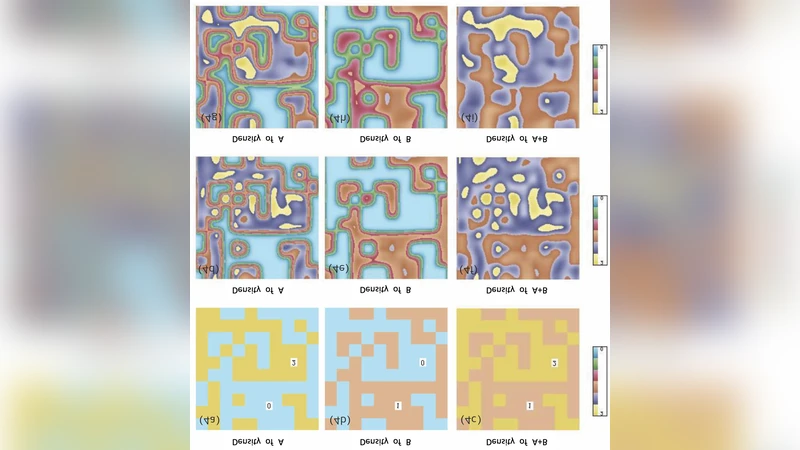
Further tests involve a two‑component flow where the domain is divided into ten vertical strips and the two components are alternately placed. The evolution shows clear internal shock structure and mixing, demonstrating that the particle‑tagging approach naturally extends to multi‑species problems. Finally, a complex‑geometry case on a 200 × 200 lattice illustrates that the same methodology can handle arbitrary initial density fields without loss of accuracy or stability.
The study concludes that a 33‑velocity discrete set is sufficient to achieve Navier‑Stokes‑level accuracy for compressible thermal flows in two dimensions, offering a reduction in computational cost relative to the traditional 37‑velocity lattice while preserving stability across a broad range of Mach numbers. The 25‑velocity set provides a cheaper alternative for low‑Mach applications but suffers from reduced robustness. The authors suggest that the approach can be extended to three dimensions, non‑isotropic flows, and higher‑order Hermite expansions, opening avenues for efficient simulation of multi‑component and geometrically complex fluid systems.
Comments & Academic Discussion
Loading comments...
Leave a Comment