Nonlinear Quantum Neuron: A Fundamental Building Block for Quantum Neural Networks
💡 Research Summary
**
The paper addresses a fundamental obstacle in quantum neural networks (QNNs): how to incorporate the nonlinear activation functions that give classical neural networks (ANNs) their expressive power while staying within the linear, unitary framework of quantum computing. The authors first review existing approaches—threshold functions, repeat‑until‑success (RUS) circuits, phase‑estimation based designs—and point out their limitations in terms of universality, resource consumption, or practical implementability.
To overcome these issues, the authors propose a two‑part strategy. First, they construct quantum oracles that map Boolean inputs to Boolean outputs, effectively encoding a discrete approximation of any desired nonlinear function. Two concrete circuit families are presented: (i) a direct mapping using controlled‑X/I gates (Fig. 1a) and (ii) a minimal‑phase oracle combined with an inverse quantum Fourier transform (Fig. 1b). Both families allow a Boolean function f : {0,1}ⁿ → {0,1}ᵐ to be realized as a unitary transformation that writes the binary representation of f(x) into an auxiliary register.
Building on these oracles, the authors introduce a generalizable framework for a quantum neuron (Fig. 3). The framework consists of three stages:
-
Encoding – Classical data vectors x are transformed into quantum states. Two encoding schemes are explored:
- Basis encoding, where each component of x is represented by a separate qubit string of fixed precision p, requiring O(p·n) qubits.
- Amplitude encoding, where the entire vector is stored in the amplitudes of a log n‑qubit register, leveraging quantum random‑access memory (qRAM).
-
Evolution – The inner product x·w with a weight vector w is computed quantum mechanically.
- In the basis‑encoding case, a series of controlled‑R_z gates imprint a phase proportional to (x·w)·2ᵐ, followed by an inverse QFT that extracts an m‑bit binary estimate v of the inner product.
- In the amplitude‑encoding case, a swap‑test prepares a superposition |φ⟩ that encodes the overlap ⟨w|x⟩. Quantum phase estimation (QPE) is then applied to estimate γ = arccos(⟨w|x⟩)/π, which is discretized into an m‑bit string u.
-
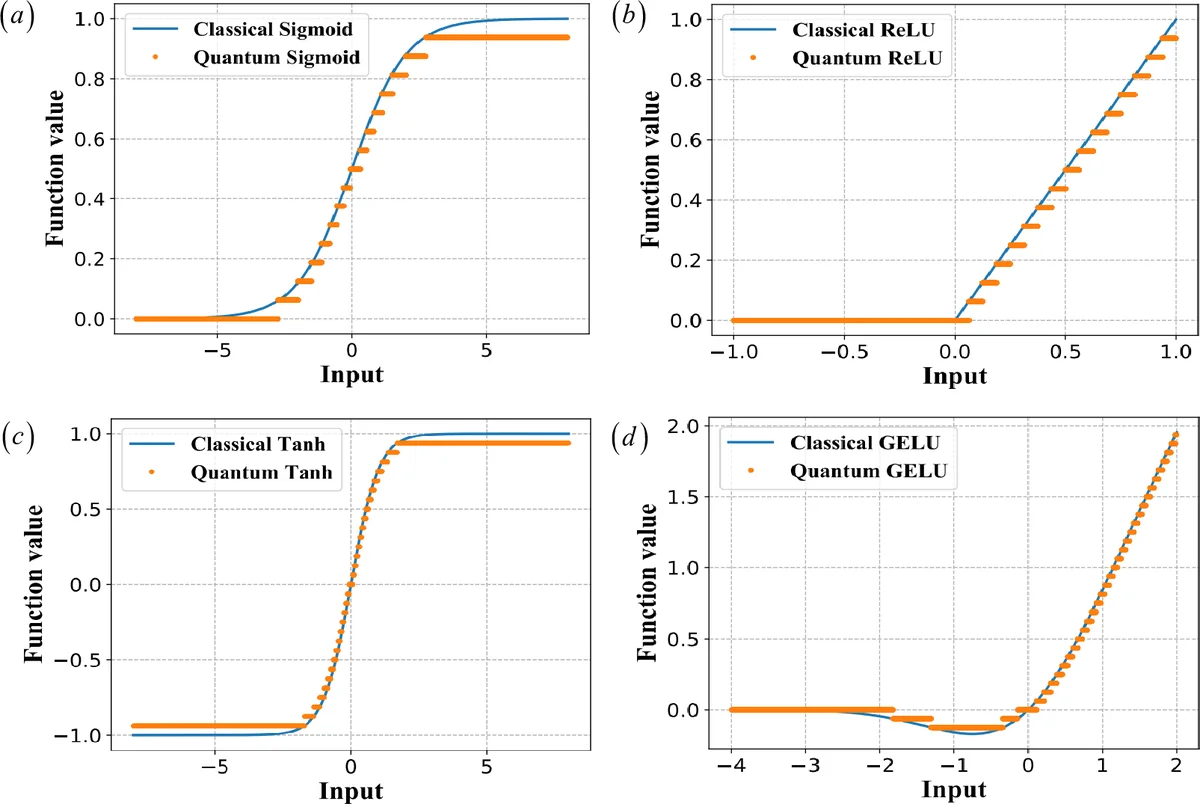
Measurement – The binary string (v or u) is fed into a Boolean oracle U_g that implements a chosen nonlinear activation function g (e.g., sigmoid, ReLU). The measurement of the first register yields the neuron’s output. Because measurement collapses the quantum state, it introduces the required nonlinearity.
Two concrete neuron designs are detailed:
-
Basis‑encoding neuron – Uses O(p·n) qubits and O(p·n·m) gates. The controlled‑R_z gates are parameterized by the weight components, and the inverse QFT converts the phase to a binary integer. A Boolean oracle then maps this integer to the activation value. This design is straightforward and scalable, though it requires a number of qubits linear in the input dimension.
-
Amplitude‑encoding neuron – Requires only O(log n + m) qubits, exploiting the exponential compression of amplitude encoding. The inner product is obtained via swap‑test and QPE, which are more resource‑intensive subroutines (qRAM, controlled‑G gates). Nevertheless, the qubit count is dramatically reduced, making this approach attractive for high‑dimensional data if the necessary hardware primitives become available.
The authors analyze resource costs, showing that both designs achieve polynomial scaling with input size, satisfying the “resource‑saving” criterion highlighted in prior work (Ref.
Comments & Academic Discussion
Loading comments...
Leave a Comment