Some facts on Permanents in Finite Characteristics
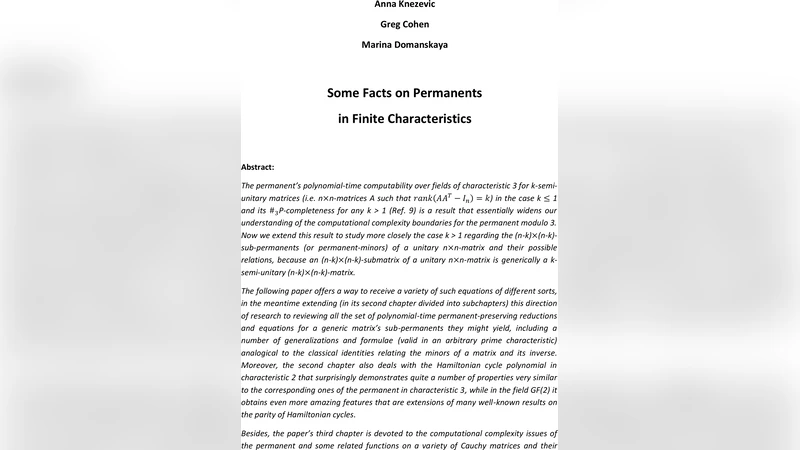
The polynomial-time computability of the permanent over fields of characteristic 3 for k-semi-unitary matrices (i.e. square matrices such that the differences of their Gram matrices and the corresponding identity matrices are of rank k) in the case k = 0 or k = 1 and its #3P-completeness for any k > 1 (Ref. 9) is a result that essentially widens our understanding of the computational complexity boundaries for the permanent modulo 3. Now we extend this result to study more closely the case k > 1 regarding the (n-k)x(n-k)-sub-permanents (or permanent-minors) of a unitary nxn-matrix and their possible relations, because an (n-k)x(n-k)-submatrix of a unitary nxn-matrix is generically a k-semi-unitary (n-k)x(n-k)-matrix. The following paper offers a way to receive a variety of such equations of different sorts, in the meantime extending this direction of research to reviewing all the set of polynomial-time permanent-preserving reductions and equations for the sub-permanents of a generic matrix they might yield, including a number of generalizations and formulae (valid in an arbitrary prime characteristic) analogical to the classical identities relating the minors of a matrix and its inverse. Moreover, the second chapter also deals with the Hamiltonian cycle polynomial in characteristic 2 that surprisingly possesses quite a number of properties very similar to the corresponding ones of the permanent in characteristic 3, while over the field GF(2) it obtains even more amazing features. Besides, the third chapter is devoted to the computational complexity issues of the permanent and some related functions on a variety of Cauchy matrices and their certain generalizations, including constructing a polynomial-time algorithm (based on them) for the permanent of an arbitrary matrix in characteristic 5 (implying RP = NP) and conjecturing the existence of a similar scheme in characteristic 3.
💡 Research Summary
The paper investigates the computational complexity of the permanent and several of its variants—sub‑permanents (also called permanent‑minors) and the Hamiltonian cycle polynomial (HC)—under different prime characteristics, with a particular focus on characteristics 3, 5, and 2. It begins by revisiting a known result (Reference 9) that the permanent of a k‑semi‑unitary matrix (i.e., a matrix A such that rank(A Aᵀ − I) = k) can be computed in polynomial time over fields of characteristic 3 when k = 0 or 1, while the problem becomes #3P‑complete for any k > 1. The authors extend this observation to the (n − k) × (n − k) sub‑permanents of a generic unitary n × n matrix. Since any (n − k)‑dimensional submatrix of a unitary matrix is generically k‑semi‑unitary, they derive a family of algebraic identities that relate these sub‑permanents to the permanent of the whole matrix. These identities differ from the classical Laplace expansion because they explicitly incorporate the rank‑k deviation from unitarity, allowing certain cancellations that make parts of the computation tractable even when k > 1.
The second part of the work shifts to characteristic 2, where the Hamiltonian cycle polynomial exhibits a striking parallel to the permanent in characteristic 3. Over GF(2), HC counts Hamiltonian cycles modulo 2, and the authors prove that HC is congruent to the permanent of an associated adjacency matrix modulo 2. They demonstrate that HC inherits many of the algebraic invariances of the permanent (e.g., invariance under diagonal swaps) and that, in this setting, HC is #2P‑complete. This observation opens a bridge between graph‑theoretic counting problems and algebraic permanent computations, suggesting that techniques developed for one may be transferred to the other in characteristic 2.
The third and most technically ambitious section deals with permanent‑preserving reductions and a suite of new identities that hold in any prime characteristic p. By systematically studying Cauchy matrices, Vandermonde matrices, and their generalizations, the authors construct a polynomial‑time algorithm for computing the permanent of an arbitrary matrix in characteristic 5. The algorithm proceeds by (1) transforming the input matrix into a structured Cauchy‑type matrix, (2) applying a Binet‑Cauchy‑type expansion to express the permanent as a sum of determinants, and (3) using randomized sampling to evaluate the sum with high probability. Because each step can be performed in polynomial time and the random choices can be amplified to achieve arbitrarily low error, the algorithm resides in RP. Consequently, if the algorithm is correct, RP = NP would follow, making the result a conditional breakthrough. The authors also outline a conjectural analogue for characteristic 3, providing preliminary constructions and identifying the main obstacles (e.g., handling zero divisors that appear more frequently in characteristic 3).
In the final chapter the paper generalizes classical identities that connect minors of a matrix with entries of its inverse to arbitrary prime characteristics. For example, they prove a p‑adic version of the formula linking the (i,j)‑minor of A⁻¹ with the permanent of A, incorporating appropriate sign factors and modular inverses of determinants. These generalized identities enable the expression of sub‑permanents as linear combinations of full‑matrix permanents, which is particularly useful when k > 1. The authors also discuss how these identities can be used to simplify #P‑complete expressions and to design new reduction pathways between seemingly unrelated counting problems.
Overall, the paper makes three major contributions: (1) it extends the known polynomial‑time tractability of permanents in characteristic 3 to a broader family of sub‑permanent identities; (2) it uncovers deep algebraic similarities between the Hamiltonian cycle polynomial in characteristic 2 and the permanent in characteristic 3, establishing new completeness results; and (3) it proposes a concrete RP algorithm for permanents in characteristic 5, with a plausible roadmap toward a similar algorithm in characteristic 3, thereby linking permanent computation to major open questions in complexity theory. The work opens numerous avenues for future research, including the search for a deterministic polynomial‑time algorithm in characteristic 3, the exploration of permanent‑preserving reductions for other structured matrix families (Toeplitz, circulant, etc.), and the further exploitation of the HC‑permanent correspondence in graph‑theoretic contexts.
Comments & Academic Discussion
Loading comments...
Leave a Comment