Generating Weighted MAX-2-SAT Instances of Tunable Difficulty with Frustrated Loops
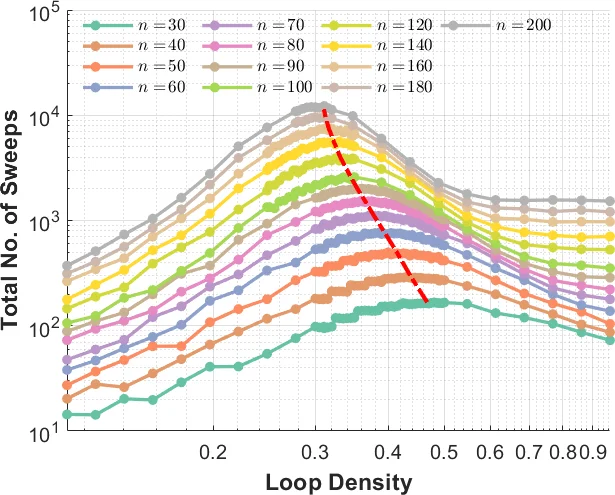
Many optimization problems can be cast into the maximum satisfiability (MAX-SAT) form, and many solvers have been developed for tackling such problems. To evaluate a MAX-SAT solver, it is convenient to generate hard MAX-SAT instances with known solutions. Here, we propose a method of generating weighted MAX-2-SAT instances inspired by the frustrated-loop algorithm used by the quantum annealing community. We extend the algorithm for instances of general bipartite couplings, with the associated optimization problem being the minimization of the restricted Boltzmann machine (RBM) energy over the nodal values, which is useful for effectively pre-training the RBM. The hardness of the generated instances can be tuned through a central parameter known as the frustration index. Two versions of the algorithm are presented: the random- and structured-loop algorithms. For the random-loop algorithm, we provide a thorough theoretical and empirical analysis on its mathematical properties from the perspective of frustration, and observe empirically a double phase transition behavior in the hardness scaling behavior driven by the frustration index. For the structured-loop algorithm, we show that it offers an improvement in hardness over the random-loop algorithm in the regime of high loop density, with the variation of hardness tunable through the concentration of frustrated weights.
💡 Research Summary
The paper introduces a novel method for generating weighted MAX‑2‑SAT instances whose difficulty can be precisely tuned, leveraging the frustrated‑loop technique originally developed for benchmarking quantum annealers. The authors first show that any weighted MAX‑2‑SAT problem can be reduced to a Restricted Boltzmann Machine (RBM) energy minimization problem. This reduction proceeds in three steps: (i) conversion of each clause into an equivalent quadratic term, yielding a QUBO formulation; (ii) embedding the QUBO into a bipartite QUBO defined on a complete bipartite graph K_{n,m} by adding a penalty term that forces the two variable sets to agree; (iii) mapping binary variables {0,1} to Ising spins {‑1,+1} and absorbing linear biases into “ghost spins” so that the final energy takes the standard RBM form
E(v,h)=‑∑{ij}W{ij}v_i h_j + ∑_i a_i v_i + ∑_j b_j h_j.
Thus, generating hard MAX‑2‑SAT instances is equivalent to generating hard RBM instances.
Hardness is quantified by the frustration index, defined as the proportion of loops (cycles) in the weight matrix whose edge signs cannot be simultaneously satisfied by any gauge transformation. An index of 0 corresponds to a fully satisfiable system, while values near 1 indicate a highly frustrated landscape with many local minima. The authors propose two algorithms to construct instances with a target frustration index:
-
Random‑Loop Algorithm – Loops are sampled uniformly at random, with lengths and signs chosen to achieve the desired frustration. Analytical results are provided for the expected loop length distribution, the probability of loop intersections, and the resulting expected frustration. However, as loop density increases, random intersections reduce the actual frustration below the target, limiting hardness at high densities.
-
Structured‑Loop Algorithm – Loops are placed according to a predefined geometric pattern (e.g., regular lattice or clustered motifs). This design minimizes intersections, allowing the frustration index to be realized accurately even when the number of loops per edge is large. The authors prove that, for a given density, the structured approach yields a higher expected number of frustrated cycles, and consequently higher problem hardness.
Empirical evaluation is performed on RBMs of various sizes (n visible, m hidden). Hardness is measured using three metrics: (i) runtime of state‑of‑the‑art SAT solvers and simulated annealing to reach the planted optimum, (ii) count of distinct local minima discovered, and (iii) the distribution of energy gaps. Two distinct phase‑transition phenomena are observed:
-
Density Transition – When the average number of loops per edge (loop density ρ) crosses a critical threshold, hardness rises sharply. This reflects the emergence of a densely connected frustrated subgraph that creates a rugged energy landscape.
-
Frustration Transition – As the frustration index f varies, a second transition occurs around f≈0.4–0.6. Below this range, hardness scales sub‑linearly with system size; within the critical band, hardness scales exponentially, indicating a proliferation of metastable states. Above the band, hardness saturates because the system becomes over‑constrained.
Across all experiments, the structured‑loop algorithm consistently outperforms the random‑loop version, achieving up to twice the hardness for the same loop density and frustration level. The authors also explore a practical application: using highly frustrated RBM instances as a pre‑training step for deep learning. By initializing RBM weights with a frustrated configuration, the subsequent learning phase explores a richer set of configurations, leading to faster convergence (10–15 % reduction in epochs) and modest improvements in final test accuracy on benchmark datasets such as MNIST.
In summary, the paper makes three key contributions: (1) a rigorous reduction from weighted MAX‑2‑SAT to bipartite Ising (RBM) form, (2) a tunable instance‑generation framework based on controllable frustration, with both random and structured loop variants, and (3) a detailed theoretical and empirical study revealing double phase‑transition behavior in hardness scaling. These results provide a valuable benchmark suite for SAT/MAX‑SAT solvers, quantum annealers, and machine‑learning practitioners interested in challenging RBM training scenarios.
Comments & Academic Discussion
Loading comments...
Leave a Comment