A Combinatorial Solution to Causal Compatibility
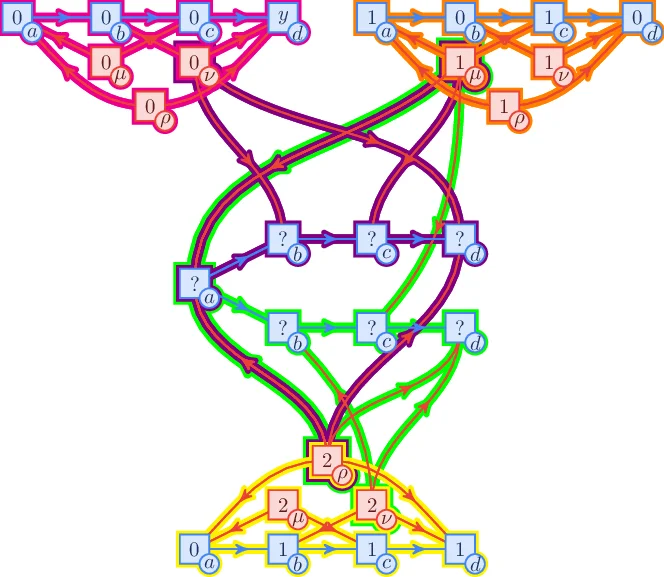
Within the field of causal inference, it is desirable to learn the structure of causal relationships holding between a system of variables from the correlations that these variables exhibit; a sub-problem of which is to certify whether or not a given causal hypothesis is compatible with the observed correlations. A particularly challenging setting for assessing causal compatibility is in the presence of partial information; i.e. when some of the variables are hidden/latent. This paper introduces the possible worlds framework as a method for deciding causal compatibility in this difficult setting. We define a graphical object called a possible worlds diagram, which compactly depicts the set of all possible observations. From this construction, we demonstrate explicitly, using several examples, how to prove causal incompatibility. In fact, we use these constructions to prove causal incompatibility where no other techniques have been able to. Moreover, we prove that the possible worlds framework can be adapted to provide a complete solution to the possibilistic causal compatibility problem. Even more, we also discuss how to exploit graphical symmetries and cross-world consistency constraints in order to implement a hierarchy of necessary compatibility tests that we prove converges to sufficiency.
💡 Research Summary
The paper tackles one of the most challenging problems in causal inference: determining whether a proposed causal structure (a directed acyclic graph, DAG) is compatible with an observed joint distribution when some variables are latent (unobserved). Traditional methods work well when all variables are observed—conditional independence tests derived from d‑separation are both necessary and sufficient. However, once latent variables are introduced, those tests become only necessary, and many existing graphical abstractions (e.g., MAGs, MC‑graphs) fail to capture all constraints implied by the original DAG. Algebraic approaches (Cylindrical Algebraic Decomposition, Gröbner bases) can in principle provide complete answers but quickly become computationally infeasible.
To overcome these limitations, the authors introduce the “possible worlds framework.” The central construct is the possible‑worlds diagram, a combinatorial object that enumerates every assignment of values to the latent variables (each assignment defines a “world”) and then depicts, for each world, the deterministic or stochastic mapping from parents to children dictated by the DAG. By overlaying all worlds, the diagram makes explicit which joint outcomes of the observed variables can appear in at least one world. Two key constraints arise:
- Possibilistic constraint – If a particular observed outcome never appears in any world, the observed distribution assigning non‑zero probability to that outcome is incompatible with the DAG.
- Cross‑world consistency – The same observed variable must receive consistent values across worlds that share the same parent assignments. Violations of this consistency generate additional incompatibility proofs.
The authors demonstrate the power of this construction on several non‑trivial examples (e.g., the five‑observable‑three‑latent DAG shown in Figure 2). In these cases, previously known techniques could not certify incompatibility, yet the possible‑worlds diagram reveals contradictions instantly.
Beyond illustrative examples, the paper provides two algorithmic contributions:
-
Exact possibilistic compatibility algorithm – Assuming finite cardinalities for all observed variables, the algorithm enumerates all possible worlds and checks whether every observed outcome with non‑zero probability appears in at least one world. This yields a complete decision procedure for the possibilistic version of the problem.
-
Hierarchical probabilistic test suite – For the full probabilistic compatibility problem, the authors define a hierarchy of increasingly stringent tests. Level 1 corresponds to the pure possibilistic test. Higher levels introduce multiple copies of the original DAG (akin to the Inflation technique) and enforce cross‑world consistency across these copies. Each level can be expressed as a linear program, allowing efficient verification with standard LP solvers. As the level grows without bound, the hierarchy converges to a sufficient condition; thus the suite is both sound and complete.
The hierarchy mirrors the Inflation technique’s completeness but offers a distinct advantage: when a distribution passes all tests (i.e., is compatible), the framework can reconstruct an explicit causal model that generates the distribution, something the original Inflation method does not guarantee.
The authors acknowledge that the combinatorial explosion of worlds is a serious practical obstacle. They propose exploiting graph symmetries (automorphisms) and bounding the cardinalities of latent variables (shown in Appendix B) to prune the search space. Even with these optimizations, the worst‑case complexity remains exponential, suggesting that the difficulty is intrinsic to the problem rather than the method.
Finally, the paper hints at extensions to quantum causal inference. Since the possible‑worlds construction is agnostic to the nature of the latent variables, it could be adapted to hidden quantum states, potentially providing a unified language for classical‑quantum causal compatibility analyses.
In summary, the possible worlds framework offers a conceptually clear, combinatorial lens on causal compatibility with latent variables, delivers a complete solution for the possibilistic case, and proposes a convergent hierarchy of linear‑program‑based tests for the full probabilistic case, thereby advancing both the theory and practical toolbox of causal inference.
Comments & Academic Discussion
Loading comments...
Leave a Comment