Analysis and Verification of Relation between Digitizer's Sampling Properties and Energy Resolution of HPGe Detectors
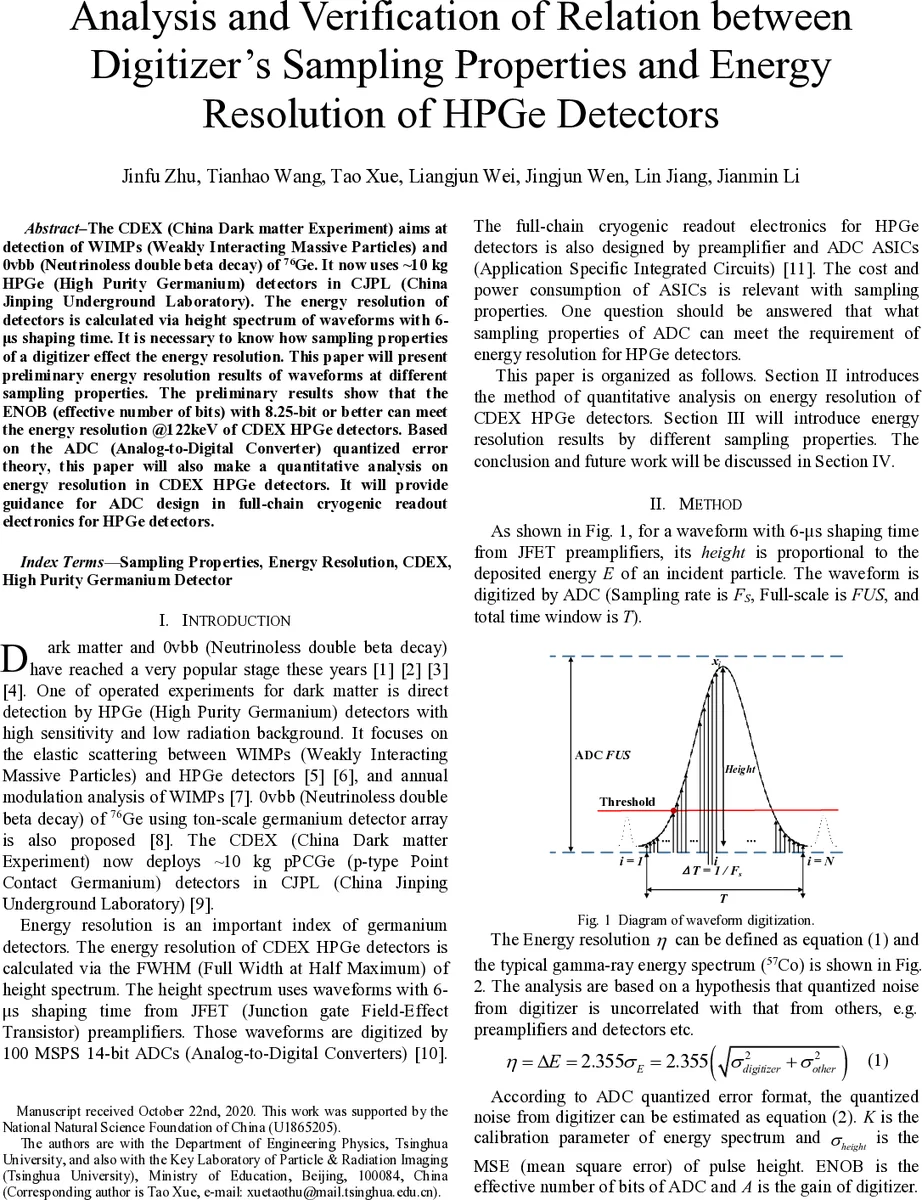
The CDEX (China Dark matter Experiment) aims at detection of WIMPs (Weakly Interacting Massive Particles) and 0vbb (Neutrinoless double beta decay) of 76Ge. It now uses ~10 kg HPGe (High Purity Germanium) detectors in CJPL (China Jinping Underground Laboratory). The energy resolution of detectors is calculated via height spectrum of waveforms with 6-us shaping time. It is necessary to know how sampling properties of a digitizer effect the energy resolution. This paper will present preliminary energy resolution results of waveforms at different sampling properties. The preliminary results show that the ENOB (effective number of bits) with 8.25-bit or better can meet the energy resolution @122keV of CDEX HPGe detectors. Based on the ADC (Analog-to-Digital Converter) quantized error theory, this paper will also make a quantitative analysis on energy resolution in CDEX HPGe detectors. It will provide guidance for ADC design in full-chain cryogenic readout electronics for HPGe detectors.
💡 Research Summary
The paper investigates how the sampling characteristics of a digitizer, specifically its sampling rate and effective number of bits (ENOB), influence the energy resolution of high‑purity germanium (HPGe) detectors used in the China Dark Matter Experiment (CDEX). CDEX currently operates about 10 kg of p‑type point‑contact germanium detectors in the China Jinping Underground Laboratory, aiming at both weakly interacting massive particle (WIMP) searches and neutrinoless double‑beta decay studies. Energy resolution is evaluated by measuring the full width at half maximum (FWHM) of the height spectrum derived from detector waveforms that have been shaped with a 6 µs time constant. These waveforms are digitized by a 100 MS/s, 14‑bit analog‑to‑digital converter (ADC).
The authors first develop a quantitative model based on ADC quantization error theory. They express the total energy resolution (\eta) as the root‑sum‑square of two independent contributions: the intrinsic detector and pre‑amplifier noise ((\sigma_{\text{other}})) and the digitizer’s quantization noise ((\sigma_{\text{digitizer}})). Using the standard quantization error formula (\sigma_{\text{digitizer}} = 2^{1-ENOB}/\sqrt{12}) and a calibration constant (K) that links pulse height to deposited energy, they derive an explicit relationship (Equation 3) that predicts how (\eta) varies with ENOB and full‑scale voltage.
Experimentally, the team records waveforms from a 122 keV ({}^{57})Co gamma source using the 100 MS/s, 14‑bit ADC. A sinusoidal test according to IEEE 1241‑2000 confirms an actual ENOB of about 11.25 bits. The waveform rise time is a few microseconds and its spectral content is confined below 1 MHz, confirming that the 100 MS/s sampling rate is more than adequate (oversampling factor ≈100). To explore the impact of reduced resolution, the authors artificially truncate low‑order bits in the digital data, thereby lowering the ENOB from 11.25 bits down to 5.25 bits in steps. For each ENOB value they compute the FWHM of the 122 keV peak. The measured resolutions follow the theoretical curve derived from Equation 3 with excellent agreement.
The key finding is that an ENOB of 8.25 bits or higher yields an energy resolution better than ~560 eV (FWHM) at 122 keV, which meets the performance requirement of the CDEX HPGe detectors. In other words, the digitizer’s quantization noise becomes negligible compared with the intrinsic detector noise once ENOB exceeds roughly 8 bits. The study also confirms that the sampling rate does not limit resolution for the given pulse bandwidth; thus, designers can prioritize power‑efficient ASICs with modest sampling speeds as long as the ENOB criterion is satisfied.
In the concluding section the authors outline future work: improving the pre‑amplifier and main‑amplifier designs to lower (\sigma_{\text{other}}), characterizing ADC behavior at cryogenic temperatures, and investigating non‑ideal effects such as gain non‑linearity and temperature‑dependent drift. By integrating these improvements with an ADC that meets the 8.25‑bit ENOB target, the full‑chain cryogenic readout electronics can achieve the optimal energy resolution needed for next‑generation dark‑matter and neutrinoless double‑beta decay experiments.
Comments & Academic Discussion
Loading comments...
Leave a Comment