Immutable Log Storage as a Service
Logs contain critical information about the quality of the rendered services on the Cloud and can be used as digital evidence. Hence, we argue that the critical nature of logs calls for immutability and verification mechanism without the presence of a single trusted party. In this paper, we propose a blockchain-based log system, called Logchain, which can be integrated with existing private and public blockchains. To validate the mechanism, we create Logchain as a Service (LCaaS) by integrating it with Ethereum public blockchain network. We show that the solution is scalable (being able to process 100 log files per second) and fast (being able to “seal” a log file in 23 seconds, on average).
💡 Research Summary
The paper addresses the inherent trust problem in cloud logging: service providers (CSPs) generate and store logs on infrastructure they control, giving them unilateral power to tamper with or delete logs that are critical for quality‑of‑service verification and legal evidence. To eliminate the need for a single trusted party, the authors propose Logchain, a blockchain‑based immutable log storage system, and they further expose it as a managed service called Logchain as a Service (LCaaS).
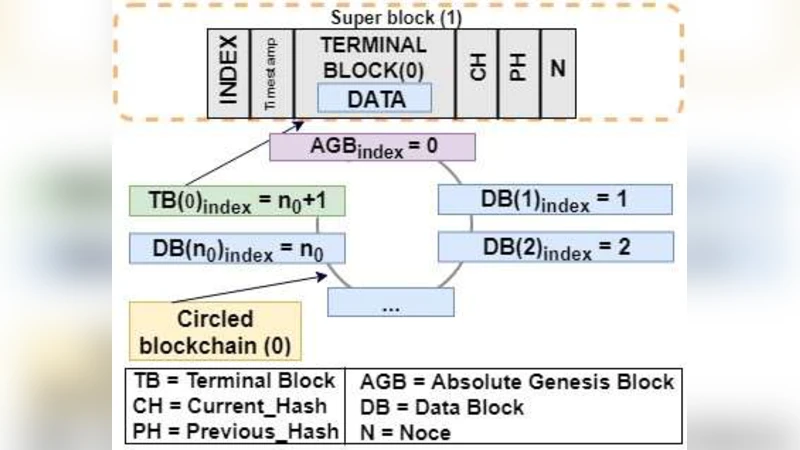
Logchain’s core innovation is a two‑level hierarchical blockchain architecture. At the lower level, logs are batched into “circular blockchains” – each such chain starts with a relative genesis block, contains a configurable number of log blocks, and ends with a terminal block that caps the chain. The entire circular chain is then summarized into a single Super Block (SB). At the higher level, a “super blockchain” consists exclusively of these SBs; each SB’s data field stores the hash of the terminal block of its corresponding circular chain, thereby guaranteeing the integrity of the whole lower‑level chain with a single verification step. Additional constructs such as an absolute genesis block (the first block of the first super blockchain) and the notion of “capped” circular chains further reinforce immutability and simplify verification. This hierarchy dramatically reduces the number of cryptographic checks required for each new log, addressing the scalability bottleneck typical of conventional blockchains where every node must process every block.
For practical deployment, LCaaS is built on a private blockchain that hosts the full Logchain data. To leverage the public trust of a widely used ledger, the authors integrate the service with the Ethereum public network. Only the digest (64‑byte hash) of each log file and a digital signature are written to Ethereum, while the raw log remains on the private chain. This hybrid approach keeps gas costs low, yet benefits from Ethereum’s transparent, tamper‑evident properties. The implementation uses Solidity smart contracts, MetaMask for transaction signing, and Etherscan for public auditability. The service is evaluated on the Ethereum Ropsten testnet, using a standard Intel i7‑7500U workstation with 16 GB RAM.
Performance experiments vary three parameters: incoming transaction rate (tps) set to {0.1, 1, 10, 100}, length of the circular blockchain (n) set to {1, 10, 100}, and gas price (g) set to {6, 9, 20 gwei}. For each of the 36 permutations, 200 or 1 000 sample logs (each 64 bytes) are submitted via Postman, and the processing time of each Super Block (SB) is recorded. Statistical analysis (Pearson, Spearman, and linear regression) shows no significant correlation between any of the three factors and the observed response times (correlation coefficients < 0.15, p‑values > 0.1). This indicates that, within the tested range, the Ethereum network’s capacity dominates performance rather than the workload characteristics.
Nevertheless, the authors observe a modest trend: lower gas prices tend to increase SB processing times, with some blocks exceeding 32 seconds. Outliers are rare but notable—5 out of 3 089 SBs (0.16 %) required 3–5 minutes, and one SB (0.03 %) took 23 minutes to be mined. These anomalies are attributed to the stochastic nature of miner selection on the testnet and would need mitigation in production environments where service‑level agreements (SLAs) demand tighter latency bounds.
In conclusion, Logchain provides a verifiable, tamper‑proof logging mechanism that can be offered as a cloud service, thereby strengthening trust between CSPs and cloud consumers. The hierarchical blockchain design mitigates the classic scalability issue of blockchains, while the hybrid private‑public deployment balances cost and transparency. Future work outlined by the authors includes extending LCaaS to other blockchain platforms (e.g., Hyperledger Fabric, Corda), optimizing gas consumption, and conducting long‑term stability tests in real‑world cloud settings.
Comments & Academic Discussion
Loading comments...
Leave a Comment