On the numerical rank of radial basis function kernels in high dimension
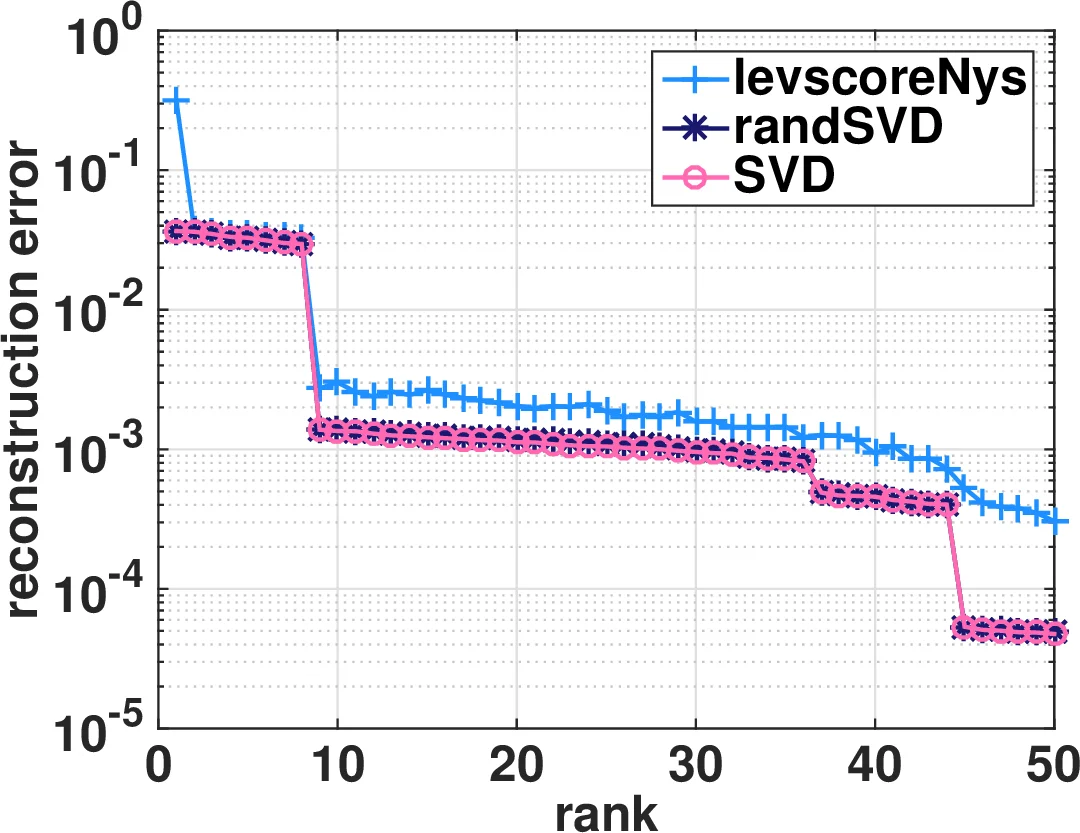
Low-rank approximations are popular methods to reduce the high computational cost of algorithms involving large-scale kernel matrices. The success of low-rank methods hinges on the matrix rank of the kernel matrix, and in practice, these methods are effective even for high-dimensional datasets. Their practical success motivates our analysis of the function rank, an upper bound of the matrix rank. In this paper, we consider radial basis functions (RBF), approximate the RBF kernel with a low-rank representation that is a finite sum of separate products and provide explicit upper bounds on the function rank and the $L_\infty$ error for such approximations. Our three main results are as follows. First, for a fixed precision, the function rank of RBFs, in the worst case, grows polynomially with the data dimension. Second, precise error bounds for the low-rank approximations in the $L_\infty$ norm are derived in terms of the function smoothness and the domain diameters. Finally, a group pattern in the magnitude of singular values for RBF kernel matrices is observed and analyzed, and is explained by a grouping of the expansion terms in the kernel’s low-rank representation. Empirical results verify the theoretical results.
💡 Research Summary
This paper investigates the theoretical foundations of low‑rank approximations for radial basis function (RBF) kernels in high‑dimensional settings. The authors introduce the notion of “function rank,” defined as the minimal number of separable terms required to approximate a kernel K(x, y)=f(‖x−y‖²) within a prescribed error ε. Unlike matrix rank, function rank provides an upper bound that can be analyzed directly in terms of the kernel’s analytic properties and the ambient dimension d.
The core contribution is a set of explicit upper bounds on function rank and corresponding L∞ approximation errors. Under an Analytic Assumption (f analytic on
Comments & Academic Discussion
Loading comments...
Leave a Comment