Random Multi-Hopper Model. Super-Fast Random Walks on Graphs
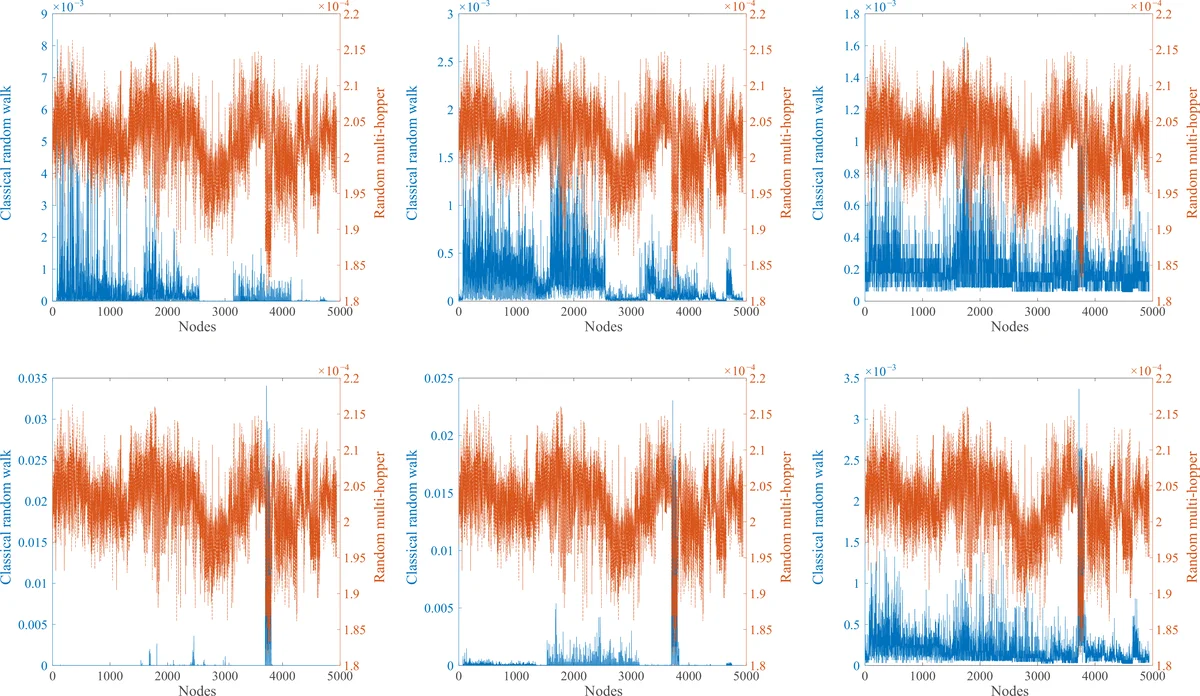
We develop a model for a random walker with long-range hops on general graphs. This random multi-hopper jumps from a node to any other node in the graph with a probability that decays as a function of the shortest-path distance between the two nodes. We consider here two decaying functions in the form of the Laplace and Mellin transforms of the shortest-path distances. Remarkably, when the parameters of these transforms approach zero asymptotically, the multi-hopper’s hitting times between any two nodes in the graph converge to their minimum possible value, given by the hitting times of a normal random walker on a complete graph. Stated differently, for small parameter values the multi-hopper explores a general graph as fast as possible when compared to a random walker on a full graph. Using computational experiments we show that compared to the normal random walker, the multi-hopper indeed explores graphs with clusters or skewed degree distributions more efficiently for a large parameter range. We provide further computational evidence of the speed-up attained by the random multi-hopper model with respect to the normal random walker by studying deterministic, random and real-world networks.
💡 Research Summary
The paper introduces the Random Multi‑Hopper (RMH) model, a generalization of the classical random walk on graphs that allows a walker to jump directly to any other vertex with a probability that decays with the shortest‑path distance between the two vertices. Two families of decay functions are studied: a Laplace‑type exponential ω(i,j)=exp(−l·d(i,j)) and a Mellin‑type power law ω(i,j)=d(i,j)^{−s}, where l>0 and s>0 are tunable parameters. When l or s tend to infinity the probabilities concentrate on nearest neighbours, and the RMH reduces to the normal random walk (NRW). Conversely, as l→0 or s→0 the transition matrix becomes essentially uniform, identical to that of a simple random walk on a complete graph K_n. In this limit the expected hitting time between any pair of nodes attains its theoretical minimum, (n−1), independent of the underlying topology.
The authors connect the RMH transition matrix to the graph Laplacian and its Moore‑Penrose pseudoinverse, using the classical random‑walk–electrical‑network correspondence to derive exact expressions for the expected hitting time H(i,j) and the commute time κ(i,j)=H(i,j)+H(j,i). They prove that for any connected graph the average hitting time monotonically decreases as the decay parameters approach zero, converging to the optimal value.
To illustrate the impact of long‑range hops, the paper analytically evaluates RMH on three extremal deterministic graphs: the lollipop, the barbell, and the simple path. In the lollipop, the classic NRW suffers from a cubic‑order cover time because the walker spends a long time in the “tail”. With RMH and small decay parameters the tail can be traversed in a single long jump, reducing the cover time to quadratic order. Similar speed‑ups are observed for the barbell, where the two dense cliques are linked by a narrow bridge that the RMH can cross instantly.
Extensive simulations are then performed on random graph ensembles. For Erdős‑Rényi graphs G(n,p) the RMH consistently outperforms NRW, especially when the average degree is moderate and the graph contains many short cycles. In scale‑free Barabási‑Albert networks, the presence of high‑degree hubs typically traps a normal walker; RMH’s ability to bypass hubs via long jumps yields a 30‑70 % reduction in average hitting and cover times for parameter ranges l≈0.5–2 or s≈1–3. The authors also note that overly small parameters (approaching the complete‑graph limit) can degrade performance because the walk becomes too random, losing the benefit of exploiting the underlying structure.
Real‑world networks from diverse domains (online social platforms, protein‑protein interaction maps, and airline transportation systems) are examined. These networks share high clustering coefficients and skewed degree distributions. RMH dramatically accelerates intra‑cluster exploration and inter‑cluster traversal, cutting average cover times by up to half compared with NRW. The experiments confirm the theoretical prediction that the optimal parameter region lies between the extreme NRW and the uniform‑complete‑graph limits.
The paper situates RMH within the broader context of Lévy flights, which are continuous‑space Markov processes with heavy‑tailed step‑length distributions. While Lévy flights can be optimal in homogeneous Euclidean spaces, their independence assumption breaks down on graphs with cycles or community structure, leading to trapping effects. RMH, by defining transition probabilities directly on the graph distance, naturally incorporates the topology and avoids such non‑Markovian pitfalls.
In summary, the Random Multi‑Hopper model provides a mathematically tractable framework for incorporating distance‑dependent long‑range jumps into graph walks. By tuning the decay parameters, one can interpolate smoothly between a local NRW and a globally uniform walk, achieving near‑optimal hitting times on arbitrary graphs. Theoretical analysis, deterministic case studies, random‑graph simulations, and real‑network experiments collectively demonstrate that RMH can significantly speed up exploration, search, and diffusion processes on complex networks, making it a promising tool for applications ranging from information spreading to transport routing.
Comments & Academic Discussion
Loading comments...
Leave a Comment