On the Robustness of Winners: Counting Briberies in Elections
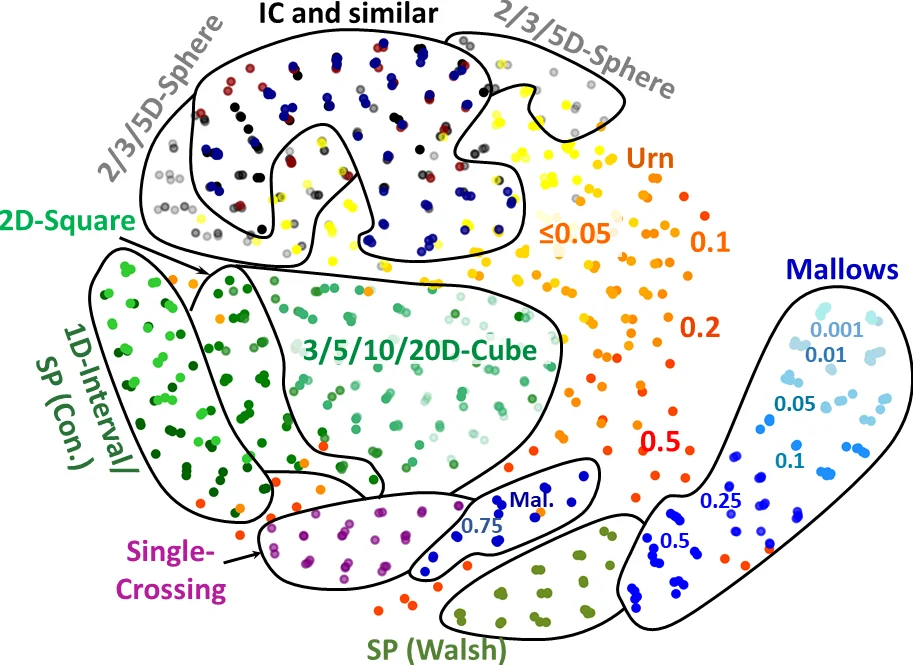
We study the parameterized complexity of counting variants of Swap- and Shift-Bribery problems, focusing on the parameterizations by the number of swaps and the number of voters. We show experimentally that Swap-Bribery offers a new approach to the robustness analysis of elections.
💡 Research Summary
The paper investigates counting versions of the well‑studied Swap‑Bribery and Shift‑Bribery problems, focusing on their parameterized complexity and their usefulness for measuring the robustness of election outcomes. In the traditional decision version, one asks whether a designated candidate can be made a winner by performing at most r swaps (or shifts) of adjacent candidates in voters’ rankings, assuming unit costs. The counting version asks for the exact number of distinct election profiles at swap distance r in which the designated candidate wins. This number, divided by the total number of profiles at distance r, yields the probability P_c(r) that candidate c wins after r random adjacent swaps – a natural robustness metric.
The authors study these problems for the Plurality and Borda voting rules. They consider two natural parameters: the swap/shift radius r (the exact number of allowed swaps or shifts) and the number of voters n. Their main theoretical contributions are summarized in a table and can be described as follows:
- Plurality – #SWAP‑BRIBERY: While the decision problem is known to be polynomial‑time solvable, the counting problem is #P‑hard. Moreover, when parameterized by the swap radius r, the problem is #W
Comments & Academic Discussion
Loading comments...
Leave a Comment