KRNC: New Foundations for Permissionless Byzantine Consensus and Global Monetary Stability
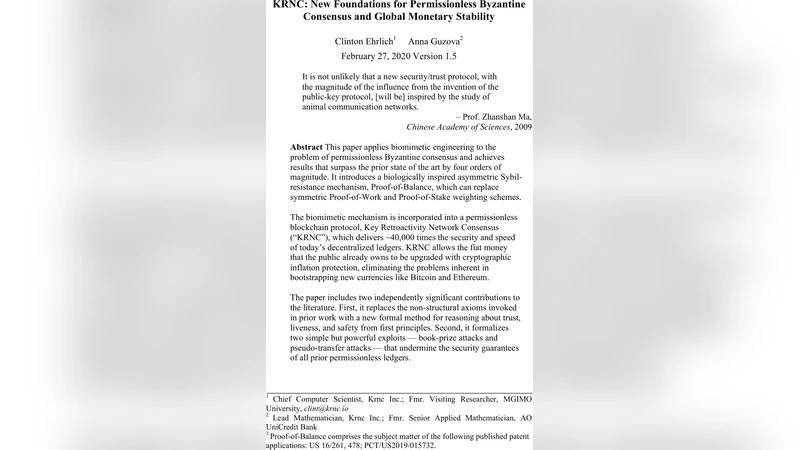
This paper applies biomimetic engineering to the problem of permissionless Byzantine consensus and achieves results that surpass the prior state of the art by four orders of magnitude. It introduces a biologically inspired asymmetric Sybil-resistance mechanism, Proof-of-Balance, which can replace symmetric Proof-of-Work and Proof-of-Stake weighting schemes. The biomimetic mechanism is incorporated into a permissionless blockchain protocol, Key Retroactivity Network Consensus (“KRNC”), which delivers ~40,000 times the security and speed of today’s decentralized ledgers. KRNC allows the fiat money that the public already owns to be upgraded with cryptographic inflation protection, eliminating the problems inherent in bootstrapping new currencies like Bitcoin and Ethereum. The paper includes two independently significant contributions to the literature. First, it replaces the non-structural axioms invoked in prior work with a new formal method for reasoning about trust, liveness, and safety from first principles. Second, it demonstrates how two previously overlooked exploits, book-prize attacks and pseudo-transfer attacks, collectively undermine the security guarantees of all prior permissionless ledgers.
💡 Research Summary
The paper titled “KRNC: New Foundations for Permissionless Byzantine Consensus and Global Monetary Stability” claims to achieve a breakthrough in decentralized consensus by borrowing concepts from biological signaling. Its central contribution is the introduction of an asymmetric Sybil‑resistance mechanism called Proof‑of‑Balance (PoB), which replaces the symmetric cost structures of Proof‑of‑Work (PoW) and Proof‑of‑Stake (PoS). PoB assigns consensus weight to participants based on the amount of fiat currency they already hold, treating existing monetary balances as a “cue” that can be cryptographically verified without requiring additional expenditure of computational power or capital.
The authors argue that this asymmetry eliminates the “handicap principle” that underlies PoW and PoS, where participants must waste resources to prove honesty. By leveraging pre‑existing economic stakes, PoB purportedly offers security that is exponentially larger than the cost imposed on honest nodes, leading to a claimed 40,000‑fold improvement in both security and throughput over today’s blockchains.
In addition to the PoB mechanism, the paper identifies two previously overlooked attack vectors: “book‑prize attacks” and “pseudo‑transfer attacks.” Book‑prize attacks exploit the fact that permissionless protocols often have a participant set that is too small to be a statistically unbiased sample of the global population, allowing an adversary to manipulate the sample composition. Pseudo‑transfer attacks target PoS systems by moving stake among an attacker’s own addresses to create the illusion of decentralization while retaining effective control over the consensus process. The authors formalize a “price‑adaptive asynchronous adversary” model to capture these threats and claim that existing PoS security proofs are tautological because they assume the very condition they aim to prove.
The KRNC protocol integrates PoB into a permissionless Byzantine consensus framework. Its genesis block is defined by the worldwide distribution of fiat balances, which the authors present as a natural Schelling point. New participants prove ownership of fiat balances, receive proportional cryptographic weight, and thereby gain voting rights. As more participants join, the weight of early dishonest actors is diluted, preventing an initial dishonest majority from maintaining long‑term control. The authors assert that KRNC’s security becomes path‑independent after the market cap stabilizes, unlike PoS where early stake can lock in power indefinitely.
Methodologically, the paper proposes a new formal taxonomy that distinguishes permissioned from permissionless consensus based on the axioms required for liveness and safety. It argues that permissionless safety is statistically reliable only when a sufficient fraction of the global population participates, and it uses a toy model without Sybil attacks to derive a minimum participation threshold. This is then extended with a game‑theoretic coordination model under incomplete information to demonstrate the necessity of the threshold.
Despite its ambitious claims, the paper lacks empirical validation. No simulations, benchmarks, or real‑world deployments are provided to substantiate the 40,000× security claim. The PoB mechanism raises serious privacy concerns, as participants must disclose fiat holdings, and it does not address regulatory or anti‑money‑laundering implications of exposing global balance data on a public ledger. Economic feasibility is also questionable: converting fiat balances into immutable cryptographic weight would require a universally trusted oracle and a mechanism to handle currency conversion, inflation, and sovereign policy changes, none of which are discussed.
Furthermore, the formal analysis is vague. The new axiomatic framework is described in prose without precise definitions, and the security proofs rely on unverified assumptions about the adversary’s budget and the statistical properties of the participant pool. The “book‑prize” and “pseudo‑transfer” attacks, while conceptually interesting, are not demonstrated with concrete attack scenarios or cost calculations, making it difficult to assess their practical relevance.
In summary, the paper introduces an intriguing idea—using existing fiat balances as a free, asymmetric Sybil‑resistance resource—and attempts to reframe permissionless consensus with a biologically inspired lens. However, the lack of rigorous mathematical modeling, empirical evidence, and consideration of economic, legal, and privacy dimensions means that the proposed KRNC protocol remains a speculative concept rather than a ready‑to‑implement solution.
Comments & Academic Discussion
Loading comments...
Leave a Comment