A Family of Software Product Lines in Educational Technologies
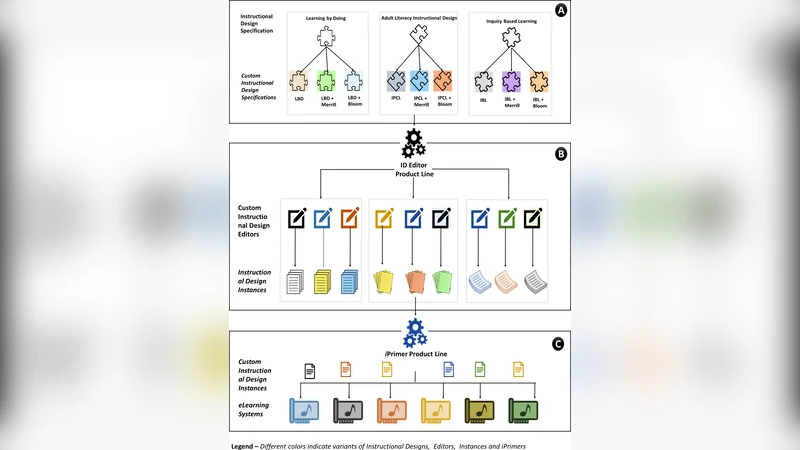
Rapid advances in education domain demand the design and customization of educational technologies for a large scale and variety of evolving requirements. Here, scale is the number of systems to be developed and variety stems from a diversified range of instructional designs such as varied goals, processes, content, teacher styles, learner styles and, also for eLearning Systems for 22 Indian Languages and variants. In this paper, we present a family of software product lines as an approach to address this challenge of modeling a family of instructional designs as well as a family of eLearning Systems and demonstrate it for the case of adult literacy in India (287 million learners). We present a multi-level product line that connects product lines at multiple levels of granularity in education domain. We then detail two concrete product lines (http://rice.iiit.ac.in), one that generates instructional design editors and two, which generates a family of eLearning Systems based on flexible instructional designs. Finally, we demonstrate our approach by generating eLearning Systems for Hindi and Telugu languages (both web and android versions), which led to significant cost savings of 29 person months for 9 eLearning Systems.
💡 Research Summary
The paper addresses the pressing need to design and customize educational technologies at both large scale and high variety, using the context of adult literacy in India as a concrete case study. The authors propose a multi‑level Software Product Line (SPL) framework that models a family of instructional designs and a family of e‑Learning systems. They begin by defining instructional design as a structured meta‑model comprising goals, processes, content, teacher styles, and learner styles. This meta‑model is captured in a feature model that enumerates optional and mandatory features such as language, media type, learning objectives, and pedagogical strategies.
Two concrete product lines are instantiated from this foundation. The first SPL generates instructional design editors: configurable authoring tools that allow educators to create, modify, and export instructional designs without programming. The second SPL produces e‑Learning systems that consume the exported designs and automatically generate complete web and Android applications. A hierarchical SPL architecture is employed: a top‑level “education domain” product line defines shared services (user management, analytics, content delivery), while lower‑level lines specialize for language (22 Indian languages) and platform (web, Android).
Implementation relies on model‑based software engineering. The authors use the Eclipse Modeling Framework (EMF) to represent the instructional design meta‑model and Acceleo templates to transform models into source code, UI layouts, and configuration files. As a proof‑of‑concept, they generated Hindi and Telugu e‑Learning systems in both web and Android forms. The automated pipeline produced each system in under four hours, compared to the months of manual effort traditionally required.
A cost‑benefit analysis shows that the SPL approach saved 29 person‑months across nine generated systems, representing a roughly 3.2 person‑month reduction per system. This translates into substantial savings for national‑scale literacy initiatives targeting 287 million adult learners across 22 languages.
The paper situates its contribution within related work on instructional design languages (IMS‑LD, LAMS, POEML, PAL, etc.) and prior attempts at learning object reuse. It argues that existing tools suffer from limited variability support, high authoring complexity, and tight coupling between design and implementation. In contrast, the SPL methodology provides systematic variability management, language‑agnostic component reuse, and a clear separation between design (feature model) and implementation (generated code).
Finally, the authors discuss future directions, including extending the SPL to other educational domains (K‑12, vocational training), integrating adaptive learning engines, and refining the meta‑model to capture assessment and feedback loops. The work demonstrates that SPLs can serve as a robust engineering backbone for large‑scale, multilingual educational technology deployments, offering both economic efficiency and pedagogical flexibility.
Comments & Academic Discussion
Loading comments...
Leave a Comment