On generalized topological spaces
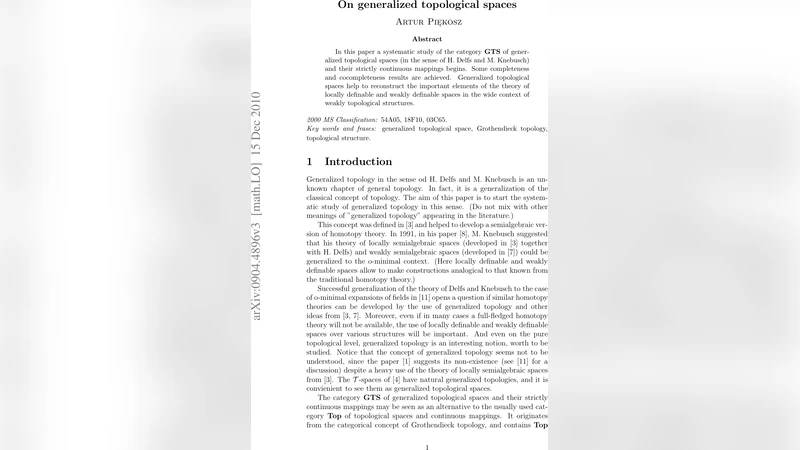
In this paper a systematic study of the category GTS of generalized topological spaces (in the sense of H. Delfs and M. Knebusch) and their strictly continuous mappings begins. Some completeness and cocompleteness results are achieved. Generalized topological spaces help to reconstruct the important elements of the theory of locally definable and weakly definable spaces in the wide context of weakly topological structures.
💡 Research Summary
The paper initiates a systematic study of the category GTS whose objects are generalized topological spaces as introduced by H. Delfs and M. Knebusch, and whose morphisms are strictly continuous maps. A generalized topological space (GTS) is defined by a family 𝒰 of subsets of a set X that satisfies three axioms reminiscent of the usual open‑set axioms: (i) ∅ and X belong to 𝒰, (ii) the intersection of any two members of 𝒰 is again in 𝒰, and (iii) arbitrary unions of members of 𝒰 belong to 𝒰. This relaxation allows one to treat collections that are not genuine topologies but still retain enough structure to support a meaningful notion of continuity.
The authors then introduce strict continuity: a map f : X → Y between GTS‑objects is strictly continuous if for every U ∈ 𝒰_Y the pre‑image f⁻¹(U) lies in 𝒰_X. This condition is stronger than ordinary continuity (which would only require f⁻¹(U) to be open in a classical sense) and is essential for the categorical constructions that follow.
With objects and morphisms fixed, the paper builds the category GTS and proves that it is both complete and cocomplete. The authors construct products, equalizers, coequalizers, and arbitrary (co)limits explicitly, showing that every diagram in GTS admits a limit and a colimit. A particularly noteworthy result is the existence of exponential objects: for any two GTS‑objects X and Y there is an object Y^X whose points are strictly continuous maps X → Y, equipped with a natural evaluation map. Consequently, GTS is a Cartesian closed category, a property that is rare among categories of generalized spaces and that enables internal function‑space constructions.
The second major theme of the paper is the relationship between GTS and the model‑theoretic notions of definable spaces and weakly definable spaces that arise in weakly topological structures. In many o‑minimal or other tame structures, one works with sets that are definable by formulas but whose induced topology may be too coarse or may fail to be a genuine topology. By embedding such sets into the GTS framework, the authors show that definable spaces become full sub‑objects of GTS, while weakly definable spaces correspond to objects whose generalized open families are only “weakly” closed under the axioms. Moreover, locally definable spaces—spaces that are locally isomorphic to definable ones—appear naturally as a subcategory of GTS closed under taking open subspaces and restrictions of strictly continuous maps.
Concrete examples illustrate the theory. Real closed fields equipped with an o‑minimal structure give rise to definable manifolds, which are GTS‑objects whose strictly continuous maps coincide with the usual definable maps. In algebraic geometry, partial algebraic sets (sets defined by polynomial equations on a domain that is not Zariski‑closed) can be modeled as GTS‑objects, and the exponential construction yields function spaces that remain within GTS. The paper also discusses how partially defined functions, common in weakly topological contexts, fit neatly into the strict continuity framework.
The concluding section reflects on the significance of the results. By establishing that GTS is a complete, cocomplete, and Cartesian closed category, the authors provide a robust categorical environment in which both classical topological methods and model‑theoretic definability techniques can be applied simultaneously. This unifies previously disparate approaches to locally definable and weakly definable spaces, opening the door to further developments such as homology and cohomology theories for GTS, investigations of internal homotopy, and the study of stronger continuity notions (e.g., strong continuity or definable continuity) within the same categorical framework. The work thus lays a foundational platform for future research at the intersection of topology, category theory, and model theory.
Comments & Academic Discussion
Loading comments...
Leave a Comment