Symplectic classification of coupled angular momenta
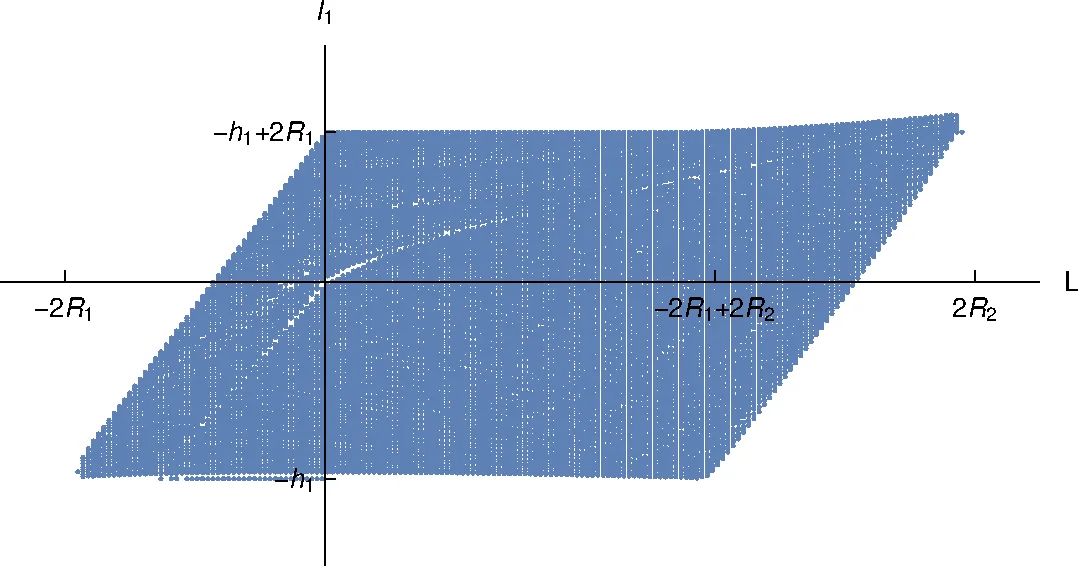
The coupled angular momenta are a family of completely integrable systems that depend on three parameters and have a compact phase space. They correspond to the classical version of the coupling of two quantum angular momenta and they constitute one of the fundamental examples of so-called semitoric systems. Pelayo & Vu Ngoc have given a classification of semitoric systems in terms of five symplectic invariants. Three of these invariants have already been partially calculated in the literature for a certain parameter range, together with the linear terms of the so-called Taylor series invariant for a fixed choice of parameter values. In the present paper we complete the classification by calculating the polygon invariant, the height invariant, the twisting-index invariant, and the higher-order terms of the Taylor series invariant for the whole family of systems. We also analyse the explicit dependence of the coefficients of the Taylor series with respect to the three parameters of the system, in particular near the Hopf bifurcation where the focus-focus point becomes degenerate.
💡 Research Summary
The paper presents a complete symplectic classification of the coupled angular momenta system, a family of completely integrable Hamiltonian systems depending on three real parameters ((R_{1},R_{2},t)) and defined on the compact phase space (M=S^{2}\times S^{2}). This family is a classical analogue of the quantum coupling of two angular momenta and provides one of the most elementary examples of a four‑dimensional semitoric system – a completely integrable system with a global proper (S^{1}) momentum map (L) and only non‑degenerate, non‑hyperbolic singularities.
Semitoric systems are classified by five symplectic invariants (Pelayo–Vu Ngoc). The authors compute all five invariants for the whole parameter range, extending earlier partial results that covered only the case (R_{1}<R_{2}) and a fixed value (t=1/2).
-
Number of focus‑focus points – The system possesses either zero or one focus‑focus singularity. The singularity exists precisely for (t) in an open interval ((t_{-},t_{+})) that depends on (R_{1},R_{2}); outside this interval the singularity becomes elliptic‑elliptic.
-
Taylor series invariant – Near a focus‑focus fibre the foliation is described by a formal power series (S(l,j)=\sum a_{mn}l^{m}j^{n}) in the action‑angle coordinates ((l,j)). The authors obtain the series up to quadratic terms in both variables, i.e. they compute the coefficients of (l), (j), (l^{2}), (lj) and (j^{2}). Their method does not rely on a direct expansion of the action integrals; instead they use the period of the reduced one‑degree‑of‑freedom system and the rotation number, which are expressed through complete elliptic integrals. By differentiating these quantities with respect to (l) and (j) they recover (\partial_{l}S) and (\partial_{j}S) and integrate to obtain (S). The final expression involves square‑roots (\sqrt{r_{A}}), arctangent functions, and logarithms, where \
Comments & Academic Discussion
Loading comments...
Leave a Comment