PassVizor: Toward Better Understanding of the Dynamics of Soccer Passes
💡 Research Summary
PassVizor is a visual analytics system designed to help soccer analysts understand the dynamic evolution of passing tactics within a match. The authors begin by highlighting the central role of passing in creating scoring opportunities and note that traditional analyses—primarily passing networks and simple sequential pattern mining—either collapse temporal information or produce overly short, non‑informative patterns. To address these gaps, the research team collaborated for a year with four domain experts (a certified coach, a senior analyst, and two former professional players) to elicit concrete analytical needs at the match, phase, and individual player levels.
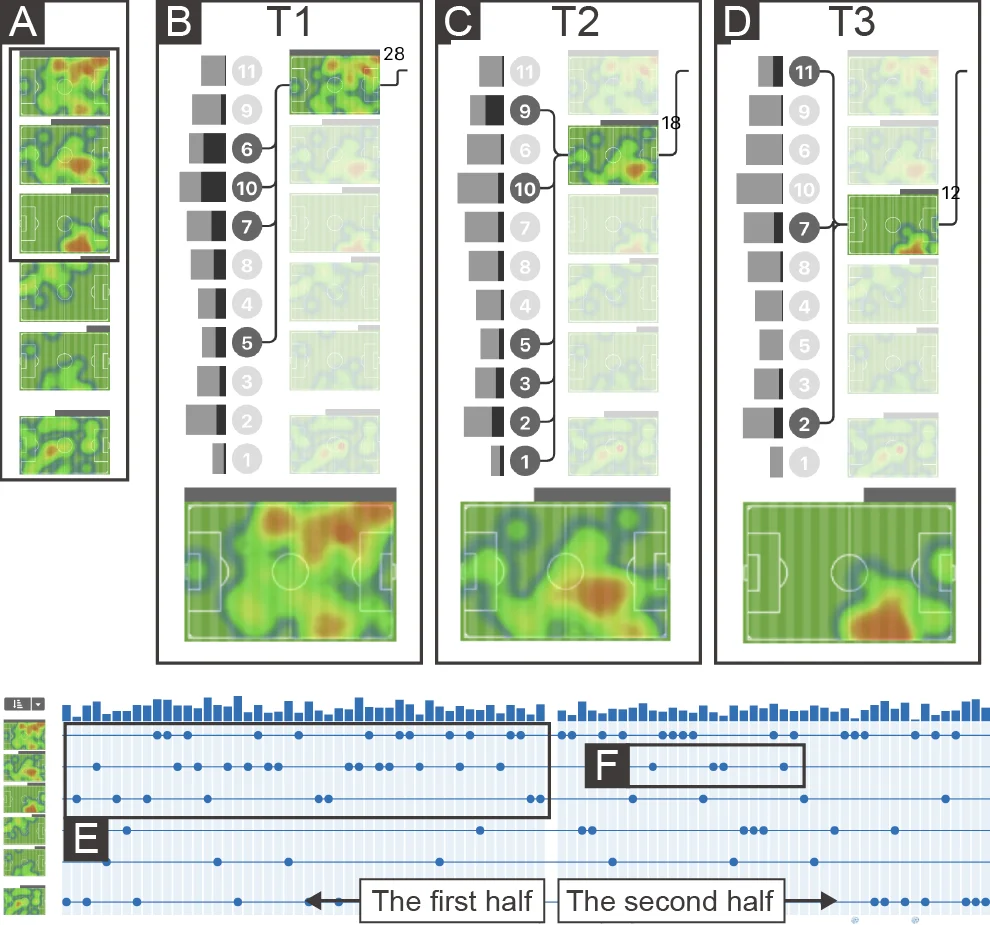
Based on the experts’ requirements, the system incorporates two main components. The first is a topic‑based pattern detection engine implemented in Python. Pass sequences are treated analogously to sentences, and Latent Dirichlet Allocation (LDA) is applied to discover latent “topics” that correspond to high‑level passing tactics. Each topic is represented by probability distributions over players, field regions, pass types, and other contextual variables, allowing the system to capture multi‑step patterns such as “high‑press counter‑attack” or “possession‑maintaining short passes.” The second component is an interactive web‑based visualization built with Vue.js. It offers an Evolution View that displays the temporal proportion of each topic across the match, and a Pitch View that visualizes individual phases using a custom glyph. The glyph encodes spatial zones, player identities, pass frequency, and formation information in a compact circular layout, enabling analysts to juxtapose hundreds of phases without overwhelming visual clutter.
Data preparation involves semi‑automatic extraction of player trajectories and event annotations (passes, shots, goals) from video footage. Position data require roughly six hours of manual correction by two annotators, while event labeling takes about ninety minutes per match. The processed data are segmented into “phases” that correspond to coherent attacking or defensive sequences.
In practice, PassVizor allows analysts to answer key questions such as: (1) How many distinct passing patterns does a team employ and what are their characteristics? (2) When and how does a team shift from an offensive to a defensive passing style? (3) How do different defensive setups (e.g., man‑marking vs. zonal) influence a team’s passing behavior? (4) What are the individual passing styles of specific players (e.g., one‑touch versus dribble‑before‑pass) and how do they affect overall effectiveness? Case studies presented in the paper demonstrate that the system can pinpoint tactical turning points, reveal adaptations to opponent defenses, and assess the efficiency of individual players’ passes in relation to outcomes such as shots or turnovers. Expert feedback confirms that PassVizor reduces the time required for tactical analysis compared with traditional video review and provides a clearer, more quantitative view of tactical evolution.
The authors acknowledge several limitations. LDA does not fully capture the exact order of passes, potentially missing subtle sequential nuances. The selection of the number of topics and other hyper‑parameters remains somewhat subjective, influencing the granularity of the discovered tactics. Moreover, the current implementation is designed for offline analysis; real‑time deployment would require performance optimizations and faster data ingestion pipelines. Future work includes exploring dynamic topic models or sequential LDA variants to better model temporal shifts, automating the tracking and labeling pipeline to lower annotation costs, and extending the system to support cross‑match comparisons for broader tactical pattern discovery. Overall, PassVizor represents a significant step toward integrating advanced machine‑learning techniques with domain‑specific visual encodings to make the complex dynamics of soccer passing accessible to analysts and coaches.
Comments & Academic Discussion
Loading comments...
Leave a Comment