Spatial Heterogeneity, Scale, Data Character, and Sustainable Transport in the Big Data Era
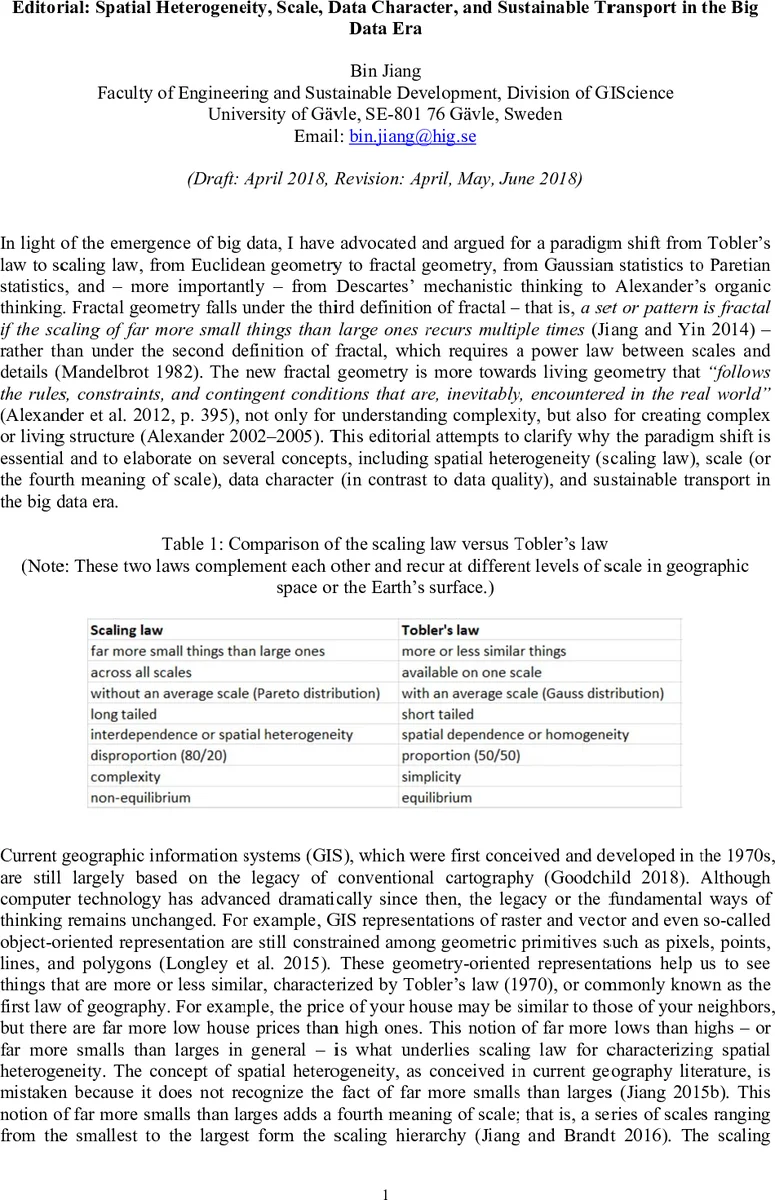
In light of the emergence of big data, I have advocated and argued for a paradigm shift from Tobler’s law to scaling law, from Euclidean geometry to fractal geometry, from Gaussian statistics to Paretian statistics, and - more importantly - from Descartes’ mechanistic thinking to Alexander’s organic thinking. Fractal geometry falls under the third definition of fractal - that is, a set or pattern is fractal if the scaling of far more small things than large ones recurs multiple times (Jiang and Yin 2014) - rather than under the second definition of fractal, which requires a power law between scales and details (Mandelbrot 1982). The new fractal geometry is more towards living geometry that “follows the rules, constraints, and contingent conditions that are, inevitably, encountered in the real world” (Alexander et al. 2012, p. 395), not only for understanding complexity, but also for creating complex or living structure (Alexander 2002-2005). This editorial attempts to clarify why the paradigm shift is essential and to elaborate on several concepts, including spatial heterogeneity (scaling law), scale (or the fourth meaning of scale), data character (in contrast to data quality), and sustainable transport in the big data era.
💡 Research Summary
The editorial argues that the advent of big‑data demands a fundamental shift in geographic and transportation research paradigms. First, Tobler’s law—“everything is related to everything else, but near things are more related than distant things”—captures local spatial autocorrelation but fails to describe the global patterns revealed by massive datasets. The author proposes replacing it, or at least complementing it, with a scaling law that reflects the ubiquitous observation that “there are far more small things than large ones.” This scaling perspective aligns with a newer definition of fractality: a pattern in which the dominance of small elements over large ones recurs across multiple hierarchical levels, rather than the classic Mandelbrot power‑law relationship between scale and detail.
Second, the paper calls for moving from Euclidean geometry, which treats points, lines and polygons as independent, static primitives, to a fractal or “living” geometry that emphasizes recursive, holistic structures. A curve, for example, should be seen not as a series of similar line segments but as a hierarchy of many tiny bends embedded within fewer large bends. This shift changes the focus from detailed geometric accuracy to the overall “wholeness” of a spatial form.
Third, the statistical foundation must change from Gaussian (normal) distributions—appropriate when data have a well‑defined mean and variance—to Pareto (heavy‑tailed) distributions that better model phenomena where extreme values are rare but influential. The author illustrates this with housing prices: locally, averaging neighboring prices works (Tobler’s law), but globally the price distribution is heavily skewed, making the mean meaningless. To operationalize the heavy‑tailed nature of big‑data, the author introduces the head/tail breaks classification. Data are recursively split at the mean into a “head” (values above the mean) and a “tail” (values below). The process repeats until the head is no longer a small proportion of the whole. The number of recursive steps is the ht‑index, a concise metric of the depth of a dataset’s scaling hierarchy.
Fourth, the editorial challenges the GIS community’s long‑standing emphasis on data quality (positional accuracy, attribute precision). Instead, it promotes the concept of “data character” – the overall structural and living qualities of a dataset. Using examples from OpenStreetMap (OSM) and a visual comparison of a high‑resolution photograph of Kim Jong‑Un versus a low‑detail cartoon, the author shows that a dataset with lower geometric fidelity can convey stronger “character” and be more useful for certain analytical tasks. In the OSM context, the fractal structure of the road network (its scaling hierarchy) is argued to be more informative for traffic flow analysis than the precise geometry of individual street segments.
Finally, the paper links these paradigm shifts to sustainable transportation. Conventional traffic models treat roads and corridors as independent optimization units, whereas a fractal, scaling‑aware view treats the transportation network as a multi‑level, recursively embedded system where many small streets feed into fewer major arteries. Sustainable transport planning therefore requires policies that simultaneously address local (micro) and global (macro) scales, leveraging big‑data streams and head/tail‑based network classifications to identify critical hierarchical structures.
In sum, the editorial proposes four intertwined transitions: (1) from Tobler’s law to scaling law, (2) from Euclidean to fractal/organic geometry, (3) from Gaussian to Pareto statistics, and (4) from mechanistic to organic thinking. It supplies concrete tools—head/tail breaks and the ht‑index—to quantify scaling, argues for prioritizing data character over raw quality, and demonstrates how these ideas can reshape GIS, urban analysis, and the design of resilient, sustainable transportation systems in the era of big data.
Comments & Academic Discussion
Loading comments...
Leave a Comment