Melt-Enhanced Rejuvenation of Lithospheric Mantle: Insights from the Colorado Plateau
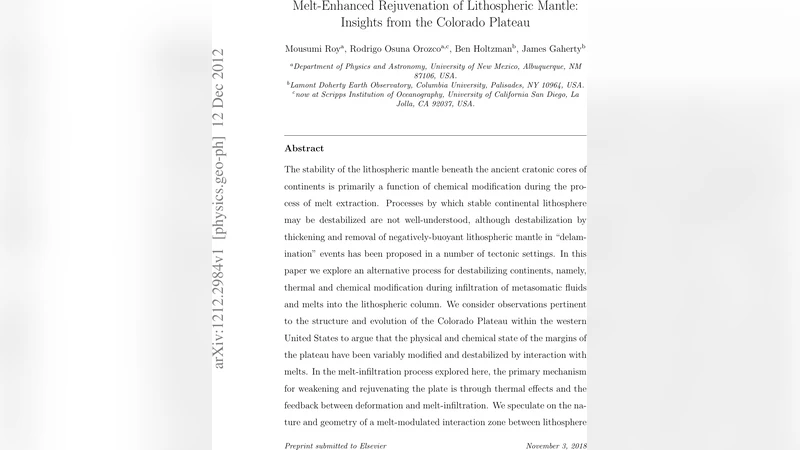
The stability of the lithospheric mantle beneath the ancient cratonic cores of continents is primarily a function of chemical modification during the process of melt extraction. Processes by which stable continental lithosphere may be destabilized are not well-understood, although destabilization by thickening and removal of negatively-buoyant lithospheric mantle in “delamination” events has been proposed in a number of tectonic settings. In this paper we explore an alternative process for destabilizing continents, namely, thermal and chemical modification during infiltration of metasomatic fluids and melts into the lithospheric column. We consider observations pertinent to the structure and evolution of the Colorado Plateau within the western United States to argue that the physical and chemical state of the margins of the plateau have been variably modified and destabilized by interaction with melts. In the melt-infiltration process explored here, the primary mechanism for weakening and rejuvenating the plate is through thermal effects and the feedback between deformation and melt-infiltration. We speculate on the nature and geometry of a melt-modulated interaction zone between lithosphere and asthenosphere and the seismically-observable consequences of variable melt-infiltration into the margins of regions of thick, stable lithosphere such as the Colorado Plateau and the Archean Wyoming Province within North America.
💡 Research Summary
The paper challenges the conventional view that the long‑term stability of continental lithospheric mantle is governed solely by its original chemical depletion and buoyancy, and that destabilization occurs mainly through mechanical removal such as lithospheric delamination. Using a multidisciplinary dataset from the Colorado Plateau (CP) and its margins, the authors argue that melt‑infiltration— the percolation of metasomatic fluids and partial melts from the underlying asthenosphere into the lithospheric column— can thermally and chemically rejuvenate otherwise stable lithosphere.
Key observations supporting this model include: (1) a pronounced reduction in both P‑ and S‑wave velocities along the plateau edges, accompanied by elevated electrical conductivity and heat flow, which are classic signatures of partial melt or metasomatic fluids; (2) focused surface strain rates and localized thinning of the lithosphere at the plateau margins, indicating that deformation is concentrated where melt is present; (3) the occurrence of high‑temperature metamorphic assemblages (e.g., spinel, garnet‑bearing peridotites, and carbonate‑rich veins) that require temperatures well above the ambient geotherm, implying an external heat source.
The authors construct a coupled thermal‑mechanical‑chemical feedback model. When melt infiltrates the lithosphere, it advects heat upward, raising the local temperature. The temperature increase reduces the viscosity of mantle minerals, which in turn accelerates strain localization. Strain creates micro‑fractures and dilatant zones that act as conduits for additional melt, reinforcing the cycle. This positive feedback leads to a “melt‑deformation” cascade that can progressively weaken a thick, chemically depleted lithospheric keel.
A novel aspect of the study is the proposed geometry of the melt‑lithosphere interaction zone. Rather than a simple planar interface, the authors suggest a three‑dimensional, asymmetric “skewed” zone that mirrors the topographic and dynamic heterogeneity of the CP margins. The irregular thickness and continuity of this zone explain the observed seismic anisotropy, variable attenuation, and the patchy nature of electromagnetic anomalies.
By comparing the melt‑infiltration scenario with the classic delamination hypothesis, the paper demonstrates that many of the CP’s peripheral features—such as the lack of a clear detachment surface, the presence of high‑conductivity corridors, and the gradual thermal uplift—are more naturally accounted for by thermal‑chemical weakening. The authors further extrapolate their findings to other ancient cratonic blocks, notably the Archean Wyoming Province, where similar mantle‑asthenosphere interactions may be occurring beneath thick lithosphere.
In conclusion, the study provides compelling evidence that melt‑infiltration can act as a primary agent of lithospheric rejuvenation. Through heat transfer, viscosity reduction, and metasomatic alteration, infiltrating melts destabilize the margins of stable continental roots, potentially leading to long‑term tectonic re‑organization. This mechanism adds a critical dimension to our understanding of continental evolution, complementing, rather than replacing, delamination‑driven models, and highlights the need for integrated seismic, magnetotelluric, and petrological investigations to fully capture the dynamics of melt‑modified lithosphere.
Comments & Academic Discussion
Loading comments...
Leave a Comment