Relation Embedding for Personalised POI Recommendation
Point-of-Interest (POI) recommendation is one of the most important location-based services helping people discover interesting venues or services. However, the extreme user-POI matrix sparsity and the varying spatio-temporal context pose challenges …
Authors: Xianjing Wang, Flora D. Salim, Yongli Ren
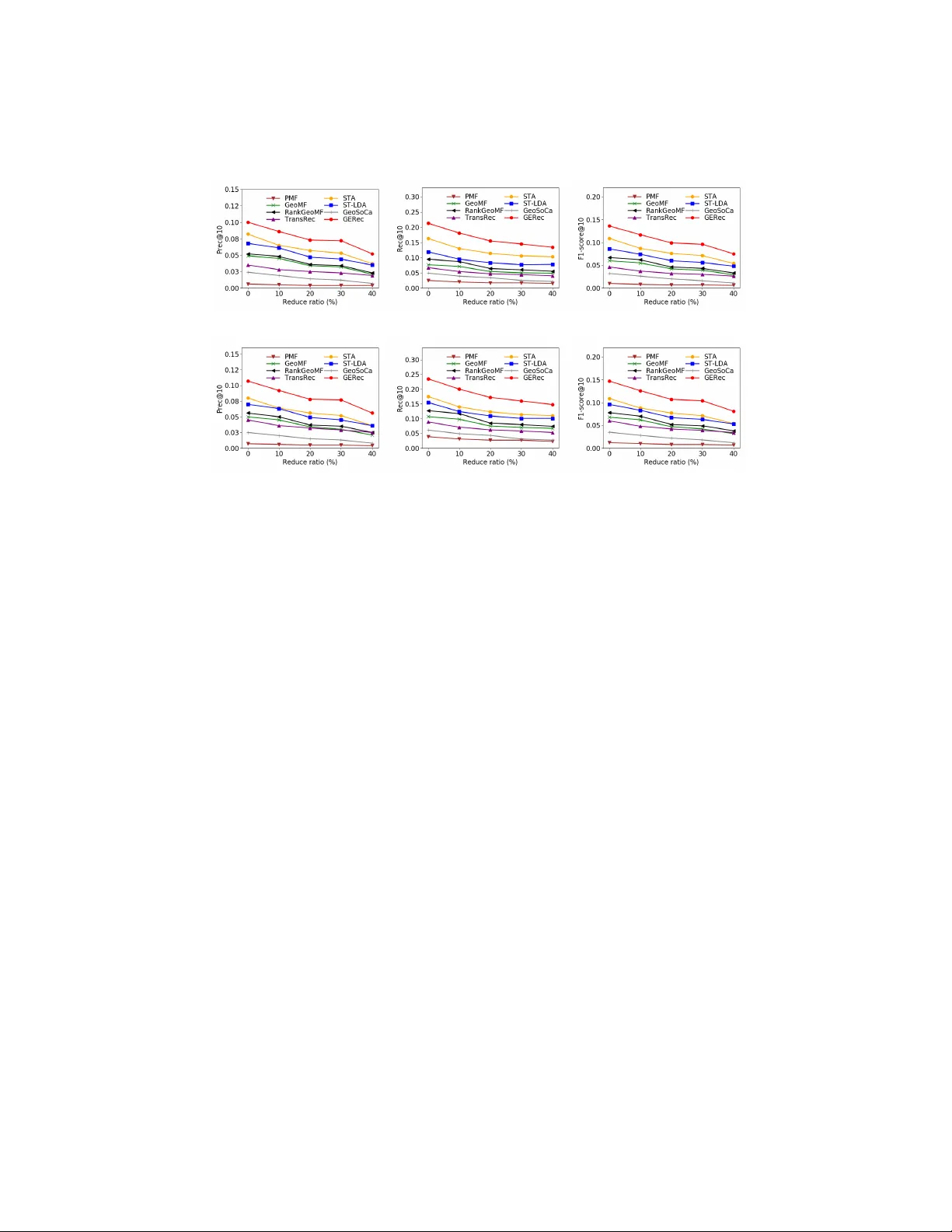
Relation Em b edding for P ersonalised T ranslation-based POI Recommendation Xianjing W ang 1 , 2 , Flora D. Salim 1 , 4 [0000 − 0002 − 1237 − 1664] , Y ongli Ren 1 [0000 − 0002 − 3137 − 9653] , and Piotr Koniusz 2 , 3 ? 1 RMIT Univ ersity , Melb ourne, Australia { xianjing.wang, flora.salim, yongli.ren } @rmit.edu.au 2 Data61/CSIR O, Canberra, Australia piotr.koniusz@data61.csiro.au 3 Australian National Univ ersity , Can b erra, Australia 4 Corresp onding author Abstract. P oint-of-In terest (POI) recommendation is one of the most imp ortan t lo cation-based services helping people discov er interesting v en ues or services. How ever, the extreme user-POI matrix sparsit y and the v ary- ing spatio-temp oral context p ose challenges for POI systems, whic h af- fects the qualit y of POI recommendations. T o this end, we propose a translation-based relation embedding for POI recommendation. Our ap- proac h enco des the temp oral and geographic information, as well as se- man tic conten ts effectively in a low-dimensional relation space by using Kno wledge Graph Embedding techniques. T o further alleviate the issue of user-POI matrix sparsity , a combined matrix factorization framework is built on a user-POI graph to enhance the inference of dynamic per- sonal interests by exploiting the side-information. Exp erimen ts on t wo real-w orld datasets demonstrate the effectiveness of our proposed mo del. Keyw ords: Knowledge graph embedding · Collab orativ e filtering · Ma- trix factorization · Recommender system · POI recommendation. 1 In tro duction With the increase of mobile devices on the market and ubiquitous presence of wireless communication netw orks, p eople gain easy access to Poin t-of-Interest (POI) recommendation services. A great n umber of Lo cation-based So cial Net- w orks (LBSNs) hav e consequen tly b een established e.g ., F oursquare, Go walla, F aceb ook Places, and Brightkite. The LBSNs often provide POI services that recommend users new POI ven ues that meet sp ecific user criteria. In this pap er, w e develop a high qualit y p ersonalized POI recommendation system by leverag- ing user c heck-in data. There are three technical challenges listed as follows: Sparsit y of user chec k-in data. One of the ma jor challenges is to ov ercome the sparsit y in the user chec k-in data. The user-POI matrix can be extremely sparse despite of millions of POIs and users in LBSNs. ? This pap er is accepted by the P AKDD’20. 2 X. W ang et al. T emporal reasoning. Lo cation-based POI recommendation systems utilize the temp oral context [24] for the purp ose of mo deling p ersonal preferences. The temp oral information reflects users’ needs and choices throughout the day . Spatial reasoning. A user’s curren t geographical lo cation limits their choice of c heck-in POIs [13]. Many approaches mo del relations betw een a user’s curren t geographical lo cation and their preferences with resp ect to the surrounding POIs. Fig. 1: Ov erview of our GERec mo del. h r − → t user 12 pm − → e 1 f oodcourt − − − − − − → sushi shop ( h, r, t ) ( u, r t , e 1 ) and ( e 1 , r l , v ) ( u, r t ◦ r l , v ) h + r = t u + r t = e 1 and e 1 + r l = v u + ( r t ◦ r l ) = v T able 1: Relation path em bedding. The ab o ve issues are often addressed b y the use of side information in tra- ditional recommendation systems. Such a side information may b e retrieved from so cial net works [9] and ma y include user demographic information, item attributes, and context information [26]. As the auxiliary data is useful for the recommendation systems [19], it is desirable to mo del and utilize heteroge neous and complex data types in recommendation systems. How ev er, the traditional collab orativ e filtering techniques suc h as Matrix F actorization (MF) cannot deal with the ab o ve problems in a unified manner. Knowledge Graph Em b edding (K GE) [21,1], also known as a translation-based embedding mo del, enco des the side-information to improv e the p erformance of Recommender Systems (RS) [16,27]. He et al . [6] and Zhang et al . [27] employ the KGE mo del to represen t users, mo vies, and movie attributes. The graph edges represent connections b e- t ween users and mo vies in a knowledge base [6,27]. Ho w ever, previous studies do not offer insights on the following c hallenges: (1) how to construct a user- POI graph that utilizes the user chec k-in data with side information, such as spatio-temp oral data and seman tic context information, to leverage data spar- sit y problem; (2) how to effectively integrate a translation-based embedding mo del with a traditional recommendation system to improv e the quality of POI recommendation. Problem definition. Giv en an LBSN user chec k-in dataset, w e aim to recom- mend each user with personalized top- k POIs they may be interested in visiting. W e build up on recent adv ances in graph embedding metho ds and prop ose Gr aph Emb e dding for POI R e c ommendation , a no v el translation-based graph em- b edding approach sp ecifically for POI recommendation, abbreviated as GER e c . T o ov ercome the challenge stemming from the spatio-temp oral context, GERec enco des temp oral and spatial information, as w ell as user dynamic chec k-in ac- tivities in a low-dimensional latent space. GERec addresses the issues of user Relation Em b edding for Personalised POI Recommendation 3 c heck-in data sparsity b y integrating user-POI graph em b edding with a com- bined matrix factorization framew ork (Fig. 1). Con tributions. I. T o deal with the data sparsity , w e prop ose a nov el translation-based POI recommendation mo del to effectively form a user-POI graph capturing the side information, suc h as spatial, temp oral, and semantic con tents. I I. W e prop ose a spatio-temporal relation path embedding to mo del the tem- p oral, spatial and seman tic conten t information to impro ve the quality of POI recommendations. I II. W e show our mo del outp erforms the state-of-the-art POI recommendation tec hniques on t wo real-world LBSN datasets, F oursquare[2] and Gow alla[3]. 2 Related W ork POI recommendations. Making p ersonalized POI recommendations is c hal- lenging due to the user dynamic c heck-in activities. Existing studies on MF-based POI recommendations either focus on aggregating spatially-wise p ersonal prefer- ence or exploring temp oral influences. Most aggregation-based POI recommenda- tion approac hes fail to capture jointly geographical and temp oral influences with the seman tic context while addressing the data sparsity in an unified framework. In [22,25], geographical lo cations are used to improv e the p erformance of POI system whic h highligh ts that there is a strong correlation b etw een user chec k- in activities and geographical distance. Geographical sparse additive generative mo del [22] for POI recommendations, Geo-SAGE, exploited co-o ccurrence pat- terns with conten ts of spatial items. A POI system [25] based on deep learning from heterogeneous features and hierarc hically additive representation learning prop osed spatially-aw are mo del for p ersonal preferences. Kno wledge Graph Embedding. K GE is well kno wn for its use in recommen- dation systems. Zhang et al . [27] prop osed a collab orativ e KG-in tegrated movie recommender framew ork to learn the latent and visual representations. Palum b o et al . [16] proposed entity2r e c to capture a user-item relatedness from K GEs with the goal of generating top- k item recommendations. Qian et al . [18] adopts K GE to mo del the side information in POI recommendation system. Their work only fo cuses on embedding the user and POI entities, and mapping the spatio- temp oral patterns as a translation matrix. Although their work explored KGEs and RS, it did not integrate graph em b edding with the traditional MF mo del. Compared with our prop osed mo del that combines the spatial and temp oral in- formation with semantic conten ts in a semantic relation embedding space, these K G em b edding-based recommender mo dels hav e limited expressive abilities as they model the key parameters ( e.g ., spatial and temp oral information) as a sim- ple matrix. Finally , noteworth y is the family of Graph Con volutional Netw orks with mo dels suc h as GCN [7], GraphSA GE [5], adversary GCN [20], kernel-based CKN [14] as well as generic graph embedding approac hes such as DeepW alk [17] and No de2V ec [4] which all hav e the capacity to mo del graph-related tasks. 4 X. W ang et al. Difference with existing w orks. 1) T o the b est of our kno wledge, this is the first work that in vestigates the join t mo deling of temp oral, geographical and seman tic category information integrated with KG embedding POI recommen- dation system; 2) A no vel em b edding is prop osed to bridge the gaps b et w een em b edding and traditional MF. Therefore, we prop ose a nov el combined MF framew ork for dynamic user-POI preference mo deling based on the learned em- b edding in a unified manner; 3) In con trast to the approac h [24] based on the bipartite graph (homogeneous graph), our approac h uses the translation-based graph (heterogeneous graph). Moreov er, approach [24] do es not apply MF while our mo del inv estigates MF for generating top- k proposals. 3 Prop osed Approac h 3.1 User-POI Graph Em b edding A heterogeneous graph admits tw o or more node t yp es whic h can b e then embed- ded b y a symmetric function e.g ., one can use in terc hange user typ e and POI typ e input argumen ts. F or the b est recommendation p erformance, w e develop an effective representation for the user and POI nodes. A user u and a POI v represen t the head or tail of a triplet ( head, r elation, tail ), denoted as ( u, r, v ), where u , e , v ∈ R k are the v ector representations of u , r and v . Head-tail en tity pairs usually exhibit div erse patterns in terms of relations [12]. Thus, a single relation vector cannot p erform all translations b et ween head and tail entities. F or example, the relation path embedding has the div ersity patterns, such as temp oral, spatial and semantic con tents patterns. The relation b et w een user (head) and POI (tail) “user - sushi shop” exhibits many patterns: (i) T emp oral pattern i.e ., a user visits a POI in a certain time slot < user, /time slot, POI > ; (ii) Geographical pattern i.e ., a user visits a POI when she is in a particular area < user, /lo cation, POI > ; and (iii) Semantic conten t pattern i.e ., a user visits a sp ecific POI that is asso ciated with a category < user, /category , POI > . In our mo del, w e embed spatio-temp oral information as a relationship connecting users and POIs. T ak e the 2-step path as an example. In T able 1, a user chec k-in activity (a user visits a POI) is asso ciated with temp oral and geographical patterns i.e ., user 12 pm − → e 1 f oodcourt − − − − − − → sushi shop denotes a user visiting a sushi shop (POI) at 12pm (time slot) at fo o d court (lo cation). Instead of building triplets ( u, r t , e 1 ) and ( e 1 , r l , v ) for learning the graph represen tation, we form a triplet ( u, r t ◦ r l , v ), and optimize the ob jectiv e u + ( r t ◦ r l ) = v . The comp osition op erator ◦ merges the temporal and spatial relations r t and r l in to the spatio-temp oral relation. Giv en a relation path r = ( r 1 , . . . , r n ), we obtain the relation path embedding r b y comp osing multiple relations via the op erator ◦ , i.e ., r = r 1 ◦ · · · ◦ r n . F or the comp osition op erator, we use the multiplication op eration. Th us, the relation path vector is defined as r = r 1 × · · · × r n . In our mo del, w e embed temp oral and geographical patterns, and semantic category conten ts into the relation path. F or instance, u r t − → e 1 r l − → e 2 r c − → v illustrates that a us er visits a POI at Relation Em b edding for Personalised POI Recommendation 5 a certain time slot t in lo cation l , whic h has semantic category information c asso ciated with the user’s curren t lo cation. W e define a spatio-temp oral and seman tic-based relation path represen tation r tlc = r t ◦ r l ◦ r c , which consists of a temp oral relation path r t , a geographical relation path r l , and a semantic relation path r c . The relation r tlc is used as our default relation representation in our POI mo del. In what follows, we write r instead of r tlc for simplicit y . T ransR [12,21] is among the most represen tative translational distance mo d- els for a heterogeneous graphs. W e apply T ransR [12] to our POI recommen- dation mo del. F or eac h triplet, including ( u, r tl , v ) and ( u, r tlc , v ) in the graph, en tities are embedded in to v ectors u , v ∈ R k and relation is embedding in to r ∈ R d . F or each relation r , we set a pro jection matrix from the en tity space to the relation space, denoted as M r ∈ R k × d . T ransR firstly maps entities u and v in to the subspace of relation r by using matrix M r : u r = u M r and v r = v M r , (1) and the T ransR score function is defined as: f r ( u, v ) = k u r + r − v r k 2 2 . (2) The follo wing margin-based ranking loss defined in [12] is used for training: L = X ( u,r,v ) ∈ S X ( u 0 ,r,v 0 ) ∈ S 0 max (0 , f r ( u, v ) + γ − f r ( u 0 , v 0 )) , (3) where γ controls the margin b et ween p ositiv e and negative samples, S and S 0 are the set of p ositiv e and negative triplets, respectively . The existing graphs that w e construct from user-POI chec k-in datasets contain mostly correct triplets. Th us, we corrupt the correct triplet ( u, r, v ) ∈ S to construct incorrect triplets ( u 0 , r , v 0 ) by replacing either head or tail en tities with other entities from the same group so that: S 0 = { ( h 0 , r , t ) } ∪ { ( h, r, t 0 ) } . (4) W e note that translation-based em b edding provides a generic wa y for extract- ing a useful information from a graph. How ev er, embedding cannot b e applied directly to matrix factorization models. Thus, we prop ose a function g ( · ) that extracts the learnt entities. Given an en tity u , v and a relation r , w e obtain rep- resen tation sets { e r u } and { e r v } , where r denotes the set of relation paths, where e r u and e r v represen t a user u and a POI v with resp ect to the sp ecific relation path r . Thus, the entit y extraction is denoted as: { φ u } ← g ( { e r u } ) , { φ v } ← g ( { e r v } ) , (5) where { φ u } and { φ v } are sets of final represen tations for user and POI em- b edding, respectively . The function g ( · ) prepares the embedded user and POI information to b ecome the entries for the matrix factorization by sorting the learn t user and POI embedding sets based on the distances from Eq. (2) sorted according to the descending order. Em b edded pairs that are further from eac h 6 X. W ang et al. other than some θ are pruned. When a user connects with a POI by a relation ( u + r ≈ v ), the smaller the score v alue, the lo w er distance betw een POI and user is. Hence, ( v + r ≈ u ) vice versa. Then, the sorted user and POI embedding sets are filtered according to the user’s current location. In many cases, POIs ma y be outside of the user’s home lo cation and it may b e not reasonable to recommend such POIs. Thus, w e set a reasonable radius w.r.t. the geographical lo cation by applying a threshold θ d to filter the learn t POIs that are too far a w ay from user’s home lo cation. F ollowing [10,23], we assume a Gaussian distribution for user current lo cation l , and we set the user’s current c heck-in POI v l so that v l ∼ N ( µ l , Σ l ). 3.2 The Combined Matrix F actorization W e in tegrate the matrix factorization into our mo del by com bining t w o parts: 1) sp atio-temp or al MF and 2) User pr efer enc e MF . The spatio-temp oral MF calculates the probability that a user will visit a POI. The user preference MF ev aluates user’s preference w.r.t. a POI. The com bined probabilit y determines the total probabilit y of a user u visiting a POI v . Spatio-temp oral MF. F or eac h embedded user vector φ u and embedded POI v ector φ v , we apply the matrix factorization to predict a probability that a user u would visit a POI v based on her current lo cation l and a particular time slot t . Given a frequency matrix P 0 ∈ R |{ φ u }|×|{ φ v }| , which represents the n umber of c heck-ins of the embedded users for the embedded POIs. MF is p erformed by finding tw o low-rank matrices: a user sp ecific matrix E ∈ R K ×|{ φ u }| and a POI sp ecific matrix O ∈ R K ×|{ φ v }| , where K is the dimension of the laten t v ector that captures the corresp onding user-POI preference transition. The probability of an embedded user u based on a particular spatio-temp oral relation r tl and em b edded lo cation v , is determined b y: P 0 uv = E u > O v , (6) where E u and O v are vectors for the user u and the POI v from matrices E and O , resp ectiv ely , while P 0 uv is a scalar frequency for u and v . The goal of matrix factorization is to accurately appro ximate the probabilities for the user frequency data: min E , O α ( k E k 2 F + k O k 2 F ) + X ( u,v ) ∈ Ω ( P 0 uv − E u > O v ) 2 , (7) where ( u, v ) ∈ Ω indicates the observ ed frequency of user u at POI v , || · || 2 F is the F rob enius norm, and α ( k E k 2 F + k O k 2 F ) is a regularization term to prev ent ov erfitting. Relation Em b edding for Personalised POI Recommendation 7 User preference MF. The second part of the com bined MF mo del is to predict the user preference given a POI. Based on the user historical chec k-in frequency , giv en an observ ed frequency matrix F , MF factorizes users and POIs so that F ≈ U > V . Then, scalar P 00 uv captures users’ preference at a POI determined by the follo wing equation: P 00 uv = U > u V v (8) The same ob jective as in Eq. (7) is applied to accurately approximate the prob- abilities for the user c heck-in frequencies. Com bined Matrix F actorization. W e prop ose a combined MF mo del that is simply a pro duct of probabilities that 1) a user is spatio-temp orally compatible with a POI and 2) the user has a preference giv en the POI. The first term is the probabilit y of an embedded user visiting an embedded POI given some spatio-geographic pattern, where P 0 uv is defined by Eq. (6). The second term is the probability of the user’s preference at a POI based on her historical records, where P 00 uv is defined in Eq. (8). The com bined mo del is denoted as: P uv = P 0 uv · P 00 uv . (9) 4 Exp erimen ts 4.1 Exp erimen tal Configuration Datasets. W e adopt tw o p opular large-scale LBSN datasets: F oursquare [2] and Gow alla [3]. The exp erimental results for our approach and the baselines are compared in the same testb ed. W e selected the F oursquare dataset from Sep 2010 to Jan 2011 which contains 1,434,668 users chec k-in activities in the USA. The F oursquare geographical area is divided into a set of 5846 lo cations/regions according to administrativ e divisions. There are 114 , 508 user entities and 62 , 462 POI en tities connected with 46 , 768 spatio-temp oral relations. F or Gow alla, an- other graph is built from 107 , 092 user en tities and 1 , 280 , 969 POI entities con- nected with 1 , 633 relations. W e apply k -means [26,18] to form 200 region clusters for Go walla geographical area. Baselines. Two of the baseline models are translation-based mo dels that are highly related work in RS [6,18]. PMF [15] is a classic probabilistic matrix fac- torization model that explicitly factorizes the rating matrix in to t wo low-rank matrices. GeoMF [9] is a weigh ted matrix factorization mo del for POI recom- mendations. Rank-GeoFM [8] is a ranking-based geographical factorization mo del in which the c heck-in frequency characterizes users’ visiting preference, and the factorization is learn t by ranking POIs. GeoSoCa mo del [28] extends the kernel densit y estimation by applying an adaptiv e bandwidth learnt from the user c heck-in data. ST-LDA [26] is a latent class probabilistic generative Spatio-T emp oral LDA (Latent Diric hlet Allo cation) mo del, whic h learns the region-dep enden t p ersonal interests according to the con tents of the chec ked-in 8 X. W ang et al. POIs at each region. T ransRec is the translation-based recommendation ap- proac h prop osed in [6], whic h embeds items into a translation space and mo dels users via a translation vector. Note that our prop osed metho d is different from T ransRec as we select b oth users and POIs as entities, and learn the embedding represen tation for a differen t t yp e of kno wledge as well as the spatio-temp oral re- lationships. ST A [18] is a spatio-temp oral context-a ware and translation-based POI recommendation mo del. How ever, this solution do es not consider the seman- tic relation embedding of spatial, temp oral and category conten t information, and th us is incapable of leveraging the user-POI graph structure. Ev aluation Metrics. F ollo wing [9,8,28], we deplo y the following ev aluation metho dology . The user-POI graph is built from historical user chec k-in activities in the training set. The spatio-temp oral relations in the user-POI graph are com- p osed based on each user’s curren t time slot and the area from the given query q = ( u, l, t ). W e divide the time slot to differen t hour lengths (1 , 2 , 4 , 8 , 12 , 24). The user’s curren t standing area b efore visiting v is selected for her lo cation l . In the exp eriment, w e first calculate the frequency for each user visiting ground- truth POIs. W e use the 80% as the cut-off p oin t so that c heck-ins b efore a partic- ular date are used for training. The rest c heck-in data generated after this date is c hosen for testing. W e form a top- k recommendation list from the top k POI rec- ommendations. W e deploy measuremen t metrics such as Precision@ k ( P r ec @ k ), Recall@ k ( Rec @ k ) and F1-score@ k ( F @ k ): P r ec @ k = 1 M P M u =1 | V u ( k ) ∩ V u | k and Rec @ k = 1 M P M u =1 | V u ( k ) ∩ V u | | V u | . 4.2 Main ev aluations F ollo wing [12,11], for translational distance mo del T ransR, w e set the learning rate λ = 0 . 001, the margin γ = 1, the dimensions of en tit y embedding and re- lation embedding d = 100, the batch size B = 120. W e trav erse all the training triplets for 1000 rounds on b oth F oursquare and Gow alla datasets. Fig. 2 rep orts the performance of the POI recommendation mo dels on F oursquare and Go w alla datasets, resp ectiv ely . W e present the p erformance for k = { 1 , 5 , 10 , 20 } . Fig. 2 presen ts the results of algorithms in terms of P r ec @ k , Rec @ k and F 1@ k on F oursquare and Go walla datasets. The figure show that the proposed GERec mo del outperforms all baseline mo dels significan tly for all metrics at different k v alues. Sp ecifically , when comparing with the traditional MF mo dels, GERec outp erforms the Rank-GeoMF, whic h is the MF baseline with the best p erfor- mance, by 50% and 47% in F1-score@10 on F oursquare and Go walla, resp ectiv ely . When comparing with translation-based mo dels, our proposed mo del also im- pro ves the POI recommendation p erformance significantly . GERec outp erforms ST A, by 20% and 25% in F1-score@10 on b oth datasets. This demonstrates the capabilit y of our graph-based GERec mo del to generate high qualit y POI rec- ommendations. Although GeoSoCa exploits so cial influences, geographical lo ca- tions and user interests, the simple kernel density estimation results in the p oor p erformance. This v alidates the effectiv eness of our GERec solution, esp ecially our prop osed step whic h exploits and integrates the user-POI interactions and Relation Em b edding for Personalised POI Recommendation 9 (a) Prec@K on F oursquare (b) Rec@K on F oursquare (c) F1@K on F oursquare (d) Prec@K on Gow alla (e) Rec@K on Gow alla (f ) F1@K on Gow alla Fig. 2: Baseline comparisons. spatio-temp oral patterns to tac kle the sparsit y in the user-POI chec k-in data. The learned embeddings are well in tegrated into the combined matrix factor- ization mo del. Thus, GERec achiev es the b est p erformance among all compared baseline mo dels. The user-POI graph constructed from Gow alla dataset has few er relation edges than the F oursquare graph, as Gow alla relation patterns r tl ha ve few er regions in the relation paths than F oursquare. 4.3 Impact of data sparsity In Fig. 3, we conduct extensive exp erimen ts to ev aluate the p erformance of the mo dels under the data sparsity . Sp ecifically , we create multiple datasets with v arious sparsit y lev els by reducing the amount of training data randomly b y 10%, 20%, 30%, and 40% of the total amount of data (b efore the cut-off date), and at the same time keeping the test data the same. The results on b oth F oursquare and Go walla are shown in the Fig. 3. Specifically , the 0 in the horizontal axis presen ts the experiment result without reducing the training data. W e observe that the Precision@ k and Recall@ k v alue decrease for all baseline models. F or example, the performance of these mo dels in terms of Prec@10 decreases at least 40% on F oursquare when reducing 40% of the training data. Results of the ST- LD A drop significantly compared with the other baseline mo dels with 37% drop in Rec@10 on b oth F oursquare and Gow alla, whic h indicates that the LDA- based model is sensitiv e to the sparse data. The PMF does not c hange m uch, ho wev er, it remains the least accurate result. The Rec@10 v alues of RankGeoMF, T ransRec, and ST A show a 42%, 41%, and 37% drop, resp ectiv ely . The GERec 10 X. W ang et al. (a) Prec@10 on F oursquare (b) Rec@10 on F oursquare (c) F1@10 on F oursquare (d) Prec@10 on Gow alla (e) Rec@10 on Gow alla (f ) F1@10 on Gow alla Fig. 3: Sensitivit y to data sparsity . drops b y only 34%, which illustrates that our proposed mo del is more stable and robust under sparsit y than the baselines. 4.4 Impact of time slot and dimensionality There are t w o parameters in the prop osed GERec model: the time slot h and the embedding dimension d . Below, we in vestigate the effect of these tw o pa- rameters. T able 2 shows the impact of the length of time slot on Precision@ k and Recall@ k . The length of the time slot affects the quality of POI recommen- dations. When the length of time slot changes, the relation paths change and the en tire graph needs to be computed again. W e split da y activities in to dif- feren t lengths. The parameter h denotes the length of eac h time slot in hours. The larger length of time slot the less the time influence on recommendation results. W e rep ort the top- k recommendation precision and recall for eac h time slot on the F oursquare and Gow alla datasets. F rom the exp erimen tal results w e observ e that the POI recommendation accuracy improv es when the time slot length increases. The recommendation accuracy reac hes a p eak point for 8 hours long time slot. Then, it starts decreasing as the time slot keeps increasing. The reason for the improv ed accuracy is that the larger time length, the denser the data. Hence, there are more user chec k-in records at each time slot for generat- ing recommendations. How ev er, the recommendation accuracy decreases as the length of the time slot reaches 8 hours. This is b ecause when the length of the time slot is large enough, it may reduce the influence of temp oral pattern. More- o ver, we study the impact of v arying dimension d of the relation embedding by Relation Em b edding for Personalised POI Recommendation 11 Hours F oursquare Gow alla Prec@1 Prec@10 Prec@20 Rec@1 Rec@10 Rec@20 Prec@1 Prec@10 Prec@20 Rec@1 Rec@10 Rec@20 1 0.075 0.061 0.041 0.062 0.128 0.163 0.089 0.064 0.047 0.071 0.141 0.169 2 0.100 0.083 0.054 0.082 0.170 0.218 0.119 0.086 0.062 0.094 0.150 0.225 4 0.113 0.090 0.060 0.092 0.192 0.245 0.134 0.096 0.070 0.106 0.168 0.253 8 0.125 0.100 0.067 0.103 0.213 0.272 0.149 0.107 0.078 0.118 0.187 0.281 12 0.119 0.095 0.064 0.098 0.202 0.258 0.142 0.102 0.074 0.112 0.178 0.267 24 0.115 0.092 0.062 0.094 0.196 0.250 0.137 0.098 0.072 0.108 0.172 0.259 T able 2: Impact of the time slot length h . d F oursquare Gow alla Prec@1 Prec@10 Prec@20 Rec@1 Rec@10 Rec@20 Prec@1 Prec@10 Prec@20 Rec@1 Rec@10 Rec@20 70 0.121 0.097 0.065 0.099 0.206 0.262 0.143 0.123 0.075 0.113 0.226 0.270 80 0.123 0.098 0.066 0.101 0.209 0.267 0.146 0.125 0.076 0.115 0.183 0.275 90 0.124 0.099 0.066 0.102 0.211 0.269 0.148 0.127 0.077 0.117 0.185 0.278 100 0.125 0.100 0.067 0.103 0.213 0.272 0.149 0.128 0.078 0.118 0.187 0.281 110 0.126 0.100 0.067 0.103 0.214 0.273 0.150 0.129 0.078 0.118 0.188 0.282 120 0.126 0.101 0.067 0.103 0.214 0.274 0.150 0.129 0.079 0.119 0.188 0.283 T able 3: Impact of dimensionalit y d . setting it to { 70 , 80 , 90 , 100 , 120 } (T able 3). The best parameter is determined according to the mean rank in the test set. The accuracy rate increases gradually when the dimension increases. Specifically , the accuracy keeps increasing un til the dimension reac hes 100, then it remains stable. 5 Conclusions In this paper, w e prop ose a no v el translation-based POI recommendation model, whic h can effectiv ely construct a user-POI graph and mo del the side informa- tion. T o address time and geographical reasoning, w e propose spatio-temp oral relation path em b edding to mo del the temp oral, spatial and semantic conten ts to leverage the user-POI interaction and improv e the quality of user embedding. T o ov ercome the sparsity of the user-POI in teraction data, w e dev elop an em- b edding function which bridges gaps b etw een the translation-based em b edding mo del and traditional MF-based mo del. The user-POI graph is integrated with a com bined MF mo del to impro ve the quality of POI recommendations. Ac kno wledgments W e ackno wledge the supp ort of Australian Research Council Discov ery DP190101485 , Alexander v on Humboldt F oundation, and CSIRO Data61 Sc holarship program. References 1. Cai, H., Zheng, V.W., Chang, K.C.C.: A comprehensiv e survey of graph embed- ding: Problems, tec hniques, and applications. TKDE 30 (9), 1616–1637 (2018) 12 X. W ang et al. 2. Cheng, Z., Ca verlee, J., Lee, K., Sui, D.Z.: Exploring millions of fo otprin ts in lo cation sharing services. In: AAAI (2011) 3. Cho, E., Myers, S.A., Lesko vec, J.: F riendship and mobility: user mov ement in lo cation-based so cial netw orks. In: SIGKDD. pp. 1082–1090 (2011) 4. Gro ver, A., Lesk o vec, J.: No de2V ec: Scalable F eature Learning for Netw orks. In: KDD. pp. 855–864 (2016) 5. Hamilton, W., Ying, Z., Lesko v ec, J.: Inductive Representation Learning on Large Graphs. In: NIPS, pp. 1024–1034. Curran Asso ciates, Inc. (2017) 6. He, R., Kang, W.C., McAuley , J.: T ranslation-based recommendation. In: RecSys. pp. 161–169 (2017) 7. Kipf, T.N., W elling, M.: Semi-Sup ervised Classification with Graph Conv olutional Net works. In: ICLR (2017) 8. Li, X., Cong, G., Li, X.L., Pham, T.A.N., Krishnaswam y , S.: Rank-geofm: A rank- ing based geographical factorization metho d for p oin t of interest recommendation. In: SIGIR. pp. 433–442 (2015) 9. Lian, D., Zhao, C., Xie, X., Sun, G., Chen, E., Rui, Y.: Geomf: joint geographical mo deling and matrix factorization for point-of-in terest recommendation. In: KDD. pp. 831–840 (2014) 10. Lic hman, M., Smyth, P .: Mo deling human lo cation data with mixtures of kernel densities. In: SIGKDD. pp. 35–44 (2014) 11. Lin, Y., Liu, Z., Luan, H., Sun, M., Rao, S., Liu, S.: Mo deling relation paths for represen tation learning of knowledge bases. In: EMNLP . pp. 705–714 (2015) 12. Lin, Y., Liu, Z., Sun, M., Liu, Y., Zh u, X.: Learning en tit y and relation embeddings for kno wledge graph completion. In: AAAI. pp. 2181–2187 (2015) 13. Liu, X., Liu, Y., Ab erer, K., Miao, C.: P ersonalized p oin t-of-interest recommenda- tion b y mining users’ preference transition. In: CIKM. pp. 733–738 (2013) 14. Mairal, J., Koniusz, P ., Harc haoui, Z., Sc hmid, C.: Conv olutional Kernel Net w orks. In: NIPS, pp. 2627–2635. Curran Asso ciates, Inc. (2014) 15. Mnih, A., Salakhutdino v, R.R.: Probabilistic matrix factorization. In: NIPS. pp. 1257–1264 (2008) 16. P alumbo, E., Rizzo, G., T roncy , R.: Entit y2rec: Learning user-item relatedness from kno wledge graphs for top-n item recommendation. In: RecSys (2017) 17. P erozzi, B., Al-Rfou, R., Skiena, S.: DeepW alk: Online Learning of So cial Repre- sen tations. In: KDD. pp. 701–710 (2014) 18. Qian, T., Liu, B., Nguyen, Q.V.H., Yin, H.: Spatiotemporal represen tation learning for translation-based p oi recommendation. TOIS 37 (2), 18 (2019) 19. Shi, C., Hu, B., Zhao, W.X., Philip, S.Y.: Heterogeneous information net work em b edding for recommendation. TKDE 31 (2), 357–370 (2018) 20. Sun, K., Koniusz, P ., W ang, Z.: Fisher-bures adversary graph conv olutional net- w orks. In: UAI (2019) 21. W ang, Q., Mao, Z., W ang, B., Guo, L.: Knowledge graph embedding: A survey of approac hes and applications. TKDE 29 (12), 2724–2743 (2017) 22. W ang, W., Yin, H., Chen, L., Sun, Y., Sadiq, S., Zhou, X.: Geo-sage: A geographical sparse additiv e generativ e model for spatial item recommendation. In: KDD (2015) 23. W ang, W., Yin, H., Du, X., Nguyen, Q.V.H., Zhou, X.: Tpm: A temp oral p erson- alized mo del for spatial item recommendation. ACM TIST 9 (6), 61 (2018) 24. Xie, M., Yin, H., W ang, H., Xu, F., Chen, W., W ang, S.: Learning graph-based p oi embedding for lo cation-based recommendation. In: CIKM. pp. 15–24 (2016) 25. Yin, H., W ang, W., W ang, H., Chen, L., Zhou, X.: Spatial-a ware hierarchical col- lab orativ e deep learning for poi recommendation. TKDE 29 (11), 2537–2551 (2017) Relation Em b edding for Personalised POI Recommendation 13 26. Yin, H., Zhou, X., Cui, B., W ang, H., Zheng, K., Nguy en, Q.V.H.: Adapting to user in terest drift for p oi recommendation. TKDE 28 (10), 2566–2581 (2016) 27. Zhang, F., Y uan, N.J., Lian, D., Xie, X., Ma, W.Y.: Collab orativ e knowledge base em b edding for recommender systems. In: SIGKDD. pp. 353–362 (2016) 28. Zhang, J.D., Chow, C.Y.: Geoso ca: Exploiting geographical, so cial and categorical correlations for p oin t-of-interest recommendations. In: SIGIR. pp. 443–452 (2015)
Original Paper
Loading high-quality paper...
Comments & Academic Discussion
Loading comments...
Leave a Comment