Pipeline Interventions
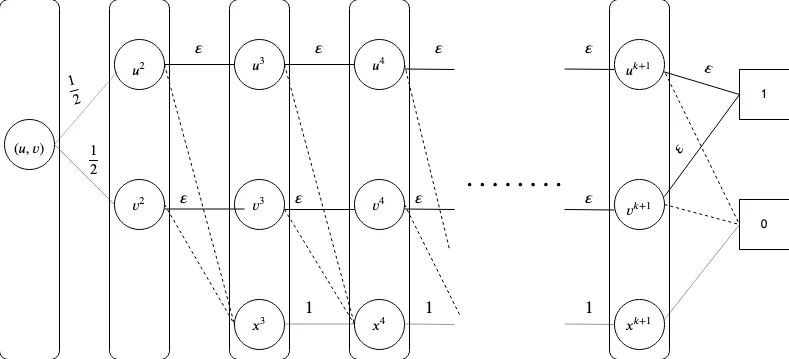
We introduce the \emph{pipeline intervention} problem, defined by a layered directed acyclic graph and a set of stochastic matrices governing transitions between successive layers. The graph is a stylized model for how people from different populations are presented opportunities, eventually leading to some reward. In our model, individuals are born into an initial position (i.e. some node in the first layer of the graph) according to a fixed probability distribution, and then stochastically progress through the graph according to the transition matrices, until they reach a node in the final layer of the graph; each node in the final layer has a \emph{reward} associated with it. The pipeline intervention problem asks how to best make costly changes to the transition matrices governing people’s stochastic transitions through the graph, subject to a budget constraint. We consider two objectives: social welfare maximization, and a fairness-motivated maximin objective that seeks to maximize the value to the population (starting node) with the \emph{least} expected value. We consider two variants of the maximin objective that turn out to be distinct, depending on whether we demand a deterministic solution or allow randomization. For each objective, we give an efficient approximation algorithm (an additive FPTAS) for constant width networks. We also tightly characterize the “price of fairness” in our setting: the ratio between the highest achievable social welfare and the highest social welfare consistent with a maximin optimal solution. Finally we show that for polynomial width networks, even approximating the maximin objective to any constant factor is NP hard, even for networks with constant depth. This shows that the restriction on the width in our positive results is essential.
💡 Research Summary
The paper introduces a formal model for “pipeline interventions” in which a population moves through a series of stages represented by a layered directed acyclic graph (DAG). Each layer contains w nodes (the width of the pipeline) and edges exist only between consecutive layers. Individuals are born into a node of the first layer according to a fixed distribution D₁ and then follow a Markov process defined by stochastic transition matrices M₀¹,…,M₀^{k‑1} that specify the probabilities of moving from one layer to the next. The final layer contains nodes with distinct rewards R(v). The expected reward for a person starting at node u is R·M_{k‑1}·…·M₁·e_u.
A central planner has a total budget B and may modify some of the transition probabilities (the “malleable” edges) at a linear cost c(Mᵗ,M₀ᵗ)=∑|Mᵗ(i,j)−M₀ᵗ(i,j)|. The planner’s goal is to choose new transition matrices (M¹,…,M^{k‑1}) within the budget to optimize one of three objectives:
- Social welfare maximization – maximize the overall expected reward of a randomly drawn individual, i.e., W = R·M_{k‑1}·…·M₁·D₁.
- Ex‑post maximin – choose a deterministic set of matrices and maximize the minimum expected reward across all initial nodes: max min_j R·M_{k‑1}·…·M₁·e_j.
- Ex‑ante maximin – allow a distribution over feasible matrix modifications; the objective is the maximum over such distributions of the worst‑case expected reward.
The authors provide several algorithmic and complexity results:
-
Additive FPTAS for constant width – When the width w is a constant (independent of the number of layers k), they give a fully polynomial‑time approximation scheme with additive error ε for both the social‑welfare and the ex‑post maximin problems. The scheme discretizes each transition matrix on an (ε/B)-grid, then uses dynamic programming across layers to select the cheapest set of modifications that achieve a target reward. Because the objective is linear in the final distribution, the DP can be performed in time polynomial in w, k, and 1/ε.
-
Reduction of ex‑ante maximin to a zero‑sum game – The ex‑ante maximin problem is non‑convex because the planner’s randomization interacts with the worst‑case initial node. The paper shows that this problem is equivalent to computing a Nash equilibrium of a two‑player zero‑sum game: the planner (player 1) chooses a feasible distribution over matrix modifications, while nature (player 2) chooses an initial node to minimize the expected reward. Using linear programming and a Lagrangian‑based saddle‑point algorithm, they obtain an additive ε‑approximation in polynomial time for constant‑width pipelines. Combined with the constant‑width DP, this yields an additive FPTAS for the ex‑ante maximin objective as well.
-
Price of fairness – They define the “price of fairness” as the ratio between the optimal social welfare achievable under the budget and the social welfare of a solution that is also ex‑post maximin optimal. Tight upper and lower bounds are derived, showing that the ratio can be as low as a constant (e.g., ½) depending on the reward spread and budget size. This quantifies the efficiency loss that must be accepted to guarantee the worst‑off group’s outcome.
-
Hardness for unbounded width – When the width w is allowed to grow polynomially with the input size, the authors prove that even approximating the maximin objectives within any constant factor is NP‑hard, even if the depth k is constant. The reduction is from classic NP‑hard problems such as Max‑Cut and Independent Set, embedding them into the transition matrices so that improving the worst‑case reward corresponds to solving the underlying combinatorial problem. Consequently, the constant‑width restriction in the positive results is essential.
-
Extensions – Although the main text assumes a simple linear cost function, the authors argue that all algorithmic results extend to any convex, monotone‑increasing cost that dominates the L₁ distance between matrices. This allows modeling of heterogeneous intervention costs (e.g., later‑stage interventions being more expensive).
The paper also discusses policy implications: investing early in the pipeline (e.g., pre‑K education) may be necessary to raise the minimum expected outcome, while later‑stage investments (e.g., job training) tend to increase total welfare but may leave the worst‑off groups behind. The presented framework lets policymakers quantitatively explore these trade‑offs under a fixed budget.
In summary, the work provides a rigorous mathematical formulation of pipeline interventions, delivers efficient additive approximation algorithms for the case of constant pipeline width, establishes tight bounds on the efficiency loss due to fairness constraints, and proves strong hardness results when the width is unrestricted. This bridges algorithmic fairness theory with practical resource allocation in multi‑stage social systems.
Comments & Academic Discussion
Loading comments...
Leave a Comment