Microphysical effects of water content and temperature on the triboelectrification of volcanic ash on long timescales
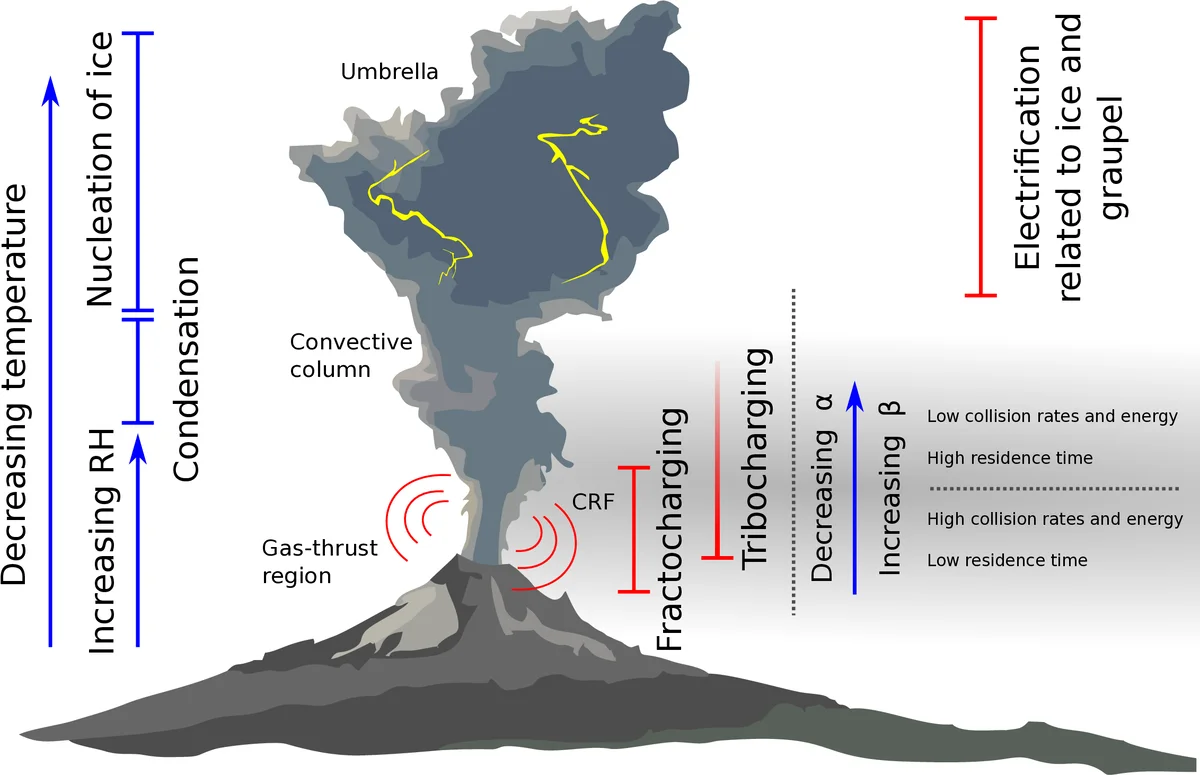
The effects of water and temperature on the triboelectrification of granular materials have been reported by numerous authors, but have not been studied robustly in the context of volcanic plumes. Here, we present the results of a set of experiments designed to elucidate how environmental conditions modulate the triboelectric characteristics of volcanic ash. We find that that small amounts of water can reduce the charge collected by micron-sized ash grains by up to an order of magnitude. Increasing temperature at a constant relative humidity also appears to decrease the amount of charge gained by particles. Analysis of our data shows that if particles undergo low-energy, low-frequency collisions in humid environments under long timescales, charge dissipation dominates over charge accumulation. Thus, our work suggests that triboelectric charging may be an inefficient electrification mechanism outside of the gas-thrust region where collision rates are high and residence times are low.
💡 Research Summary
This paper investigates how ambient water content and temperature modulate the triboelectric charging of volcanic ash under conditions that mimic the mature, convective column of a volcanic plume where particle collisions are low‑energy and occur at low frequency over long residence times. The authors designed a laboratory apparatus based on a rotating aluminum tube whose interior is coated with ash particles identical to those placed inside, ensuring that charge exchange occurs only through particle‑particle and particle‑wall collisions. Prior to each run, the ash is neutralized with a bipolar ionizing gun, and the experimental chamber’s relative humidity (RH) and temperature are precisely controlled. Two experimental series were performed: (1) varying RH (0–50 %) at a constant 20 °C, and (2) varying temperature (–20 °C to 40 °C) at a constant 30 % RH. The total water content in the chamber ranged from 0 to 0.015 kg m⁻³.
During charging, the tube rotates at 0.5 m s⁻¹ for 20 minutes, a regime previously shown to reach electrostatic steady state within ~15 minutes. After charging, the tube is tilted so that particles roll out and fall through an open‑ended Faraday cage connected to a high‑impedance charge amplifier (feedback capacitance 100 pF). This setup permits non‑contact measurement of individual particle charges down to 1 fC (10⁻¹⁵ C). The ash used is a well‑characterized sample from Popocatépetl (125–250 µm), washed, dried, and baked to eliminate contaminants and residual moisture.
The key findings are: (i) Increasing RH markedly reduces the mean surface charge density (σ) of the ash. At 30 % RH, σ drops by roughly 50 % relative to dry conditions, and at 50 % RH the charge is almost negligible. The authors attribute this to thin conductive water films on particle surfaces and enhanced air conductivity, which facilitate rapid charge dissipation. (ii) Raising temperature at fixed RH also diminishes σ. Higher temperature accelerates water molecule dynamics (evaporation, adsorption) and may alter the work function of the ash surfaces, thereby reducing the efficiency of charge transfer during collisions. (iii) Under the low‑energy, low‑frequency collision regime studied, charge dissipation dominates over charge accumulation when residence times are long, implying that triboelectric charging is inefficient in the mature plume where collisions are gentle and infrequent. Conversely, in the gas‑thrust region near the vent—where collision energies and frequencies are high and particles spend only seconds to minutes in the flow—triboelectric charging can still be a significant source of electrical activity, potentially leading to lightning.
These results reconcile previously conflicting reports on the role of moisture in triboelectric charging. While some studies suggested that trace water can enhance charging by promoting size‑dependent ion segregation, this work demonstrates that in the context of low‑energy collisions typical of plume maturation, even modest water content suppresses charging. Temperature effects, though less pronounced than humidity, are consistent with earlier observations that higher temperatures reduce charge on vibrating beads or nanogenerators.
The authors argue that plume‑scale electrical models must incorporate region‑specific charging efficiencies. A multi‑zone approach—distinguishing the gas‑thrust zone, the transitional convective column, and the mature plume—should include parameters for collision energy, frequency, residence time, RH, and temperature to accurately predict charge buildup and lightning likelihood. In particular, the transitional column may experience rapid charge loss, limiting the contribution of triboelectric processes to observed lightning, which is instead likely driven by other mechanisms (e.g., ice‑particle interactions) in the upper plume.
In summary, the study provides robust experimental evidence that both water vapor and temperature critically control volcanic ash triboelectric charging, especially under low‑energy, long‑duration collision conditions. This insight refines our understanding of volcanic plume electrification and offers concrete guidance for improving predictive models of volcanic lightning and related electromagnetic phenomena.
Comments & Academic Discussion
Loading comments...
Leave a Comment