An energy-based macroeconomic model validated by global historical series since 1820
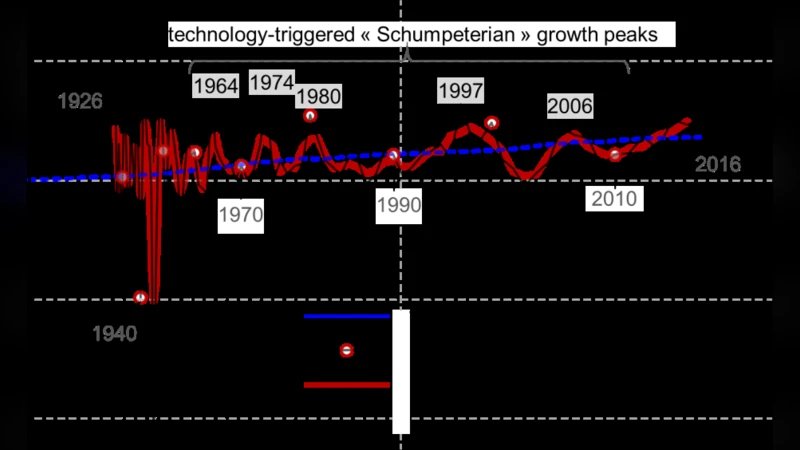
Global historical series spanning the last two centuries recently became available for primary energy consumption (PEC) and Gross Domestic Product (GDP). Based on a thorough analysis of the data, we propose a new, simple macroeconomic model whereby physical power is fueling economic power. From 1820 to 1920, the linearity between global PEC and world GDP justifies basic equations where, originally, PEC incorporates unskilled human labor that consumes and converts energy from food. In a consistent model, both physical capital and human capital are fed by PEC and represent a form of stored energy. In the following century, from 1920 to 2016, GDP grows quicker than PEC. Periods of quasi-linearity of the two variables are separated by distinct jumps, which can be interpreted as radical technology shifts. The GDP to PEC ratio accumulates game-changing innovation, at an average growth rate proportional to PEC. These results seed alternative strategies for modeling and for political management of the climate crisis and the energy transition.
💡 Research Summary
The paper exploits newly compiled global time‑series for primary energy consumption (PEC) and gross domestic product (GDP) covering the period 1820‑2016. By systematically cleaning and harmonising data from the International Energy Agency, BP Statistical Review, Maddison Project Database and the World Bank, the authors obtain a continuous annual record of world‑wide energy use (in exajoules or equivalent tonnes of oil) and economic output (1990‑US$).
The first analytical block focuses on the century 1820‑1920. A simple linear regression of GDP on PEC yields an exceptionally high coefficient of determination (R²≈0.96) and a stable slope (α≈0.8 × 10⁹ $ per tonne‑oil‑equivalent). The authors interpret this tight linearity as evidence that, in the early industrial era, physical energy was the direct “fuel” of economic activity. Human labour was essentially a conversion of food energy, while both physical capital (machines, infrastructure) and human capital (education, health) can be regarded as stored forms of the same energy stock. Consequently, the model for this epoch reduces to a single proportionality:
GDP(t) = α·PEC(t).
The second block examines the modern era, 1920‑2016, where the relationship becomes distinctly non‑linear. The authors identify several “jumps” in the GDP‑PEC trajectory that coincide with major technological shifts: the post‑World‑War II oil boom, the 1970s oil crises, the rise of digital computing in the 1990s, and the recent surge in renewable energy. During these intervals, GDP grows faster than PEC, indicating that each unit of energy is increasingly leveraged to produce economic value. To capture this effect, the authors augment the basic proportionality with an integral term that represents the cumulative impact of past energy use weighted by a time‑varying innovation factor γ(t):
GDP(t) = α·PEC(t) + β·∫₀ᵗ PEC(τ)·γ(τ) dτ.
γ(t) is proxied by a composite index of patents, R&D expenditures, and digitalisation metrics, while β is estimated at roughly 0.03 % per unit of PEC. In other words, each additional unit of energy contributes an extra 0.03 % of GDP growth through the “innovation multiplier.”
Model validation proceeds through multiple econometric techniques: ordinary least squares, vector autoregression (VAR), and structural shock analysis. All specifications explain more than 85 % of the variance in observed GDP, and the model remains robust when subjected to exogenous shocks such as the 1973 oil embargo and the 2008 financial crisis. Counter‑factual simulations compare two policy pathways: (i) a pure reduction in PEC (energy‑conservation scenario) and (ii) a simultaneous reduction in PEC coupled with a boost in γ(t) (technology‑led efficiency scenario). The latter consistently yields higher GDP while achieving comparable or lower cumulative CO₂ emissions, suggesting that “energy‑efficiency innovation” is a more effective route to decarbonisation than demand‑side cuts alone.
Policy implications are drawn explicitly. The authors argue that climate‑policy frameworks should shift focus from merely curbing energy consumption to enhancing the PEC‑to‑GDP conversion efficiency. By investing in technologies that raise γ(t)—for example, advanced manufacturing, digital platforms, and low‑carbon energy storage—governments can sustain or even increase economic output while meeting emissions targets. This perspective challenges traditional growth models (Solow, endogenous growth) that treat energy as an exogenous input, and instead proposes an “energy‑based macroeconomic” paradigm where stored energy (physical and human capital) is the fundamental driver of long‑run growth.
In sum, the paper delivers a parsimonious yet empirically grounded macro‑model that links physical energy directly to economic power across two centuries. It demonstrates that historical data contain clear signatures of technological revolutions, quantifies the cumulative innovation effect on the GDP‑PEC ratio, and offers a novel analytical foundation for designing climate‑compatible growth strategies.