Optimal Energy Efficiency with Delay Constraints for Multi-layer Cooperative Fog Computing Networks
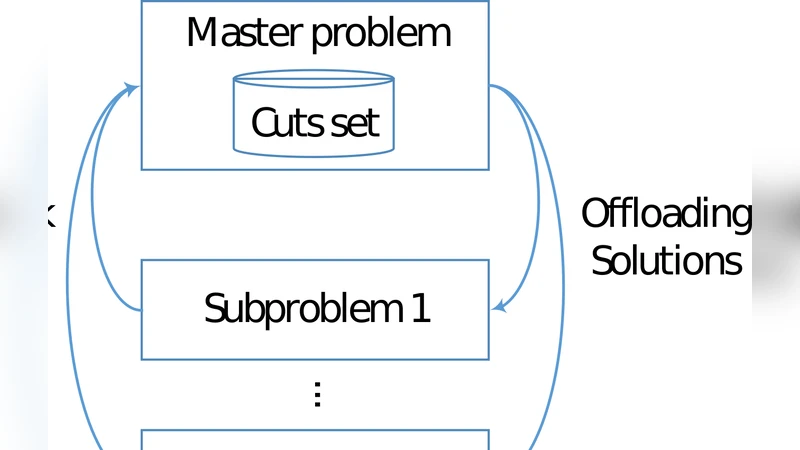
We develop a joint offloading and resource allocation framework for a multi-layer cooperative fog computing network, aiming to minimize the total energy consumption of multiple mobile devices subject to their service delay requirements. The resulting optimization involves both binary (offloading decisions) and real variables (resource allocations), making it an NP-hard and computationally intractable problem. To tackle it, we first propose an improved branch-and-bound algorithm (IBBA) that is implemented in a centralized manner. However, due to the large size of the cooperative fog computing network, the computational complexity of the proposed IBBA is relatively high. To speed up the optimal solution searching as well as to enable its distributed implementation, we then leverage the unique structure of the underlying problem and the parallel processing at fog nodes. To that end, we propose a distributed framework, namely feasibility finding Benders decomposition (FFBD), that decomposes the original problem into a master problem for the offloading decision and subproblems for resource allocation. The master problem (MP) is then equipped with powerful cutting-planes to exploit the fact of resource limitation at fog nodes. The subproblems (SP) for resource allocation can find their closed-form solutions using our fast solution detection method. These (simpler) subproblems can then be solved in parallel at fog nodes. The numerical results show that the FFBD always returns the optimal solution of the problem with significantly less computation time (e.g., compared with the centralized IBBA approach). The FFBD with the fast solution detection method, namely FFBD-F, can reduce up to $60%$ and $90%$ of computation time, respectively, compared with those of the conventional FFBD, namely FFBD-S, and IBBA.
💡 Research Summary
**
This paper tackles the joint task offloading and resource allocation problem in a multi‑layer cooperative fog computing environment, where multiple mobile devices must meet individual latency constraints while minimizing the total energy consumption of the system. The considered architecture consists of N mobile users, M fog nodes, and a cloud server, forming three hierarchical layers (mobile → fog → cloud). Each user’s computation task is characterized by input and output data sizes, required CPU cycles, and a maximum tolerable delay. A task can be processed locally, offloaded to a specific fog node, forwarded through a fog node to the cloud, or sent directly to the cloud.
The decision variables are binary offloading indicators (x_i) (local, fog‑j, fog‑to‑cloud‑via‑j, direct‑cloud) and continuous resource allocation variables (r_{ij} = (r^{u}{ij}, r^{d}{ij}, r^{f}_{ij})) representing uplink, downlink, and CPU rates assigned to the task at the chosen processing entity. The latency model aggregates transmission times (input and output) and processing time, yielding a linear expression (T_i = h_i^{\top} x_i). Energy consumption combines transmission energy (proportional to data size and per‑bit energy coefficients) and processing energy (proportional to CPU cycles with a per‑cycle coefficient). Because the objective (total energy) and the latency constraints involve products of binary and continuous variables, the overall formulation is a mixed‑integer non‑linear program (MINLP), which is NP‑hard.
To obtain optimal solutions, the authors first propose an Improved Branch‑and‑Bound Algorithm (IBBA) that exploits problem‑specific features (e.g., tight bounds on resource usage) to prune the search tree more aggressively than a generic B‑B. IBBA is centralized: a single controller collects all task information, performs the branch‑and‑bound search, and returns the optimal offloading and allocation decisions. While IBBA can guarantee optimality, its computational burden grows quickly with the number of users and fog nodes, limiting its practicality for large‑scale networks.
Consequently, the paper introduces a distributed solution based on Feasibility‑Finding Benders Decomposition (FFBD). The original MINLP is decomposed into:
- Master Problem (MP) – decides only the binary offloading variables. It incorporates cutting planes that encode the resource‑capacity constraints of each fog node. These cuts are generated from the subproblems’ feasibility status.
- Subproblems (SP) – for a given offloading pattern, each fog node (or the cloud) solves a continuous resource‑allocation problem. The authors derive a closed‑form solution for the SPs and, more importantly, a “fast solution detection” method that can instantly determine whether a subproblem is feasible under the node’s resource limits. If feasible, the optimal continuous variables are computed analytically; if infeasible, a Benders cut is generated for the MP.
Two variants are examined: FFBD‑S (standard Benders decomposition) and FFBD‑F (the fast detection version). Because SPs are solved analytically and can be processed in parallel across fog nodes, FFBD dramatically reduces the overall runtime. Simulation results (e.g., N = 30 users, M = 10 fog nodes) show that FFBD‑F achieves up to 90 % reduction in computation time compared with the centralized IBBA, while still returning the exact optimal solution. FFBD‑S also outperforms IBBA, albeit with a smaller speed‑up (≈60 %). Energy consumption and latency satisfaction are identical across all methods, confirming that the distributed decomposition does not sacrifice optimality.
The paper’s contributions are:
- A comprehensive system model that captures both vertical (mobile‑fog‑cloud) and horizontal (fog‑to‑fog) cooperation, together with realistic latency and energy models.
- An improved branch‑and‑bound algorithm that leverages problem structure for tighter bounds.
- A novel Benders‑decomposition framework (FFBD) that isolates binary decisions from continuous resource allocation, enabling distributed computation.
- A fast feasibility‑detection technique for the subproblems, yielding closed‑form solutions and powerful Benders cuts.
- Extensive simulations that validate the optimality and computational advantages of the proposed methods.
Limitations include the assumption of static channel conditions and a linear energy model (constant per‑cycle power), which may not hold in highly dynamic wireless environments. Future work could extend the framework to time‑varying channels, more sophisticated power consumption models, and integration with real‑world fog orchestration platforms. Overall, the paper provides a solid theoretical foundation and practical algorithmic tools for energy‑efficient, latency‑aware task offloading in large‑scale cooperative fog computing systems.
Comments & Academic Discussion
Loading comments...
Leave a Comment